
This post contains Amazon affiliate links. If you buy through one, I earn a small commission at no extra cost to you. It never changes what I write about a book.
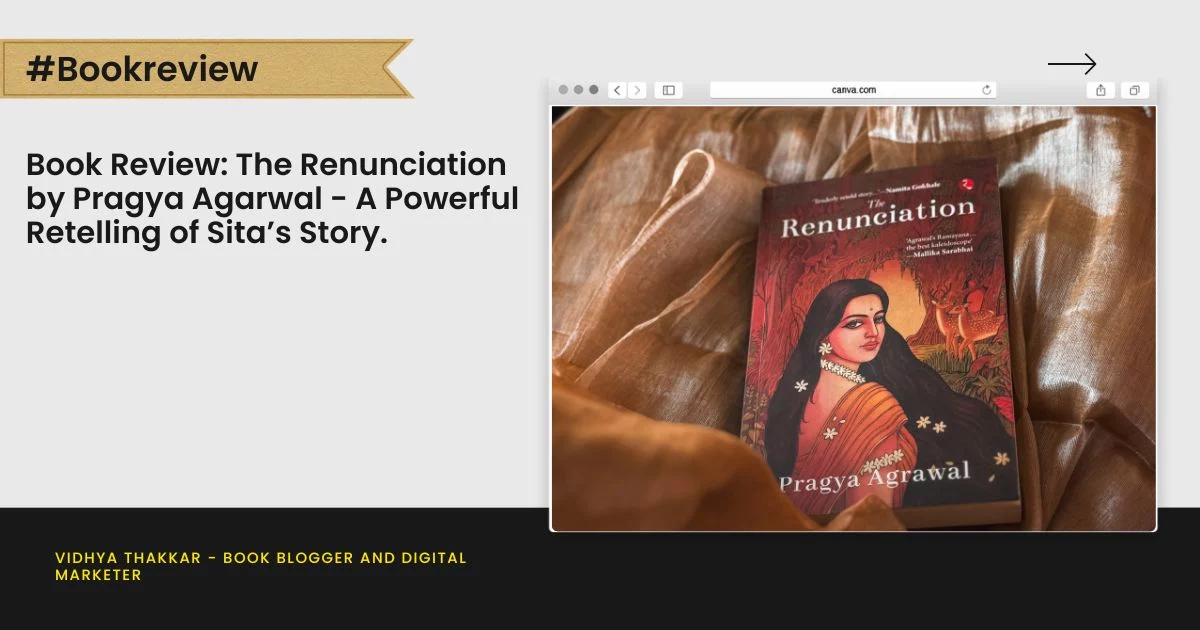
Author: Pragya Agarwal
Publisher: Rupa Publications
Summary
The Renunciation is a thoughtful and introspective retelling that invites readers to reflect on the untold emotional spaces within the Ramayana. For readers who enjoy mythological retellings that are thoughtful, introspective, and character-driven, The Renunciation offers a deeply reflective reading experience — one that allows Sita’s voice to be heard beyond the epic.
Review
“She was ready to step back, ready to salvage the one strong fierce Sita, the one who always had powerful resolution, a mind of her own, and the will to live through tough times.”
“She no longer lived in the world she saw- but the world she willed to see.”
Mythological stories are never truly old. They evolve with us, revealing new meanings each time we return to them. The Ramayana is one such epic – timeless, layered, and rich with meaning. Yet within its grand narrative of duty and dharma, there are silences — moments that make us pause and wonder about the emotions that were never fully spoken. There are countless retellings of the Ramayana, yet every once in a while a book comes along that asks us to pause and look at the story from a quieter, deeper perspective. The Renunciation by Pragya Agarwal is one such book. Instead of retelling the epic in its entirety, the novel focuses on one of its most emotional and often overlooked chapters. The life of Sita after she leaves Ayodhya. It invites us to revisit Sita’s story from a perspective that feels raw, emotional, and deeply personal.
The story unfolds in Sage Valmiki’s ashram where Sita, now living under the name Vandevi, raises her twin sons, Luv and Kush. Away from the grandeur of Ayodhya, she builds a quiet life for herself and her children. Her life becomes simple yet layered with memories and quiet resilience. The forest becomes her refuge — a space where grief slowly transforms into resilience. Her sons grow up unaware of their true identity, learning stories of courage and dharma, including the Ramayana itself, without knowing that they are deeply connected to it.
What makes this book particularly moving is the way it presents Sita not just as a symbol of sacrifice we often see in mythology, but as a woman carrying the weight of love, loss, dignity and motherhood. In this book, Sita is not just the calm and silent figure many narratives portray. Instead, she emerges as a fearless woman with a mind of her own — someone who faces every challenge with strength, dignity, and quiet determination. The story presents her as both a fierce individual and a deeply compassionate mother. We often see her through the lens of devotion and sacrifice, but here we see her thoughts, her doubts, her strength, and her quiet resilience and courage of continuing to live, to nurture, and to protect her children despite everything she has endured.
Told in Sita’s own voice, the narrative takes us through her life journey — from being Janaknandini, the beloved daughter of King Janak, to becoming Ram’s wife, to later embracing motherhood as the mother of Lav and Kush. Through her memories and reflections, we see her evolve into a powerful individual who carries both love and quiet resilience. The book beautifully traces the many phases of Sita’s life — her childhood in Mithila, her meeting with Ram, their life in the forest, the painful time in Ravana’s Lanka, and her later life in Valmiki’s ashram. Each chapter gradually deepens the emotional layers of the story. What stands out most is the way the author captures Sita’s inner strength. We see her thoughts, her doubts, her courage, and her determination to stand by her truth.
The story begins with Luv and Kush learning the Ramayana and preparing to step outside the ashram to explore the world beyond, hoping to eventually meet Raja Ram. As their journey unfolds, Sita too begins to revisit her past — recalling moments of love, pain, and the memories she shared with Ram. Through these reflections, the narrative slowly unfolds into a deeply emotional journey. We see Sita as a mother raising Luv and Kush, guiding them with wisdom and strength, while also preparing herself for the possibility of meeting Ram again.
The forest setting of Valmiki’s hermitage adds a calm, almost meditative atmosphere to the narrative. Life there is slower, quieter, and deeply introspective. This peaceful environment contrasts beautifully with the emotional storms Sita carries within her. Pragya’s writing feels calm and reflective, much like the forest setting of the ashram itself. Her writing style is simple yet evocative, allowing the emotions to unfold gently rather than through dramatic intensity. The tone of the narrative remains thoughtful and introspective throughout, drawing readers into Sita’s inner world with quiet depth. The story moves gently, focusing less on dramatic events and more on emotions, memories, and inner strength. She captures these moments with sensitivity, allowing readers to feel the depth of Sita’s silence and strength.
The narrative allows readers to pause and reflect on the many versions of Sita we have grown up hearing. It reminds us that behind the mythology lies a woman who lived through love, separation, motherhood, and the weight of expectations. Pragya brings out these emotions with sensitivity, making Sita’s voice feel intimate and powerful at the same time.
One of the most touching aspects of the novel is the bond between Sita and her sons. Luv and Kush bring innocence, curiosity, and warmth into the story. They grow up in innocence, unaware of their royal lineage or the pain their mother carries within her silence. Watching them grow, learn, and question the world around them becomes one of the most powerful emotional threads in the story. Their interactions with their mother reveal not only her nurturing side but also the quiet courage she embodies. Watching them learn the Ramayana — the very story they unknowingly belong to — adds a bittersweet layer to the narrative.
What I appreciated about this retelling is that it does not attempt to diminish other characters from the Ramayana. Instead, it gently shifts the lens to focus on Sita’s voice. A voice that is often overshadowed in traditional narratives. The story explores what it means to choose dignity even when the world has been unfair. It simply gives Sita the space to exist as a human being – someone who loves deeply, suffers quietly, and ultimately chooses self-respect.
The final moments of the story carry a powerful stillness. The climax of the novel, Sita’s final renunciation, is portrayed with grace and quiet power. It is not portrayed as defeat or escape, but as a quiet moment of choosing her own truth. In that moment, Sita is not just a queen, a mother, or a symbol of virtue — she is simply a woman choosing her truth, her story. By the end of the book, you do not just see Sita as a character from the Ramayana, you see her as a woman who chose dignity, strength, and self-respect above everything else. And that is what makes The Renunciation such a compelling and thought-provoking read.
The Renunciation is a thoughtful and introspective retelling that invites readers to reflect on the untold emotional spaces within the Ramayana. It reminds us that even within the most well-known stories, there are voices waiting to be heard. Rather than focusing on epic battles or grand events, the novel explores the emotional landscapes of love, sacrifice, and dignity. For readers who enjoy mythological retellings that are thoughtful, introspective, and character-driven, The Renunciation offers a deeply reflective reading experience, one that allows Sita’s voice to be heard beyond the epic.
Get your Book Reviewed by Vidhya Thakkar – Connect us Now