
This post contains Amazon affiliate links. If you buy through one, I earn a small commission at no extra cost to you. It never changes what I write about a book.
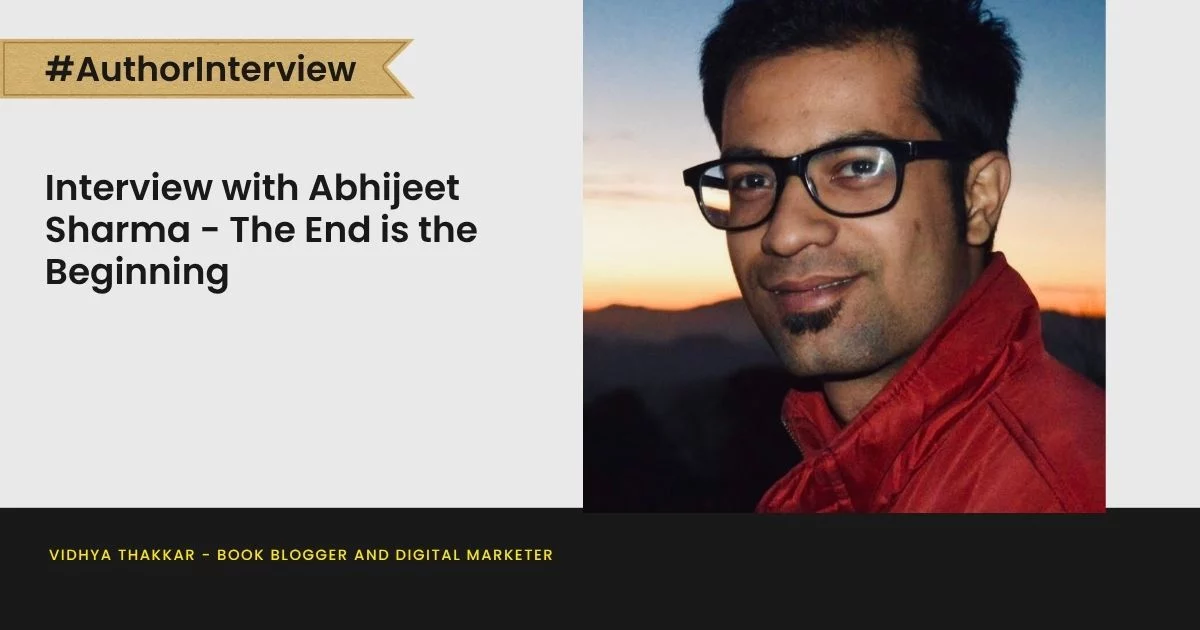
In this conversation, poet Abhijeet Sharma talks about the inspiration behind The End Is the Beginning, the emotional journey through its sections, the role of vulnerability in poetry, and how themes of love, grief, healing, and self-reflection found their way into his poems.
About The Author
Abhijeet Sharma is a cybersecurity professional, poet, and traveller whose writing explores identity, memory, grief, love, spirituality, and the search for meaning. He writes under the name Tacit Yes. Raised in Shimla and based in Delhi, he finds inspiration in mountains, long walks, quiet nights, old books, music, and the ordinary moments that often go unnoticed.
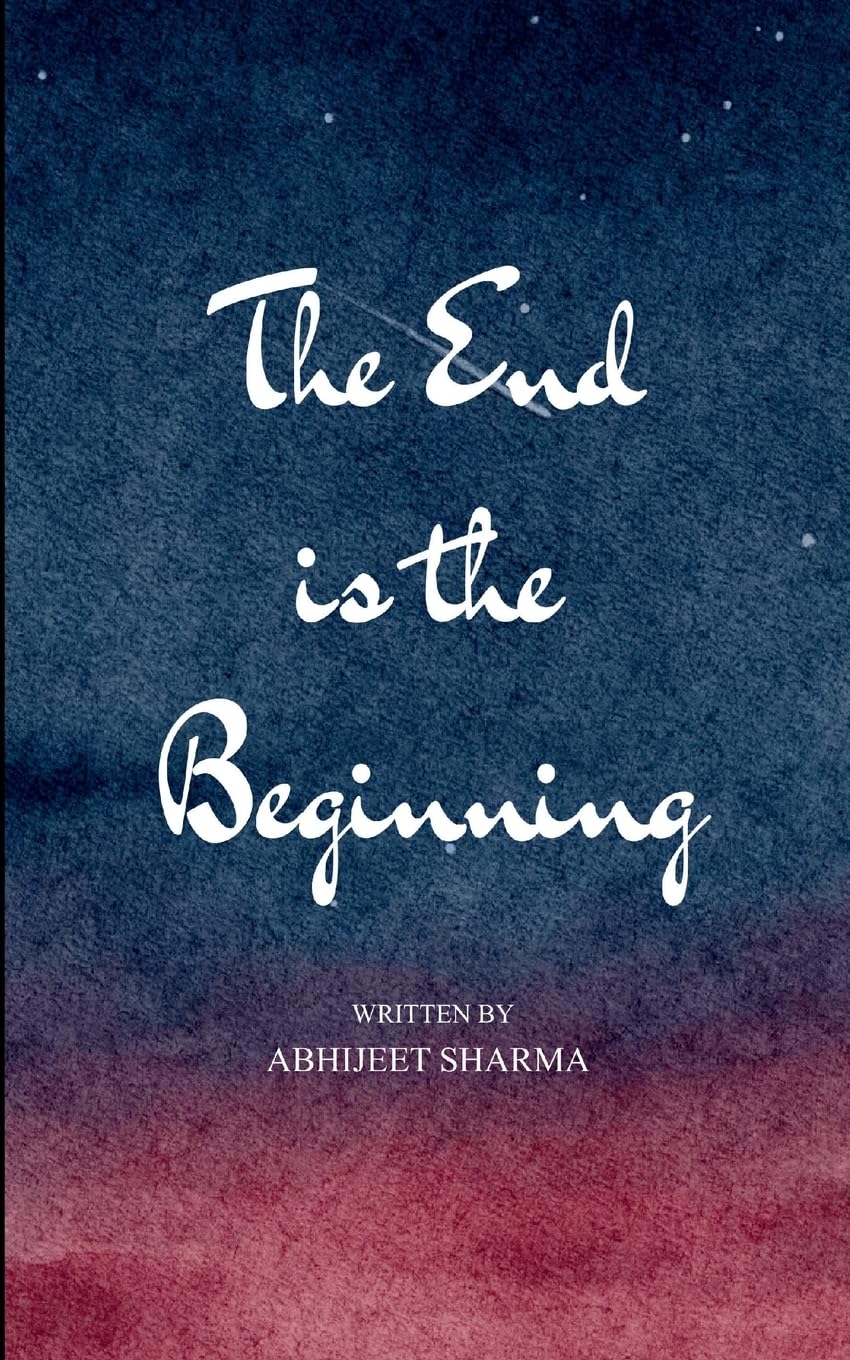
His poems emerge from observation rather than certainty, seeking honesty over perfection and questions over conclusions.The End is the Beginning is his debut poetry collection. Find him on Instagram @tacityes
Get your copy here – https://amzn.to/4eNm9y7
Interview
Q) The title The End is the Beginning is intriguing. What inspired it, and what does it personally mean to you?
The title comes from a poem I wrote around three years ago, which itself was inspired by a poem written by a friend. When I began compiling my first collection, it felt natural to make that poem both the title and the closing piece of the book. On a personal level, The End is the Beginning reflects a belief I have carried since childhood, one rooted in Vedantic thought and echoed across many traditions; that endings are rarely final, and often the doorway to something new.
Q) The collection moves through sections like Awakening, Conflict, Flesh and Fracture, and Homecoming. How did you decide on this structure, and did you always envision the poems as part of a larger emotional journey?
The structure was not something I envisioned from the beginning. Most of the poems had been written years apart, during different phases of life and reflection. When it came time to compile them, I realised they naturally gravitated toward certain emotional and philosophical themes. The sections—Awakening, Conflict, Flesh and Fracture, and Homecoming—emerged from that realisation. The addition of short connecting prose pieces helped weave the poems into a broader journey, allowing the collection to be experienced not just as individual works, but as a progression through different states of being.
Q) Many poems in the collection feel deeply personal and vulnerable. Was there any poem that was particularly difficult for you to write or revisit?
Vulnerability was never accidental in this collection, it is part of its essence. The poems were written with sincerity, often from a place that felt deeply personal and unguarded. There isn’t one poem that I find difficult to revisit, but Lovers in Delirium and No One Knows remain particularly haunting. Even today, they carry an emotional resonance that surprises me; I still find myself getting shivers when I read them.
Q) The language throughout the collection remains simple and accessible while carrying strong emotions. Was this simplicity a deliberate stylistic choice?
Yes, it was a conscious choice. Poetry has always been my preferred form of expression, but in a time when poetry often reaches a limited audience, I wanted this collection to remain accessible to a wide range of readers, including younger generations. I believe the poets we study in school and the readers of today share many of the same emotions—love, loss, longing, wonder, uncertainty. While the feelings remain timeless, the language through which we express them evolves. With this collection, I tried to present those enduring human experiences through a contemporary voice: simple, approachable language paired with emotionally resonant poetry.
Q) How much of your poetry comes from personal experiences, and how much is inspired by observing the emotions and stories of others?
Most of the poems draw from shared experiences, memories, conversations, and reflections—with friends, family, loved ones, strangers, and, quite often, with myself. While some pieces are personal, many are shaped by observing the lives and emotions of others. Before I am a writer, I am a reader. I have always loved J.R.R. Tolkien’s words: “A reader lives a thousand lives before he dies. The man who never reads lives only one.” In a similar way, I believe a writer lives many lives too—through imagination, empathy, observation, and experience. Some of those lives eventually find their way onto paper.
Q)What role does silence play in your writing? Many poems seem to explore emotions that are left unsaid rather than spoken aloud.
Yes, that was intentional. As I mentioned earlier, the collection explores shared human experiences, generational commonalities, and the simple yet profound feelings of being. Some emotions and questions were deliberately left unresolved. I wanted them to exist as they are, rather than be explained away. I have always believed that poetry should invite interpretation rather than direct it. Once a poem is published, it belongs as much to the reader as it does to the writer. The silences, ambiguities, and unanswered thoughts create space for readers to bring their own experiences into the work. It was certainly a risk to publish the collection in this way. Not every reader connected with that approach, but thankfully many did. In the end, it seems to have found its way to the audience it was meant to reach, including you.
Q) Were there any poets, writers, or literary influences that shaped this collection?
Many. Far too many to name here. Some of them are acknowledged in the book itself. Most of my literary influences came from the poets and writers I encountered during my school and college years, whose words stayed with me long after I had finished reading them. There are also influences from the music I listened to as a teenager, particularly lyricists who showed me how much meaning can be carried in a few emotionally raw words.
At the same time, my inspirations have never been limited to a single language or tradition. I have drawn from writers across cultures, including many classical Hindwi poets and authors. In the end, every reader becomes a collection of the voices they have admired, and every writer carries traces of those influences into their own work.
Q) What do you hope readers take away from The End is the Beginning once they reach the final poem?
I do not hope to guide readers toward a particular meaning or conclusion. The emotions explored in the book are universal, and if there is one thing I would wish for the reader, it is that they do not feel alone in those experiences. If the book leaves them with one thought, it is this: Endings need not be tragedies. Feelings, thoughts, joys, losses, and transformations all have their place in our lives. Everything exists for a reason, and every ending carries within it the possibility of a new beginning.
Q) Did your understanding of healing change while writing this book?
The book was not written specifically about healing, but about exploring the range of emotions we carry as human beings. That said, my understanding of healing remains simple: Sharing has always been one of the healthiest ways to heal. It is something humans have done for as long as we have existed.
Q) What was the most surprising thing you discovered about yourself while writing these poems?
One surprising discovery was how naturally I found myself writing from perspectives beyond my own, including that of women and their experiences. Perhaps even more surprising was that many of the book’s readers and supporters turned out to be women, who seemed to connect deeply with those voices.
Q)If you could revisit and rewrite one poem from The End is the Beginning today, which poem would it be, and what would you change about it?
I wouldn’t rewrite any of the poems. Each reflects a particular moment and feels complete to me as it is. If I could change anything, I might have included a few more pieces. But overall, I’m grateful I took the leap and published the collection when I did.
Q) Is there a poem in the collection that still feels unfinished to you in some way? If so, what would you add to it now?
Trust me, I have thought about that a lot. In many ways, that constant revisiting and rethinking is what delayed the book’s publication. At some point, I had to let the poems be what they were.
Q) Looking back at the book, is there a poem whose meaning has changed for you since you first wrote it?
In a way, yes. Every reader has shown me something different about the poems. Some pieces I personally considered ordinary or less significant were deeply appreciated by readers who found meanings I had never consciously intended. More than changing the poems themselves, those experiences changed my understanding of them. And I am only grateful.
Q) If you were to add one new poem to The End is the Beginning today, where would it fit within the collection’s journey, and what would it explore?
I wouldn’t add one. The collection feels complete to me as it is. These are reflections of particular time, feeling, state of mind, and journey. Some things are best left unchanged.
Q) If you could have readers spend extra time with just one poem from the collection, which poem would you choose and why?
Definitely He Asked. If I could ask readers to spend extra time with one poem, it would be that one. To me, it reflects a way of looking at life that appears across traditions, philosophies, and even in nature itself.
Q) Are you working on something new?
Yes, though not for the immediate future. I have been quietly working on a concept that is quite different from my debut book. If it does become a book, I think it will be rawer, more expansive, and more deliberate in its progression. Hopefully, it will offer readers even more to sit with and reflect upon.
Get your Book Reviewed by Vidhya Thakkar – Connect us Now