This post contains Amazon affiliate links. If you buy through one, I earn a small commission at no extra cost to you. It never changes what I write about a book.
Author: Rajnish Kumar
Publisher: Penguin India
Genre: Business, Entrepreneurship, Startup, Leadership
Pages: 213 pages
Ideal for: Entrepreneurs and startup founders, Business leaders and managers
Summary
Made in Fire is an insightful and thought-provoking read for entrepreneurs, founders, business leaders, and aspiring startup builders. More than teaching readers how to build a successful company, Rajnish Kumar reminds us that lasting success is built on values, culture, customer obsession, empathy, integrity, and the courage to continuously evolve. It is not just a story about building Ixigo, it is a roadmap for building organizations, leading people, and growing as an individual. Whether you’re building a startup, leading a team, or simply curious about the story behind one of India’s most successful travel-tech companies, Made in Fire offers valuable lessons that stay with you long after the final page.
Review:
“Your company is not your life. Your life is your life. Every decision you make compounds, not just in business but in life. Success isn’t just revenues or valuations. It’s whether you kept your integrity when it was tested, whether you were resourceful when constraints closed in, whether you gave your family and your people the time and love they deserved.”
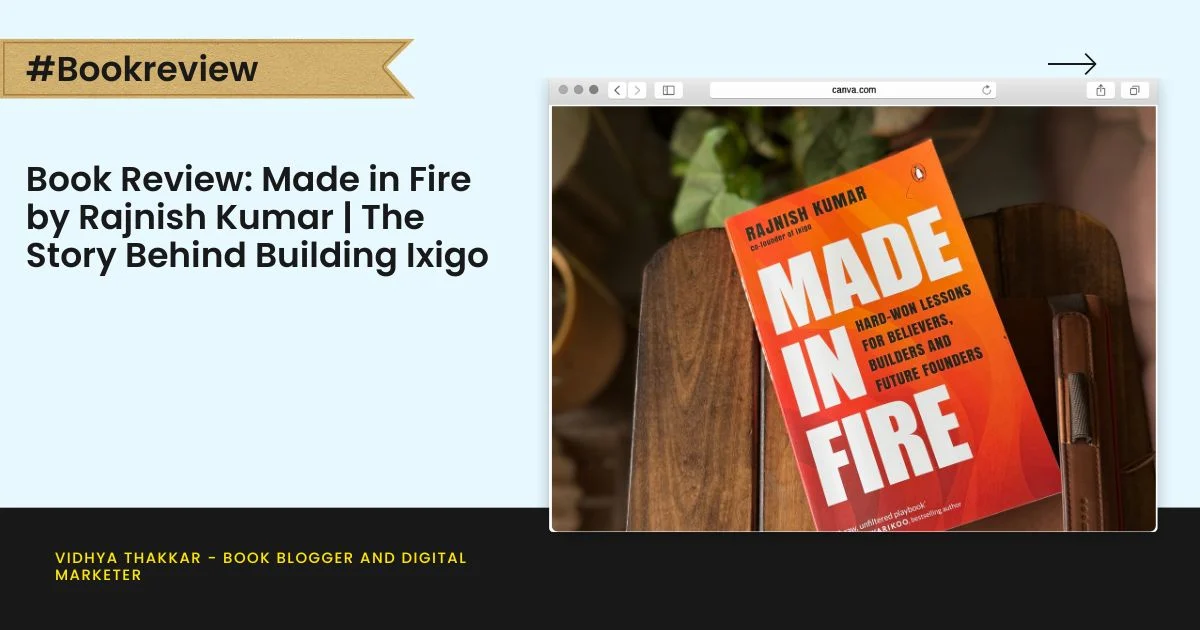
I love reading books written by business leaders because they always broaden my perspective. Beyond strategies and success stories, they offer lessons shaped by real experiences. Made in Fire by Rajnish Kumar, co-founder of Ixigo, did exactly that and surprised me in the best way. I’ve been using Ixigo for years, but I had never paused to think about the story behind the company. This book takes readers behind the scenes, revealing how Ixigo was built from scratch, the challenges it faced, and the principles that shaped its journey. More than a startup story, Made in Fire is part memoir and part operating manual for founders, entrepreneurs, and anyone building something meaningful.
The title itself beautifully captures the essence of the book. Made in Fire is exactly what it promises to be a raw, honest, and unfiltered account of building a company from the ground up. Rajnish doesn’t shy away from sharing the failures, financial struggles, tough decisions, or moments of uncertainty that shaped Ixigo. Instead of presenting success as a straight path, he shows how resilience, values, and the willingness to evolve are forged through adversity. Much like steel is strengthened in fire, this book reminds us that enduring companies and leaders are built through the challenges they overcome.
What truly stood out to me was the book’s emphasis on company culture. While many startup books focus heavily on fundraising, scaling, or growth hacks, Rajnish repeatedly highlights culture as the foundation of a successful organization. He believes that culture is not built during easy times, it is forged in moments of uncertainty, pressure, and crisis. One takeaway that stayed with me is that as companies scale, they don’t fix their culture, they amplify it. That’s why protecting and nurturing culture becomes a continuous responsibility rather than a one-time effort. Through honest anecdotes, Rajnish shares the company’s financial struggles, difficult decisions, and defining moments, showing how the team stood together through every challenge. Whether it was navigating difficult business phases or leading through crises like COVID, the company never compromised on its values, proving that culture is truly tested when circumstances are at their toughest.
Rajnish’s writing style is candid, practical, and engaging. The tone is honest, reflective, and conversational, making the book feel less like a conventional business manual and more like a founder sharing lessons learned through experience. The insights come from lived experiences rather than management theories, making the book feel authentic throughout. He encourages readers to think deeply, ask better questions, and build organizations with intention. His use of real-life examples and experiences from Ixigo makes even complex business concepts accessible and relatable.
One of my favourite aspects of the book is its unwavering focus on customer obsession. Rajnish repeatedly reminds readers that “the user is your universe,” stressing that customer obsession is not simply a department or function but the foundation of every decision a company makes. Ixigo’s success, according to him, came from solving real customer problems rather than chasing growth for the sake of numbers. His belief that every decision should begin with asking, “What creates the most value for the user?” is one of the book’s biggest takeaways. I also enjoyed his concept of full-stack thinking, where people are encouraged to think beyond their designated roles and collaborate across functions instead of working in isolated silos. Ownership, according to Rajnish, isn’t limited to job titles, it comes from taking responsibility for the larger mission of the company and contributing wherever needed.
The chapters on hiring were particularly insightful. One of the strongest ideas in the book is the distinction between missionaries and mercenaries. Rajnish believes companies should hire people who genuinely believe in the mission and culture rather than those who are driven only by compensation or titles. He also shares his interview process, the questions he asked prospective employees, their responses, and how those conversations revealed far more than a résumé ever could. The interview questions themselves make you reflect on what truly matters while hiring. More than testing qualifications, they reveal a person’s mindset and values – qualities that helped Rajnish identify people who later became some of Ixigo’s strongest pillars. It beautifully demonstrates how thoughtful hiring decisions can shape a company’s culture and long-term success.
At times, however, this section felt slightly overwhelming. Rajnish spends considerable time discussing hiring philosophies, interview experiences, and culture-building. While these lessons are undoubtedly valuable and central to the book’s message, it felt repetitive and could have been more concise. Nevertheless, the practical insights shared through these real-life hiring stories make this one of the book’s strongest and most applicable sections, especially for founders and leaders building their own teams.
Another thread running consistently throughout the book is empathy. Rajnish presents empathy not as a weakness but as one of the strongest business strategies, especially during uncertain times. It is one of the pillars of Ixigo’s culture, helping the company build trust, strengthen relationships, and lead with compassion. The book beautifully shows that high-performing organizations are built not just on efficiency and results, but also on genuine care for people.
The book also explores leadership with refreshing honesty. Rajnish believes that leaders must own both problems and successes, lead with integrity, and remain accountable during difficult times. Rather than offering simplistic formulas for success, he encourages readers to develop the right mindset, ask better questions, and stay committed to their purpose. He also discusses how creativity often thrives in scarcity, how necessity breeds innovation, and why ownership is one of the defining qualities of effective leadership. One of the most relevant sections discusses the rise of Artificial Intelligence. Rajnish explains how AI is reshaping businesses and why companies must reinvent themselves before AI-native competitors make them irrelevant. He also discusses how trust is becoming the new currency, why stability has become just as important as speed in today’s rapidly changing world, and shares several frameworks and internal philosophies that shaped Ixigo’s journey. He explains these concepts through relatable examples, making even complex ideas easy to understand.
My absolute favorite chapter is the concluding one, where the book shifts from building companies to building a meaningful life. Rajnish reminds us that no business achievement is worth sacrificing our health, relationships, or peace of mind. True wealth, he argues, isn’t measured by numbers alone but by the life we create outside our work. It is a thoughtful reminder that while companies may become successful, our personal lives deserve equal attention. It also reinforces one of the book’s biggest messages: sustainable businesses aren’t built by chasing quick wins but by making long-term decisions rooted in values and purpose.
Overall, Made in Fire is an insightful and thought-provoking read for entrepreneurs, founders, business leaders, and aspiring startup builders. More than teaching readers how to build a successful company, Rajnish Kumar reminds us that lasting success is built on values, culture, customer obsession, empathy, integrity, and the courage to continuously evolve. It is not just a story about building Ixigo, it is a roadmap for building organizations, leading people, and growing as an individual. Whether you’re building a startup, leading a team, or simply curious about the story behind one of India’s most successful travel-tech companies, Made in Fire offers valuable lessons that stay with you long after the final page.
Get your Book Reviewed by Vidhya Thakkar – Connect us Now
Frequently Asked Questions (FAQs)
1. What is Made in Fire by Rajnish Kumar about?
Made in Fire tells the story of how Rajnish Kumar and his team built Ixigo from the ground up. Blending memoir with practical business lessons, the book explores company culture, leadership, customer obsession, hiring, innovation, AI, and building a meaningful life alongside a successful business.
2. Is Made in Fire only for entrepreneurs?
No. While entrepreneurs and startup founders will find it particularly valuable, the book also offers insights for business leaders, managers, students, professionals, and anyone interested in leadership, teamwork, and personal growth.
3. What are the key lessons from Made in Fire?
Some of the biggest takeaways include building a strong company culture, putting customers first, hiring people who believe in the mission, embracing full-stack thinking, leading with empathy, adapting to AI, and making long-term decisions rooted in values and purpose.
4. Is Made in Fire based on a true story?
Yes. The book is based on Rajnish Kumar’s real experiences as the co-founder of Ixigo. It shares the company’s journey, challenges, successes, and the lessons learned while building one of India’s leading travel-tech companies.
5. Does the book discuss Artificial Intelligence?
Yes. Rajnish explains how AI is transforming businesses and why organizations need to evolve continuously. He also discusses trust, innovation, and preparing for an AI-driven future.
6. Is Made in Fire worth reading?
If you’re interested in startups, leadership, entrepreneurship, or the story behind Ixigo, Made in Fire is a worthwhile read. Its honest storytelling, practical insights, and focus on values make it much more than a typical business book.
Reader_viddh’s Take:
Made in Fire is more than the story of building Ixigo, it’s a thoughtful reflection on leadership, company culture, customer obsession, and the values that shape lasting success. Rajnish Kumar’s honest storytelling and practical insights make this an engaging read for anyone looking to build not just a successful business, but a meaningful career and life.