
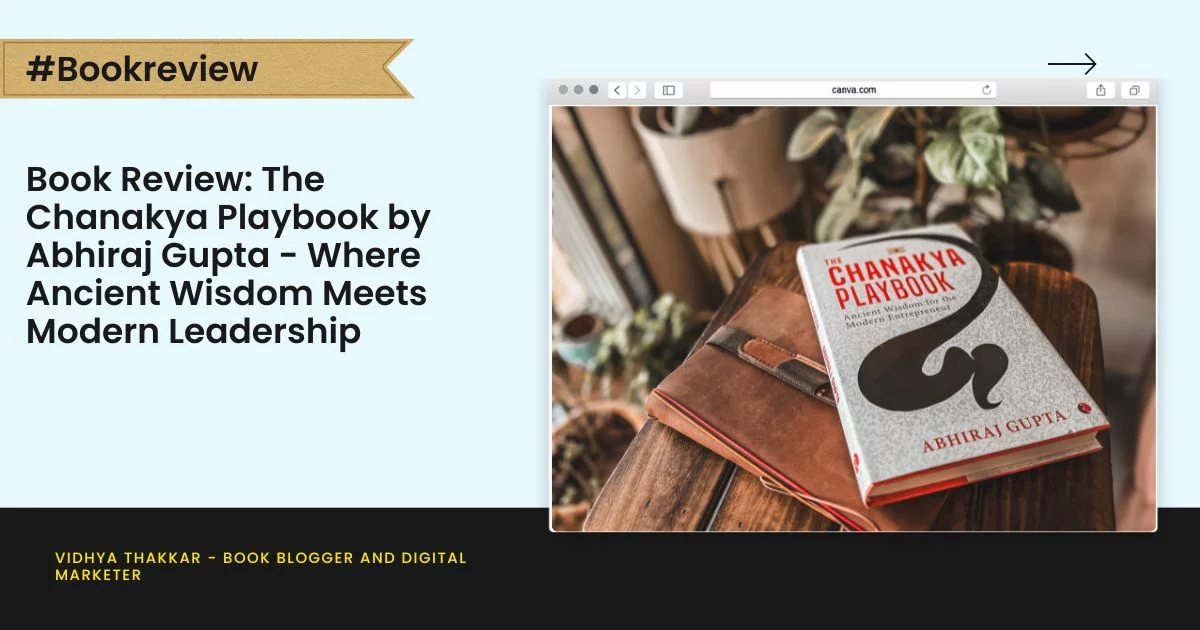
This post contains Amazon affiliate links. If you buy through one, I earn a small commission at no extra cost to you. It never changes what I write about a book.
Author: Abhiraj Gupta
Publisher: Rupa Publications
Summary
The Chanakya Playbook is not just a book about business or leadership, it is a book about clarity, responsibility, foresight, and building something that lasts beyond immediate success. It reminds us that true leadership is not measured merely by power or profit, but by the wisdom to lead with balance, integrity, resilience, and long-term vision.
Review
“True mastery is knowing when to talk, when to pay, and when to walk away.”
Late Dr. Radhakrishnan Pillai introduced many of us to the timeless wisdom of Chanakya. Reading The Chanakya Playbook after his passing felt like revisiting those teachings through a fresh, modern voice.
The Chanakya Playbook by Abhiraj Gupta is a bold, insightful, and deeply thought-provoking book that every entrepreneur, leader, founder, and decision-maker should read. Rooted in the wisdom of Chanakya and the Arthashastra – the ancient Indian treatise on governance, economics, and strategy, this book brilliantly blends ancient principles with modern organizational and leadership challenges. In a world driven by uncertainty, competition, and constant change, Chanakya’s principles feel more relevant than ever.
This book serves as a modern guide to leadership and organizations, helping readers understand how to navigate uncertainty, build resilient systems, and create organizations that sustain for generations. Rooted in Chanakya’s principles, it teaches how true success comes not just from profit, but from balancing Dharma and Artha – ethics and ambition. Abhiraj’s writing style is sharp, practical, smooth, and insightful. Even while discussing deep strategic concepts, the language remains accessible. The inclusion of Sanskrit terms along with their meanings adds authenticity and depth to the reading experience. What makes this book impactful is that it does not remain purely philosophical. It constantly pushes readers toward practical application. Through practical examples, strategic frameworks, tables, and hypothetical situations, Abhiraj simplifies complex concepts and shows how ancient wisdom can still shape modern businesses and institutions.
The book explores themes like ethical governance, strategic foresight, resilience, organizational balance, leadership responsibility, and long-term thinking. It also revolves around three transformative pillars – internal mastery, structural resilience, and strategic agility teaching readers the importance of self-discipline, adaptability, foresight, and institution-building. What makes the leadership approach in this book truly effective is how it emphasizes that strong organizations are not built merely through authority or profit, but through discipline, trust, foresight, ethical decision-making, and long-term vision.
One thing I appreciated was how the book focuses not only on growing an organization, but also on sustaining it for generations. In today’s fast-paced world where short-term success often overshadows long-term vision, this perspective felt incredibly valuable. My favorite chapter was ‘The Sentinel’s Watch’ — turning intelligence into your greatest asset. That section stood out because it beautifully highlights how awareness, observation, and strategic thinking are often the strongest tools a leader can possess.
This is definitely not a light or fast read. It is a layered book that demands patience, reflection, and re-reading. Some lessons stay with you long after you finish the chapter because they quietly force you to question the way we lead, make decisions, handle power, and build trust. What stayed with me the most is how relevant Chanakya’s wisdom still feels today. Centuries may have passed, but human nature, ambition, leadership, politics, and organizational struggles remain strikingly similar and that is what makes this book powerful. Even if we apply just 1% of these teachings in our lives, relationships, or leadership, it has the power to create meaningful change.
In all, The Chanakya Playbook is not just a book about business or leadership, it is a book about clarity, responsibility, foresight, and building something that lasts beyond immediate success. It reminds us that true leadership is not measured merely by power or profit, but by the wisdom to lead with balance, integrity, resilience, and long-term vision.
Get your Book Reviewed by Vidhya Thakkar – Connect us Now