This post contains Amazon affiliate links. If you buy through one, I earn a small commission at no extra cost to you. It never changes what I write about a book.
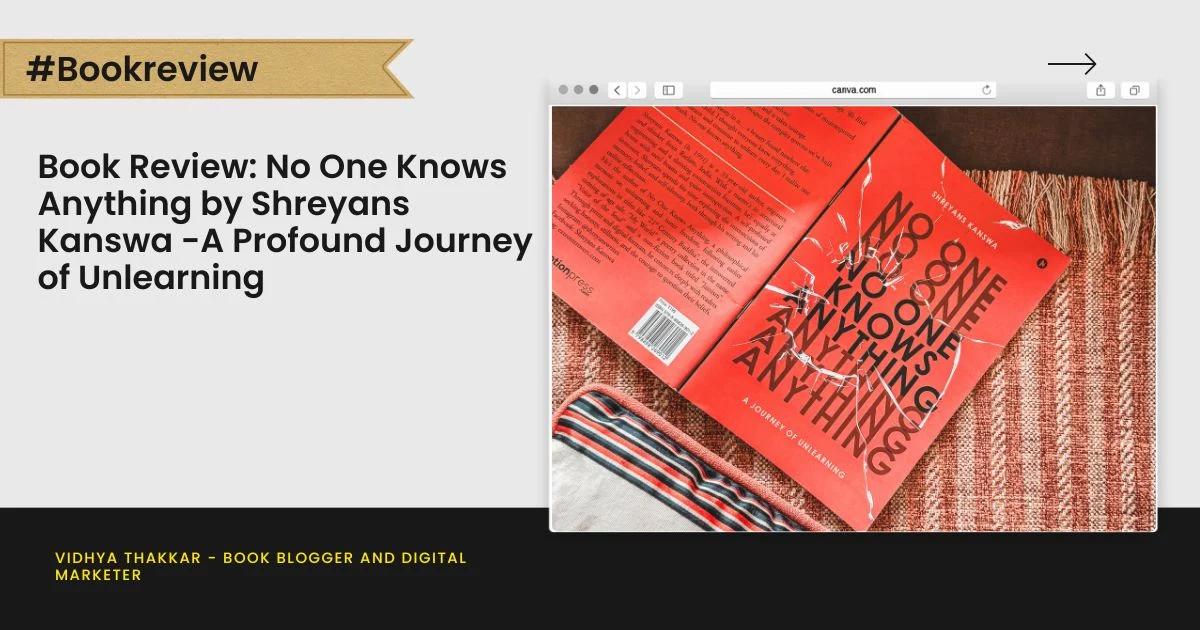
Authors: Shreyans Kanswa
Publisher: Notion Press
Summary
In a world obsessed with knowing, planning, and achieving, Shreyans reminds us to return to simplicity, to embrace the flow of life without always trying to define it. Because sometimes, the greatest truth is the one we can’t pin down. No one really knows anything. And maybe that’s exactly what makes life beautiful.
Review
“Who knows? What is success? What’s gone by is beautiful, what’s coming is beautiful. What’s happening right now? I don’t know. It’s just life flowing. Moment after moment. We are living. Is it not a success? Aren’t we all struggling regularly?”
These lines stayed with me long after I finished reading.
At just 37 pages, No One Knows Anything may seem like a small book, but its ideas ripple far beyond its length. It’s not a book you simply read and move on from; it stays with you, urging you to pause, reflect, and gently unlearn everything you think you know. In a world where everyone claims to have the answers about success, happiness, and the right way to live, Shreyans Kanswa dares to share something refreshing: No one really knows anything. His book is a thoughtful collection of ideas, meanings, and beliefs we unconsciously carry through life. It acts as a quiet mirror, reflecting how deeply we’re conditioned, how many of our “truths” are borrowed, and how the act of unlearning can become the beginning of true awareness.
Also Read: Book Review: Happiness Happens by Robin Singh – Happiness for Those Who Have Everything Else
Each of the eleven short essays captures a moment of introspection, moments where realisation dissolves certainty, and simplicity replaces noise. One of the most striking chapters is The Programme Called Me, where he explores how our identity is built upon others’ expectations and false or borrowed beliefs.
“From being a doer, you have become the watcher. But you are not just the watcher; you are also the doer at the same time. But you were never the doer. The automatic programs made you the doer. This is the moment of realisation.”
This passage hit me deeply. It perfectly captures that moment of awakening, when you suddenly see how much of your life has been lived on autopilot, driven by patterns, conditioning, and invisible programs you never consciously chose. The Programme Called Me makes you question how often we operate mechanically, repeating old scripts without awareness. The moment you realise this, that you are not merely the doer but also the watcher, is where true unlearning begins. You start observing your thoughts, emotions, and patterns without clinging to them. You understand that you are more than your conditioning. This shift, from reacting to reflecting, is where freedom lies. It’s a quiet yet powerful transformation that changes how you view yourself and the world around you.
Another chapter that resonated deeply is The Pattern of Boredom, where he talks about our constant chase for stimulation. We treat boredom as something negative, something to escape, when in truth, boredom can be the gateway to stillness. It’s in those quiet pauses that we reconnect with ourselves.
Then comes The Half Mark That Changed Everything, an honest reflection on how one small event, one perceived failure, one missed mark, can completely shift your understanding of success. The chapter beautifully captures how a single “half mark” can make the difference between passing and failing, and yet, what truly changes is not the mark itself but our perspective.
It makes you realise how much of our identity is shaped by the perceptions of those around us, how easily we start believing “this is who I am” simply because others think so. But as Shreyans shows, it’s only when we begin to unlearn those borrowed beliefs that we see how much more we truly are. That realisation, that we are not confined by others’ definitions of success or failure, becomes the heart of the journey toward self-awareness.
Shreyans writes with raw honesty and simplicity. There’s no pretence or overcomplication, just clear, heartfelt reflections. His words carry the tone of a conversation with a friend who’s been through the same questions you’re asking yourself. He doesn’t preach; he reflects. And in doing so, he creates space for the reader to introspect. His writing blends philosophy with lived experience, exploring themes of doubt, grief, spontaneity, and acceptance.
What makes it powerful is how real it feels. These aren’t abstract concepts; they’re moments we’ve all lived, only seen now through a lens of mindfulness. I loved how he captures small moments of doubt, grief, and joy, the ones we often overlook and reminds us that these fleeting moments shape who we are. His approach is practical and grounded, and his crisp, descriptive narrative makes it an insightful read. While the book could have delved deeper in places, its brevity is also part of its charm. It leaves space for you to fill in the blanks, to interpret and to introspect.
In essence, No One Knows Anything is not just about unlearning what you’ve been taught; it’s about embracing uncertainty, questioning definitions of success, and finding peace in not knowing. It’s a book to read slowly, perhaps in one sitting, and then return to whenever you need a reminder that it’s okay not to have all the answers. Because sometimes, as Shreyans beautifully reminds us — “No one really knows anything.”
In a world obsessed with knowing, planning, and achieving, Shreyans reminds us to return to simplicity, to embrace the flow of life without always trying to define it. Because sometimes, the greatest truth is the one we can’t pin down. No one really knows anything. And maybe that’s exactly what makes life beautiful.
Get your Book Reviewed by Vidhya Thakkar – Connect us Now