
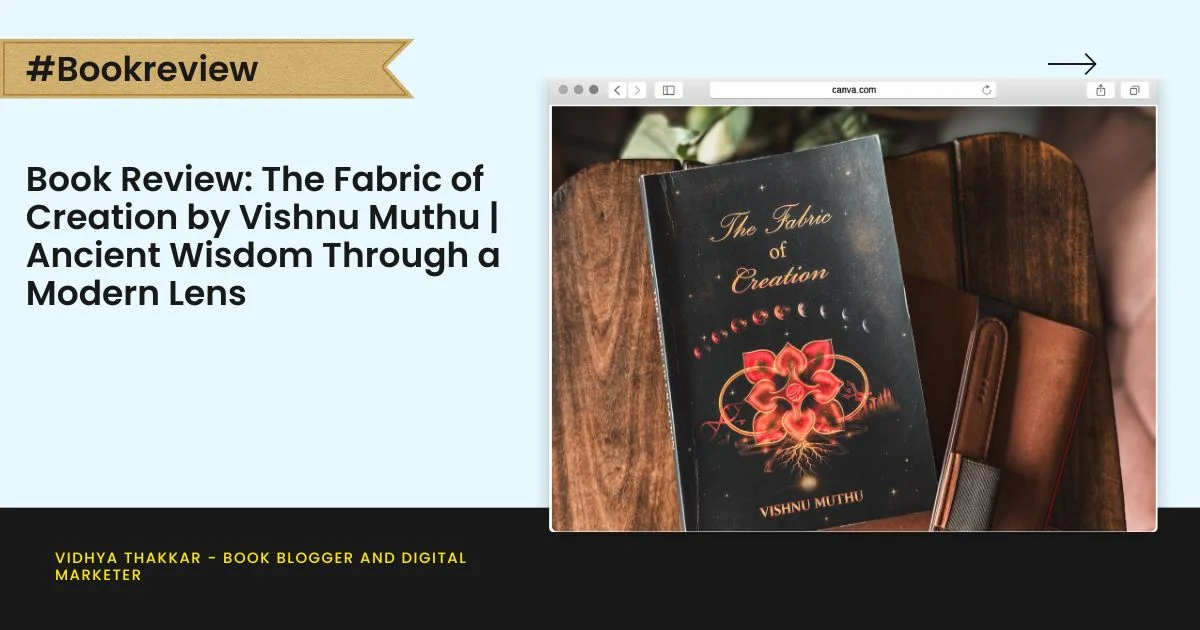

This post contains Amazon affiliate links. If you buy through one, I earn a small commission at no extra cost to you. It never changes what I write about a book.
Author: Vishnu Muthu
Genre: Philosophy, Spirituality, Mythology, Science & Culture
Pages: 155 pages
Ideal for: Philosophy Enthusiasts, Knowledge Seekers
Summary
The Fabric of Creation is a thought-provoking book that connects mythology, science, spirituality, and philosophy, encouraging readers to question, reflect, and see familiar traditions in a new light. More than providing answers, it invites readers to observe patterns, challenge assumptions, and explore how these ideas shape our understanding of human existence.
Review:
“The highest skill one can achieve is to learn how to manage their feelings.”
This book literally made me take notes. Every few chapters, I found myself writing down an idea, a connection, or a perspective I didn’t want to forget. Reading it often felt like solving a puzzle, each chapter revealed another piece that connected with something I had read earlier, making the experience both immersive and intellectually rewarding. It’s been a long time since I read a book that challenged the way I looked at familiar concepts. It made me think about the universe, nature, and life in ways I had never paused to consider before.
The Fabric of Creation by Vishnu Muthu isn’t a book you’ll race through. It’s one you’ll pause after almost every chapter, reflecting on the unexpected connections it draws between mythology, science, spirituality, nature, and everyday life. The book unfolds through five broad pillars—Myth, Origin, Mathematics, Science, and Commercialization using each as a lens to explore how human understanding has evolved over time. Spanning topics as diverse as creation, evolution, mathematics, environmental science, sound, light, business, and the universe, its greatest strength lies in the way it connects these ideas. What stood out to me was how the author encourages readers to look beyond familiar beliefs, understand the “why” behind traditions, and discover the patterns that connect different aspects of life. It not only broadens our perspective but also inspires us to see the world differently.
What fascinated me most was realizing that many of these ideas weren’t entirely new. We’ve grown up listening to these stories, participating in these rituals, and celebrating these traditions. This book simply made me pause and understand the why behind them. One of the most engaging aspects of the book is its exploration of Indian traditions through a fresh lens. From the relationship between the Navagrahas and the nine days of Navratri, to Ashta Lakshmi, the symbolic meaning of the Ashta Siddhis, the five elements, the seven chakras, and the balance between masculine and feminine energies, familiar concepts are revisited with thoughtful interpretations that bridge symbolism, philosophy, and science. I particularly enjoyed Muthu’s interpretation of Lord Nataraja’s cosmic dance as a representation of the eternal cycle of creation and destruction. Equally compelling is his comparison of Lord Vishnu’s avatars with the stages of human evolution and the human life cycle. These perspectives don’t seek to replace traditional narratives; instead, they invite readers to view them through a contemporary lens and discover new layers of meaning.
One of the book’s most unexpected ideas is its inclusion of Commercialization as one of its five pillars. Instead of treating business as separate from philosophy or science, Vishnu explains how exchange, value creation, growth, and human progress are closely linked , offering a perspective that is both unexpected and thought-provoking. The book also shines in its practical approach. Whether discussing Om as the universe’s fundamental vibration, sound and light, gravity, colours, branding, marketing, or business growth, Muthu consistently grounds abstract concepts in relatable examples. The result is a book that feels intellectually stimulating without becoming inaccessible. His writing is straightforward and conversational despite the depth of the subject matter. Stories, analogies, and real-life observations make complex ideas approachable, while the concise conclusion at the end of each chapter helps reinforce the key takeaways.
That said, The Fabric of Creation demands patience. Packed with mythology, astrology, philosophy, science, psychology, business, and environmental concepts, it contains an extraordinary amount of information within a relatively short space. At times, the sheer volume of ideas can feel overwhelming, and a few discussions could have benefited from greater depth. I found it most rewarding to read one chapter at a time, allowing myself the space to pause, absorb, and reflect before moving on.
At times, reading the book felt like exploring an encyclopedia of ideas. Every chapter opened the door to another subject, making the experience both fascinating and demanding. As someone who has grown up listening to many of these stories and traditions, I especially appreciated revisiting them from an entirely different perspective. Rather than retelling familiar narratives, the book enriches them through symbolic, scientific, and philosophical interpretations. Whether you’re deeply spiritual or simply curious, it encourages you to look beyond the surface and appreciate the wisdom embedded within beliefs that have been passed down through generations.
More than offering answers, The Fabric of Creation celebrates curiosity. It invites readers to observe patterns, question assumptions, and explore the fascinating intersections of mythology, science, spirituality, and human existence. I closed the book with more questions than answers but also with a deeper appreciation for the invisible threads that connect traditions, science, nature, and our everyday lives. For me, that is what makes this book truly memorable.
Get your Book Reviewed by Vidhya Thakkar – Connect us Now
Frequently Asked Questions (FAQs)
1. What is The Fabric of Creation by Vishnu Muthu about?
The Fabric of Creation explores the connections between mythology, science, spirituality, mathematics, philosophy, and business through five pillars—Myth, Origin, Mathematics, Science, and Commercialization. It encourages readers to understand the deeper meaning behind traditions and the patterns that shape our world.
2. Is The Fabric of Creation worth reading?
Yes, especially if you enjoy thought-provoking non-fiction that blends ancient wisdom with modern perspectives. It’s a reflective read that challenges familiar beliefs and encourages curiosity rather than offering definitive answers.
3. Who should read The Fabric of Creation?
This book is ideal for readers interested in Indian mythology, spirituality, philosophy, science, symbolism, and personal growth. It’s also a great pick for anyone who enjoys exploring the “why” behind traditions and everyday concepts.
4. Is The Fabric of Creation easy to read?
The writing is clear and conversational, but the book is rich in ideas and concepts. It’s best enjoyed one chapter at a time, allowing space to reflect on the connections the author presents.
5. Does the book only focus on mythology?
No. While mythology forms an important foundation, the book also explores mathematics, environmental science, sound, light, business, psychology, and philosophy, showing how these ideas intersect with one another.
6. What makes The Fabric of Creation different from other mythology books?
Instead of retelling familiar stories, Vishnu Muthu interprets them through scientific, symbolic, and philosophical perspectives. The focus is on understanding the deeper significance of traditions rather than simply narrating them.
7. Is The Fabric of Creation suitable for beginners?
Yes. Although it explores complex themes, the author’s conversational writing style, relatable examples, and chapter summaries make the book accessible to readers who are new to these subjects.
Reader_viddh Take
The Fabric of Creation is a book you experience. Every chapter encourages you to pause, reflect, and connect ideas that initially seem unrelated. While the abundance of information can feel overwhelming at times, the author’s ability to weave together mythology, science, spirituality, and everyday life makes it a rewarding and thought-provoking read. If you enjoy books that challenge your perspective and leave you with more questions than answers, this one deserves a place on your shelf.
Also Read:
Book Review: The Gita for Gen Z by Rania Sen
Book Review: The Book of Daily Brilliance by Pamela Puja Kirpalani
Book Review: The Chanakya Playbook by Abiraj Gupta