
This post contains Amazon affiliate links. If you buy through one, I earn a small commission at no extra cost to you. It never changes what I write about a book.
About The Author

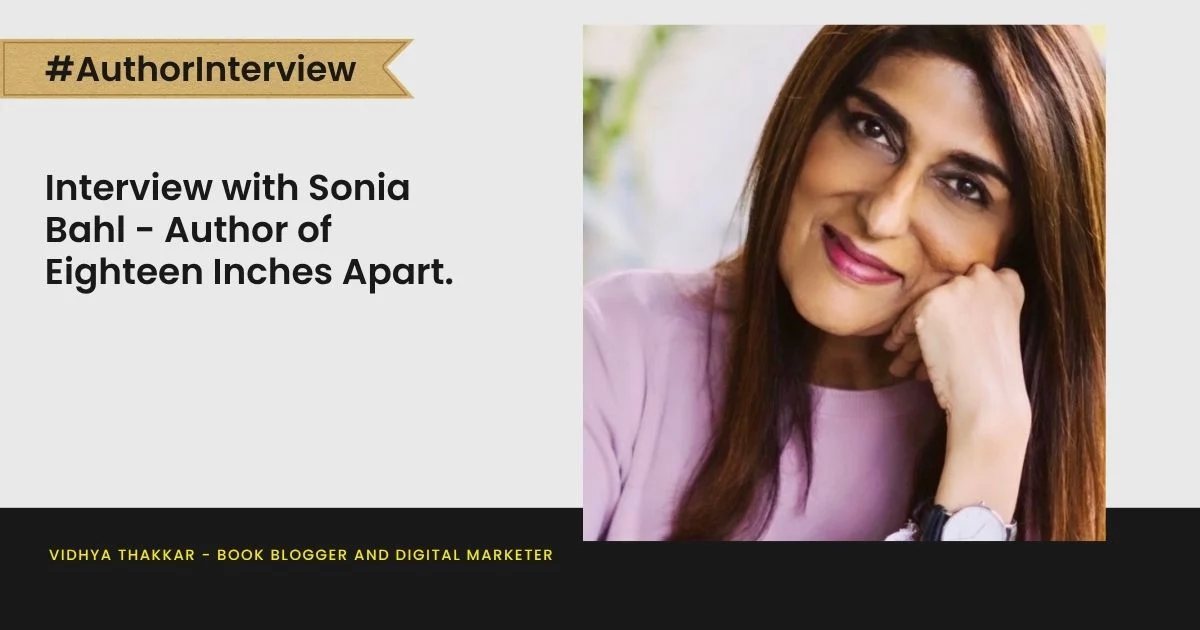
Sonia Bahl is a novelist and screenwriter whose work explores human connection, memory, and emotional truth. She made her literary debut with The Spectacular Miss, a coming-of-age novel that was optioned by a leading Bollywood studio, and followed it with A Year of Wednesdays in 2019, a contemporary story about two strangers whose brief encounter leaves a lasting imprint on their lives. Bahl’s writing draws on her global experiences and creative career in advertising and film, and she lives and writes in Singapore.
Get your copy here – https://amzn.to/42CtkCo
Also Read: Book Review: Eighteen Inches Apart by Sonia Bahl – A Moving Story of Love, Loss & Healing
Interview
Q) What inspired the story of Eighteen Inches Apart? Was there a real emotion or moment that sparked it?
It began with a photograph I didn’t take. My brother did. He’s an accidental street photographer with an uncanny gift: he captures people you’d pass without a glance, but his photographs make you want to know their stories. A couple of years ago he sent me a picture of a man standing very still, near-Zen, and somehow removed from everyone else on a loud, bustling street.
At first glance he seemed like a typical homeless man, except he carried himself with this rare, unmistakable regal bearing, and his ensemble of rags could have passed for haute couture in a parallel universe! What made him even more intriguing was the fact that he was there for a blink of an eye and then he was gone.
I couldn’t stop looking at the photograph. His mysterious, ephemeral presence resulted in us forever referring to him as The Shapeshifter. He threw up a constellation of questions that remained unanswered. That became Leela. And the question that haunted me became the book: do strangers carry hidden messages? Stories that are somehow invisibly connected to our own stories? We never get to see those threads in real life. Fiction felt like the only place I could make them visible.
Q) The book explores grief so deeply—how did you approach writing such an emotionally intense theme?
I started writing this during the pandemic — a time when we had never felt more distant from the people we loved, or more connected to people we’d never met. We were immersed in the stories of strangers. There was grief everywhere, but there was also a heightened sense of shared humanity. We all had one foot in hope and one in dread, we hovered in between. That tension became the emotional climate of the book.
But grief is not what this story is about. It’s the entry point. The thing that cracks people open and forces the real question: who are you when everything you counted on is gone? Turns out, you might be someone far more interesting than the person you were before it happened. And to find out, both Leela and Neel must take the greatest journey of all — eighteen inches from the head to the heart.
Q) The story shows how love changes form after loss—was that a conscious theme while writing?
Honestly, no. I was following the characters, not a theme. But in retrospect it seems almost inevitable. Because that’s what love actually does. It doesn’t disappear when someone does. It just finds somewhere else to go.
Q) Do you believe grief ever truly fades, or does it simply evolve with time?
I love these words by Ocean Vuong: “Grief is the last form of love. If we’re lucky, it will stay with us a long time.” I don’t think we’re ever done with grief. The searing intensity may soften into a steady hum, but the missing doesn’t go away. It just becomes more bearable. It starts as the centre of your entire living, breathing, thinking universe, and then, slowly, it allows you to rebuild your world around it and emerge, sometimes as a version of you that hasn’t existed before. It’s a complex cartography. One that etches its map of invisible lines inside you and stays there.
Q) Neel and Leela cope with loss in very different ways—how did you shape their emotional journeys?
I didn’t, really. Their personalities did. How we handle grief, joy, failure—any of it—is rarely a choice. It’s an extension of who we already are. Leela is bold, fiercely protective, constitutionally incapable of backing down. When life knocks her sideways, she doesn’t retreat. She hunts. Neel is the opposite. Gentle, interior, someone who has spent a lifetime refraining from making ripples. Loss makes him go even quieter. Until one small moment with a street musician cracks something open. Same grief. Completely different people. That’s the only architecture the story needed.
Q) The narrative shifts between perspectives—what made you choose this structure?
I wanted the reader to feel like a voyeur. To witness two lives running in parallel, with the two people completely unaware of each other, while the reader sits with the exquisite tension of knowing what neither of them does. The dual perspective also made it possible to hide things in plain sight. There are easter eggs throughout. Subtle threads connecting their lives that the reader might catch before the characters do. A detail in Leela’s world that quietly echoes something in Neel’s. A moment that rhymes across continents without either of them hearing it. They are always this close, but never quite close enough. The structure had to make you feel that distance—and that proximity—at the same time. I can’t say for sure if I managed that.
Q) Kolkata and London feel so vivid—how important were these settings to the story?
They aren’t settings. They’re characters. Lead players. Cities shape us like nothing else can. Think of Notting Hill without London. Sex and the City without New York. The city isn’t backdrop, it’s biography. I wanted Calcutta and London to feel like extensions of their protagonists.
Calcutta is crumbling and magnificent, old world and artistic, unapologetic and unbothered by the need to announce itself. It’s the perfect city for a woman with Leela’s moxie., London is a city of contradictions: grand yet anonymous, cool Britannia yet old world. An immigrant’s haven or an unwelcoming fortress depending entirely on who you are and who you want to be. Ideal for a man like Neel to disappear into, and eventually, to find a reason to show up in.
Q) The idea of the universe “at play” is subtle yet powerful—was that intentional?
It was woven into the DNA of the story from the start. I didn’t want it to feel like a device or a narrative convenience. Not the kind of fate that arrives with a soundtrack and a spotlight. It had to be quieter, behind the scenes, inescapable. A universe that keeps leaving doors ajar and giving chances to those brave enough to walk through. The concept of Leela—the learning centre Neel builds—is a nod to the Hindu philosophical idea of divine creative play. The fact that it’s also the name of the woman he’s destined to meet…universe at play?
Q) The climax feels complete yet leaves a lingering ache—was that balance intentional? Many readers feel it hints at a continuation… should we expect a part two?
Completely intentional. I wanted the ending to feel like a call to hope rather than a full stop. Fruition, but not a resolution tied up in a ribbon. I was reluctant to state the obvious then underline it for emphasis. The reader deserves the dignity of adding their own brush strokes to the resolution. As for Part 2. Nope, never imagined it. It would be like deconstructing the magic. Some doors are more beautiful left ajar, no?
Q) What do you hope readers carry with them after finishing this book?
When loss breaks you open, you may just find the best version of yourself waiting on the other side. But only if you’re willing to believe before you see. Or as one of my favourite poets put it: “Only if there are angels in your head will you ever, possibly, see one.”
Q) Which character was the hardest for you to write—and why?
Honestly? The Shapeshifter. He has no lines, no backstory, no explanation. And yet he had to carry the entire gravitational pull of the novel. Every time he appeared I had to resist the urge to explain him. His power lives entirely in what is withheld.
Q) Did writing this book change your own perspective on love or loss?
It confirmed what I’ve always believed: that detours and heartbreaks have one purpose. To get you exactly where you are meant to be.
Q) What would you like to say to your readers who connected so deeply with this story and are not ready to let go of these characters yet?
Just — thank you. Genuinely. You read the invisible threads I tried to weave and felt them. That’s not a given. That’s a monumental privilege.
Get your Book Reviewed by Vidhya Thakkar – Connect us Now

