
This post contains Amazon affiliate links. If you buy through one, I earn a small commission at no extra cost to you. It never changes what I write about a book.
Author: Saurabh Gadgil
Publisher: Penguin India
Genre: : Business Memoir | Entrepreneurship | Leadership | Family Business | Management
Pages: 246 pages
Ideal for: Readers interested in entrepreneurship, family businesses, leadership, brand building, business strategy and real-life journeys of building and transforming legacy businesses.
Summary
Choosing Gold is not simply the story of PNG Jewellers. It is a story about choices, family, leadership, failure, resilience, people and the responsibility of building something that can outlive you. Saurabh Gadgil’s journey is particularly relevant for anyone involved in a family business or preparing to take one forward. It reminds us that a legacy isn’t something you simply inherit and protect. You have to earn the right to carry it forward. If you enjoy books about entrepreneurship, family businesses, leadership, brand building and real-life business journeys, Choosing Gold is a book worth picking up.
Review:
“There are moments when a decision is made quietly. Something important is placed in your hands, and you must decide whether you are willing to carry its weight.”
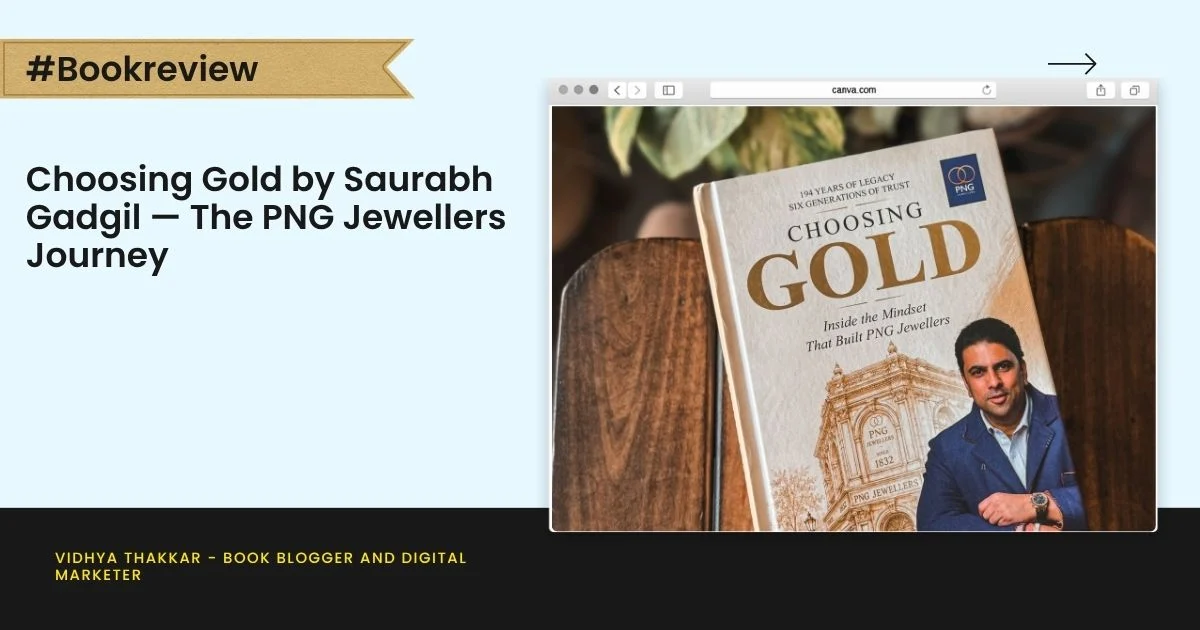
Building a business from scratch is one thing. Building on a business that has already existed for generations is something entirely different. You are not just trying to create something new; you are trying to understand what has already been built, decide what needs to change, and find a way to take it forward without losing what made it valuable in the first place. Choosing Gold by Saurabh Gadgil is an interesting look at exactly this journey.
Saurabh Gadgil, the sixth-generation custodian of PNG Jewellers, takes us through his experience of growing up around the family business and eventually taking on the responsibility of leading it. But what makes the book interesting is that it doesn’t present family business as simply an advantage or a disadvantage. There are opportunities that come with being part of a legacy, but there are also expectations, pressures, disagreements and difficult decisions that come with it. And this is where I think Choosing Gold works best. The book isn’t just about how PNG Jewellers grew. It is about the choices behind that growth – the decisions that worked, the ones that didn’t, the setbacks, the failures and what Saurabh learnt from them.
The title Choosing Gold itself becomes meaningful as the story progresses. Gold is precious, but it also goes through heat and refinement before it takes its final form. In a similar way, Saurabh’s journey is shaped by pressure, uncertainty, failures and difficult choices. The “gold” here isn’t just about the jewellery business; it becomes a metaphor for choosing what matters, choosing the harder path and choosing what you want to preserve for the future.
I particularly liked that Saurabh doesn’t try to make the journey look perfect. There are setbacks, failures, moments of doubt, difficult phases and decisions that came with consequences. The book also touches upon periods of family restructuring and the challenges that arise when personal relationships and business responsibilities overlap. That makes the journey more relatable because family businesses are rarely only about business. I also liked how the book connects business lessons with real experiences. You don’t have to be a jewellery professional or a business owner to understand the broader lessons around leadership, people, decision-making and resilience.
The writing style is simple, conversational and accessible, which works particularly well for a book that deals with business, leadership and entrepreneurship. Saurabh explains the concepts with his experiences, decisions and situations from his own journey, making the ideas easier to understand even for someone who doesn’t regularly read business books. I also liked the reflective and honest tone of the book. There is a sense that Saurabh is looking back at certain decisions with the understanding that comes only with time. He doesn’t just tell us what happened; he reflects on what those experiences taught him as a businessman and a leader.
The narrative moves between personal experiences and practical business lessons, which gives the book a memoir-like quality without making it entirely autobiographical. At times, it feels like sitting across from someone who has spent years building a business and is sharing the lessons he learnt along the way rather than reading a conventional management book. The pace is generally smooth and engaging, particularly when Saurabh talks about turning points, family dynamics, failures and decisions that changed the direction of the business. However, because the book is strongly driven by leadership and business lessons, there were a few moments where I wanted the narrative to pause and explore the emotional side of those experiences more deeply. That said, I liked how the book balances storytelling with practical takeaways. The lessons don’t feel completely separate from the narrative; most of them emerge from situations Saurabh has actually experienced, which gives the advice more context and makes it easier to relate to.
The family aspect is one of the parts I found most interesting. Growing up in a family business means learning from the previous generation, but taking the business forward also requires creating your own identity as a leader. Saurabh wanted to do things differently from what earlier generations had done, and that meant questioning established patterns and finding his own way. That process comes with its own cost. For me, this is one of the strongest ideas in the book: a legacy gives you a foundation, but it doesn’t give you a ready-made roadmap for the future. As PNG Jewellers grew, another important transition had to happen — from a family-run business to a professionally managed organisation. The book looks at delegation, systems, accountability, succession and the importance of building a strong team. I particularly liked the emphasis on people. A business may begin with one person’s vision, but an institution cannot be built by one person alone. Saurabh’s experiences show that building a strong team is just as important as having a strong vision.
The book also looks at another challenge that every legacy brand eventually faces: how do you remain relevant without losing your identity? PNG Jewellers had to evolve with changing customers, technology, consumer expectations and newer generations. The journey involved thinking differently about branding, retail, customers and expansion while still retaining the trust associated with the name. This balance between heritage and change is something I enjoyed reading about.
From its traditional family-business roots to becoming a professionally managed organisation with a much larger presence across India and abroad, and eventually becoming a publicly listed company, the transformation shows how a legacy business has to keep evolving. What worked for me was the honesty of the narrative. Instead of focusing only on achievements, Saurabh talks about the difficult parts of the journey as well. The conversations with family members, the lessons that became meaningful only with time, the failures and the decisions that didn’t necessarily have obvious answers make the book more personal.
While I enjoyed the lessons and experiences, I sometimes found myself wanting more emotional depth, especially during the moments where family, personal expectations and business decisions intersected. Some experiences are explained from a business perspective, but I would have liked to see more of what Saurabh was feeling during those turning points. For me, this is the one area where the book could have gone a little deeper. What stayed with me after reading Choosing Gold is that continuing a legacy can sometimes be harder than building something from scratch. When you build something yourself, you decide where to go. When you inherit something, you first have to understand where it came from before deciding where it should go next. And sometimes, taking a legacy forward also means thinking differently, questioning what has always been done and having the courage to create a new path without losing sight of where you came from. Perhaps that is where the metaphor of gold works beautifully.
Gold is valuable, but its value doesn’t mean it remains untouched. It is melted, shaped, refined and transformed. In much the same way, a legacy business has to go through change if it wants to survive across generations. Choosing Gold is therefore not simply the story of PNG Jewellers. It is a story about choices, family, leadership, failure, resilience, people and the responsibility of building something that can outlive you. Saurabh Gadgil’s journey is particularly relevant for anyone involved in a family business or preparing to take one forward. It reminds us that a legacy isn’t something you simply inherit and protect. You have to earn the right to carry it forward.
If you enjoy books about entrepreneurship, family businesses, leadership, brand building and real-life business journeys, Choosing Gold is a book worth picking up.
Get your Book Reviewed by Vidhya Thakkar – Connect us Now
Frequently Asked Questions (FAQs)
1. What is Choosing Gold by Saurabh Gadgil about?
Choosing Gold is a memoir about Saurabh Gadgil’s journey of leading PNG Jewellers, exploring family business, leadership, difficult choices, failures, resilience and the process of transforming a legacy business while staying connected to its roots.
2. Is Choosing Gold only about PNG Jewellers?
No. While PNG Jewellers forms the backdrop of the book, Saurabh Gadgil presents it as his personal journey and the lessons he learnt through different experiences, decisions, setbacks and challenges. The lessons are intended to go beyond the jewellery industry
3. What are the major themes in Choosing Gold?
The book explores family business, leadership, decision-making, resilience, failure, succession, team building, professionalisation and adapting a legacy business to changing times. A recurring idea is that the choices made during difficult moments can shape the future of an organisation.
4. Is Choosing Gold useful for entrepreneurs and family-business owners?
Yes. The book is particularly relevant for entrepreneurs, business leaders, students and people involved in family businesses because it shares practical lessons from Saurabh’s experiences rather than presenting business principles only as theory.
5. How is the writing style of Choosing Gold?
The writing is simple, conversational and reflective, with personal experiences being used to explain business and leadership lessons. It is accessible even for readers who don’t regularly read business books.
Reader_viddh’s Take
If you enjoy real-life business journeys that go beyond success stories and explore family, leadership, difficult choices, failures and the courage to think differently, Choosing Gold is a worthwhile read. What stayed with me most is its idea that carrying a legacy isn’t simply about preserving what already exists; sometimes, it means having the courage to reshape it for the future.
Also Read:
Book Review: Made in Fire by Rajnish Kumar | The Story Behind Building Ixigo
Harsh Realities by Harsh Mariwala and Ram Charan – Book Review