This post contains Amazon affiliate links. If you buy through one, I earn a small commission at no extra cost to you. It never changes what I write about a book.
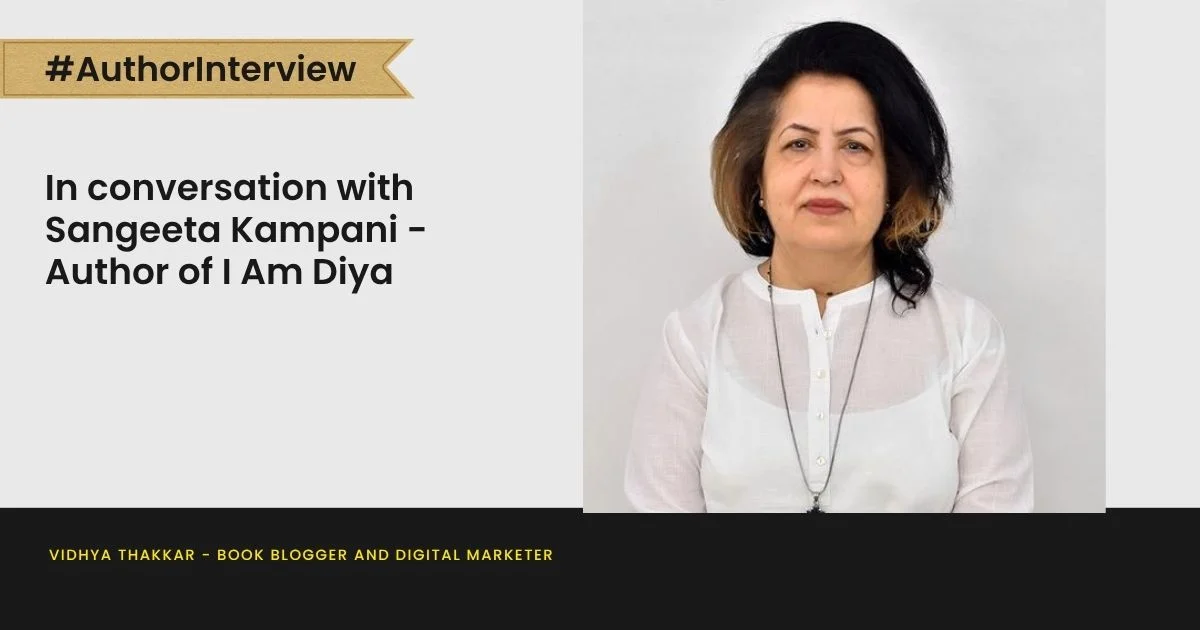
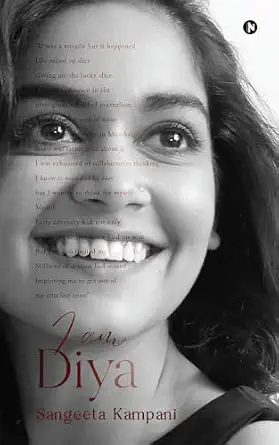
I Am Diya is a story of love, heartbreak, identity and the courage to begin again. In this conversation, Sangeeta Kampani takes us behind Diya’s journey and shares her own writing journey.Sangeeta Kampani is a story that brings together love, heartbreak, friendship, family, independence and the courage to begin again. Through Diya’s journey, Sangeeta Kampani explores what it means to choose yourself, find your identity beyond the roles others give you, and build a life that feels truly your own.
About the Author
Sangeeta Kampani is a former IRS officer who retired as a Commissioner of Income Tax, Delhi. An M.A. in English from Panjab University, Chandigarh, she has continued to pursue her love for writing, contributing essays, poems and reflections to publications including The Indian Express, ThePrint and The Wire.
Her writing often engages with women’s experiences, gender, social expectations and the choices that shape our lives. Her work in ThePrint includes poetry and personal reflections on working women, feminism, privilege and women’s right to make their own choices. With I Am Diya, Kampani turns her attention to fiction, telling the story of a woman navigating marriage, heartbreak, friendship, independence and the courage to begin again.
Get your copy here https://link.amazon/B0f1wzXMQ
Also Read: I Am Diya by Sangeeta Kampani: A Story of Courage, Identity, Love & Starting Over
Interview
Q) What inspired you to write I Am Diya, and when did you first know that Diya’s story needed to be told?
I think I Am Diya grew out of my curiosity about the young woman of today. She has a vocabulary that is quite different from that of my generation. She is more independent, more exposed to the world, and much less willing to accept some of the old rules. And yet, many of the expectations around her have not changed at the same speed.
I wanted to write about that young woman—not as a victim and not as a rebel, but simply as someone trying to make sense of her own life. Diya came to me as a woman who was not waiting to be rescued—not by a man, not by her family, not even by society. She had to find her own way. I think that is when I knew her story was worth telling.
Q) Diya’s journey begins with a difficult decision to walk away from her marriage. What did you most want readers to understand about the courage it takes to choose oneself, especially when that choice is not supported by family?
We often romanticise the act of leaving. We imagine that once a woman decides to walk away, she has conquered her fear and is suddenly free. Real life is rarely so neat. The difficult part begins after the decision. There is uncertainty, loneliness, the fear of having made the wrong choice, and sometimes the painful feeling that the people you expected to stand beside you do not understand you. So for me, courage is not always the dramatic act of leaving. Sometimes courage is living with the silence that follows. And choosing yourself does not mean that you stop loving the people around you. It simply means that you recognise that your life, too, has a claim on you.
Q) The book explores the idea that a woman may have to fight her first battle at home before she can face the world. Why was this an important part of Diya’s journey for you?
Because home is supposed to be the place where you don’t have to explain yourself. When it becomes the place where you are most questioned, the hurt is very different. We often speak about society as the great obstacle. But many of our deepest negotiations happen at home—over what a daughter should be, what a wife should tolerate, what a woman should want, and even how much freedom she should exercise.
The world may question you, but when home questions you, the question goes much deeper. I wanted Diya to experience that. Because if you cannot first find some space within yourself and within your own life, facing the larger world becomes much harder.
Q) The title I Am Diya feels significant because Diya gradually moves beyond being defined as someone’s daughter, wife or partner. Was the idea of identity and discovering oneself at the heart of the book from the beginning?
Yes, very much so. But I don’t see identity as a rejection of relationships. We are daughters, wives, mothers, partners, friends, colleagues—and all these relationships matter. But they cannot be the entirety of who we are. For a woman especially, there is often a tendency to introduce her through her relationship with somebody else. Someone’s daughter, someone’s wife, someone’s mother. I wanted Diya to gradually discover the person who existed underneath all those descriptions. So the title is really about arriving at that simple but powerful place where “I am” is enough. Everything else can follow.
Q) Mumbai plays such an important role in Diya’s transformation. What does Mumbai mean to you, and why did you choose it as the city where Diya begins to discover herself?
Mumbai has always seemed to me like a city that allows you to reinvent yourself.
It is wonderfully indifferent to your pedigree. It doesn’t spend too much time asking where you came from before giving you a chance to find your place. There is anonymity, but there is also possibility. You can arrive carrying one version of yourself and slowly discover another.
And I liked that for Diya.
She needed a city where she could step outside the identity that had been created for her and begin again. Mumbai gives her that physical distance, but more importantly, it gives her psychological space.
Perhaps that is what I love about the city: Mumbai doesn’t necessarily know who you were. That can be wonderfully liberating.
Q) Many women believe perimenopause means they have to accept weight gain, poor sleep, brain fog and low energy as their new normal. Based on your experience, what can actually be improved, and what gives you hope for women in this phase of life?
Absolutely not. Perimenopause is a natural transition, not a disease or the end of good health. While hormonal changes can lead to symptoms like weight gain, poor sleep, brain fog and low energy, research shows that many of these symptoms can be improved through simple lifestyle changes. Supporting the body through nourishing food, strength training, quality sleep, stress management and gut health helps maintain muscle, improve metabolism, balance blood sugar and boost overall wellbeing.
What gives me hope is seeing these transformations every day. Women often come to me feeling defeated, frustrated by stubborn weight gain, mood swings and low energy, believing their body is working against them. A few months later, they realise their body wasn’t the problem; it simply needed the right support, nourishment and care. Our bodies have an incredible capacity to adapt and thrive when we give them the right support. My hope is that every woman realises perimenopause isn’t something to fear; it’s an opportunity to become stronger, healthier and more connected to her body than ever before.
Q) Friendship is another beautiful part of Diya’s journey. Why was it important for you to show the role of friendships alongside romantic relationships?
Because friendship is often the quiet architecture of our lives. Romantic relationships get enormous attention in literature. Friendship doesn’t. Yet when life goes wrong, it is often a friend who sits beside you, listens to the same story for the tenth time, brings you coffee, or simply refuses to let you feel that you are alone. I wanted Diya to have that world. Her friends don’t necessarily solve her problems. They do something more important—they give her a place where she doesn’t have to perform.
Q) Diya experiences love, heartbreak and eventually finds love again later in life. What are your own thoughts on second chances in love and in life?
I don’t believe life has an expiry date on beginnings. We tend to organise life into timetables—by a certain age you should be married, by another age you should have settled down, and after that, perhaps, you are expected to stop beginning anything new. But human beings don’t work according to those timetables. A second chance is not necessarily a second version of the first life. Sometimes it is the first life you have chosen for yourself. And I think that applies not just to love. It applies to work, friendship, cities, dreams—and to the person you become.
Q) The idea of Shakti—the divine energy within every woman who dares to dream—is woven into the book. What does Shakti mean to you personally?
For me, Shakti is not about being invincible. That is an important distinction. Women are often told that strength means being able to handle everything, to need nobody, to never break. I don’t believe that. To me, Shakti is the inner energy that allows you to dream, to endure, to create, and, when necessary, to begin again. You can be frightened and still be strong. You can be vulnerable and still have Shakti. Perhaps the simplest way I would put it is: Shakti is not the absence of weakness. It is the courage to move despite it.
Q)Your writing in I Am Diya is direct yet poetic. How would you describe your writing style, and how has it evolved through your writing journey?
I have always been drawn to language that is simple on the surface but has something lingering underneath. I Am Diya is lyrical fiction in verse, so I was consciously working with rhythm, silence and the space between words. But I didn’t want the poetry to become ornamental. I wanted it to remain accessible, because the emotions Diya experiences are not exotic. They are very ordinary human emotions—love, loneliness, hope, disappointment, the desire to belong.
Over the years, I think I have become less interested in telling readers what to think and more interested in leaving them with something to feel. I like writing that looks simple when you read it, and stays with you a little after you have put it down.
Q)Was there any part of writing I Am Diya that surprised you, perhaps a character, a relationship or an emotion that developed differently from what you had initially imagined?
Diya herself surprised me. I began with a fairly clear idea of her journey, but as I wrote, she refused to become a heroine in the conventional sense. She made mistakes. She got lonely. She wanted love. She sometimes doubted herself. And I was glad she did. I didn’t want to create a perfect, invincible woman who walks through adversity without being touched by it. That isn’t how most of us live. Diya’s strength, for me, lies precisely in the fact that she is vulnerable and yet she carries on. In a way, she became more human than the woman I had initially imagined.
Q) What has your journey as a writer taught you about yourself, and what would you like to say to readers who are about to pick up I Am Diya?
Writing has taught me that people contain many versions of themselves. Perhaps that is why I am so interested in ordinary lives. We are never quite the person that one label suggests. And I have also learnt that we keep discovering ourselves. There is no age at which we become a finished version of ourselves. That is perhaps what I hope readers will take from Diya. Not a lesson, really. I don’t want to tell them whether Diya is right or wrong, brave or foolish. I would simply ask them to walk with her for a while. Come to her with an open mind. She may remind you of someone you know. She may even remind you of a version of yourself you had forgotten.
Get your Book Reviewed by Vidhya Thakkar – Connect us Now
Frequently Asked Questions (FAQs)
1. Who is Sangeeta Kampani?
Sangeeta Kampani is the author of I Am Diya. She is a former IRS officer and retired Commissioner of Income Tax who has also contributed to publications including The Indian Express, ThePrint and The Wire.
2. What is I Am Diya by Sangeeta Kampani about?
I Am Diya is a story of love, heartbreak, friendship, independence and self-discovery, following a woman as she finds the courage to make her own choices and begin again.
3. What are the main themes of I Am Diya?
The book explores women’s independence, identity, marriage, relationships, friendship, family expectations, second chances and starting over.
4. What role does Mumbai play in Diya’s journey?
Mumbai becomes an important part of Diya’s transformation, giving her the freedom to step outside her comfort zone, build meaningful friendships and discover herself beyond the roles assigned to her.
5. Who should read I Am Diya?
It is ideal for readers who enjoy women-centric fiction, emotional relationship stories, self-discovery, friendship and stories about finding the courage to start over.