This post contains Amazon affiliate links. If you buy through one, I earn a small commission at no extra cost to you. It never changes what I write about a book.
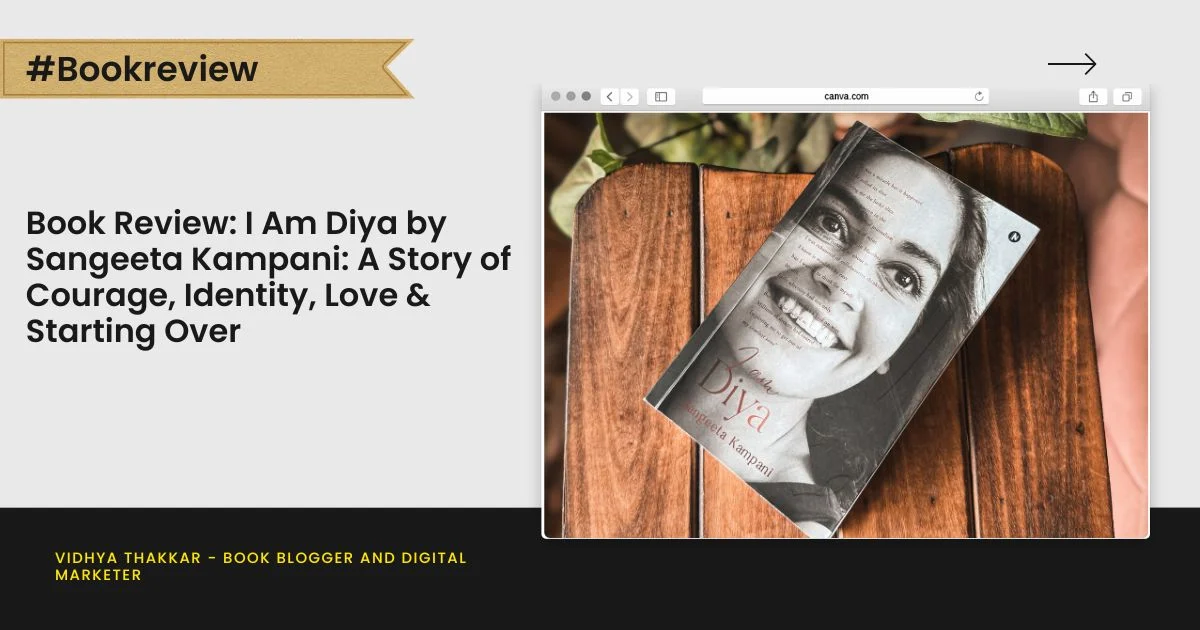
Author: Sangeeta Kampani
Publisher: Notion Press
Genre: Women’s Fiction • Contemporary Fiction • Literary Fiction
Pages: 69 pages
Ideal for: Readers who enjoy women-centric fiction, short, reflective reads with a strong female protagonist
Summary
I Am Diya is ultimately a story about a woman taking charge of her life, making difficult choices, experiencing love and heartbreak, and finding the courage to begin again. A short, emotional and thought-provoking read about women’s journeys, relationships, friendship, independence and second chances.
Review:
“Oh heart, as long as you have the language of love, every scar is a testament of love.”
I finished reading I Am Diya by Sangeeta Kampani, and one thought that really stayed with me was how often a woman has to fight her first battle at home before she can step out and fight the world. Diya’s journey beautifully captures this struggle of standing up for yourself, making choices that others may not understand, and eventually taking charge of your own life. At its heart, this is also a book about finding your own home within yourself. We have to build a life that feels honest and whole, no matter what it takes and no matter where life takes us.
The story follows Diya, a woman who gets married at a young age, only to realise that her marriage is not the life she had imagined. The relationship begins to fall apart, and eventually, the situation becomes too much for her to handle. Eventually, Diya makes the difficult decision to leave and return home, where she has to face her parents and their expectations. Her father, especially, is initially against her decision, and it takes him time to understand what Diya has actually gone through. She eventually decides to take charge of her future and moves to Mumbai to pursue her studies.
The plot of the story is interesting and engaging, particularly because it follows Diya through different stages of her life rather than limiting itself to her marriage. Sangeeta Kampani’s writing style is direct yet poetic, with simple prose that occasionally becomes lyrical through her observations and descriptions, adding an emotional layer to the narrative. The tone is reflective and conversational, making it an easy and accessible read while still touching upon some serious themes.
The book explores themes of women’s independence, marriage, love, heartbreak, friendship, family expectations, second chances and identity. One thought that particularly stayed with me was the idea that we can choose how we suffer. It made me think about how much courage it takes to take the reins of your future into your own hands and fight for your happiness and mental peace.
Mumbai plays a beautiful role in Diya’s transformation. It is where she steps outside her comfort zone, meets new people and begins discovering herself beyond the identities that have been imposed on her. Sangeeta Kampani also describes Mumbai beautifully. There is a particular thought about the city that stayed with me:
“ Where the call of money isn’t just about money.
It’s about freedom, the freedom to assert oneself.”
I really liked this because Mumbai, for Diya, becomes much more than a city where she goes to study. It becomes a space where she experiences independence, makes her own choices and learns to assert herself. The city gives her the freedom to see herself as an individual rather than only through the roles of daughter, wife or partner.
Mumbai also brings some beautiful friendships into Diya’s life. She finds two of her best friends there, and they become the heartbeat of each other’s lives – always there for one another and just a call away. I liked this aspect because Diya’s journey isn’t only about romantic relationships. Her friendships become an important support system and an integral part of the new life she creates for herself. In Mumbai, Diya falls in love again. But once again, life doesn’t go exactly as she expects. She experiences heartbreak, learns from it and continues moving forward before eventually meeting her partner
The idea of identity is another important layer in the book. Diya is initially defined through the roles she occupies – daughter, wife and partner. But as she moves through different stages of her life, she begins to understand who she is outside those identities. The title I Am Diya itself feels significant here because ultimately, she has to discover herself as Diya, beyond being someone’s daughter, wife or partner. I liked that the book doesn’t make Diya’s journey a simple story of leaving one marriage and immediately finding happiness somewhere else. She experiences multiple heartbreaks, and each experience becomes part of her journey and growth. Eventually, Diya marries again at forty, which I thought was an interesting aspect of the story because it challenges the timelines society often places on women. There is no fixed age to begin again, fall in love or build a new life.
I also enjoyed the way the chapters are titled. The title of each chapter feels meaningful and almost tells a little story of its own. It adds another interesting element to the reading experience and makes you curious about what each chapter holds. The relationship between Diya and her parents is another aspect I liked. Her father’s initial reaction and his eventual understanding show how difficult it can be for families to accept choices that challenge their expectations.
At the same time, I did wish the book had gone deeper. It is a short read, and the author manages to cover a lot within its pages, but there were several places where I felt Diya’s experiences could have been explored further. I often felt that some of these experiences were touched upon rather than fully explored. Because the book moves through so many stages of Diya’s life, some emotional transitions feel quite quick. I wanted to spend more time with her emotions and understand what these experiences were doing to her as a person. Her heartbreaks, in particular, could have carried more emotional weight, and some of her relationships and friendships could have been explored beyond the events themselves. For a story that deals with such significant emotional changes, I sometimes wanted the narrative to pause rather than move so quickly to the next phase of Diya’s life. Some of the important turning points could have had more room to breathe.
Still, I enjoyed the overall journey. It is a short yet beautiful and engaging read with an interesting plot, accessible writing and several themes that give you something to think about. I particularly liked Mumbai’s role in Diya’s transformation, the friendship she finds there, the exploration of identity and the fact that her journey towards love and companionship doesn’t follow a predictable timeline.
I Am Diya is ultimately a story about a woman taking charge of her life, making difficult choices, experiencing love and heartbreak, and finding the courage to begin again. A short, emotional and thought-provoking read about women’s journeys, relationships, friendship, independence and second chances.
Get your Book Reviewed by Vidhya Thakkar – Connect us Now
Frequently Asked Questions (FAQs)
1. Is The Last Eligible Billionaire worth reading?
Yes. If you enjoy fake dating romances with emotional depth, witty banter, and memorable characters, The Last Eligible Billionaire is an entertaining and heartfelt read. It beautifully balances humour, healing, and romance.
2. What romance tropes are featured in The Last Eligible Billionaire?
The novel features several popular romance tropes, including fake dating, grumpy × sunshine, opposites attract, billionaire romance, and dual POV, making it an engaging choice for contemporary romance readers.
3. Is The Last Eligible Billionaire a spicy romance?
The book contains romantic and intimate moments, but its strongest appeal lies in the emotional connection, character development, humour, and healing journey rather than relying solely on spice.
4. Who are the main characters in The Last Eligible Billionaire?
The story follows Hayes, the country’s last eligible billionaire from the influential Rutherford family, and Begonia, a recently divorced art teacher rediscovering herself. Their fake relationship gradually turns into a heartfelt romance built on trust and vulnerability.
5. What makes The Last Eligible Billionaire different from other billionaire romances?
Unlike many billionaire romances that focus primarily on wealth and glamour, this novel explores emotional vulnerability, healing from past heartbreak, family expectations, and learning to trust again. The humour, chemistry between Hayes and Begonia, and the unforgettable Marshmallow make it stand out.
6. Who should read The Last Eligible Billionaire?
This book is perfect for readers who enjoy contemporary romance, fake dating stories, grumpy × sunshine dynamics, emotional character growth, witty romantic comedies, and stories about healing and second chances.
Reader_viddh’s Take
What stayed with me wasn’t the fake dating trope or the billionaire glamour, it was Hayes and Begonia’s emotional journey. Pippa Grant reminds us that behind every guarded heart is a story waiting to be understood. Their relationship isn’t built on grand gestures but on trust, patience, shared vulnerabilities, and feeling safe enough to be imperfect. Add to that witty banter, laugh-out-loud moments, a scene-stealing Marshmallow, and a heartfelt cast of characters, and The Last Eligible Billionaire becomes much more than a romantic comedy. It’s a comforting reminder that the right kind of love doesn’t change you, it gives you the courage to be yourself.
Also Read:
Red Flags and Rishtas by Radhika Agarwal
A Wrong Way home by Shunali Shroff
No More Secrets by Lucy Score