
This post contains Amazon affiliate links. If you buy through one, I earn a small commission at no extra cost to you. It never changes what I write about a book.
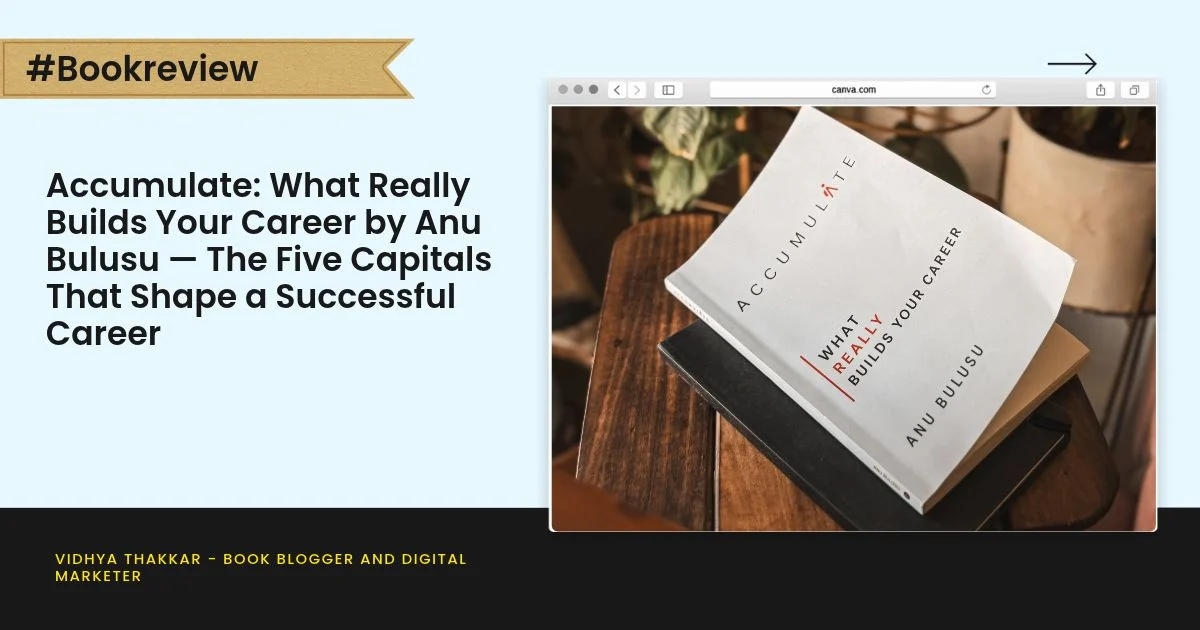
Author: Anu Bulusu
Publisher: Notion Press Publisher
Genre: Nonfiction | Career Development | Professional Growth
Pages: 160 Pages
Ideal for: Readers interested in professional growth, building credibility, developing influence, strengthening workplace relationships, and creating a sustainable career.
Summary
Accumulate: What Really Builds Your Career is an insightful and practical read that encourages us to look at our careers as something we continuously build, manage, and strengthen. It is particularly useful for students, young professionals, and individuals looking to reassess their professional growth.
Review:
“Credibility is the only capital that cannot be easily consumed.”
I have always enjoyed reading books by Anu Bulusu. What I particularly appreciate about her writing is how she brings a broader perspective to different aspects of life, explaining complex ideas in a simple and relatable way. And Accumulate: What Really Builds Your Career is no different. We often associate a successful career with achieving targets, earning promotions, acquiring new skills, or reaching a certain position. But is that all it takes to build a career that lasts? What about the relationships we nurture, the credibility we establish, and the influence we create along the way?
Accumulate: What Really Builds Your Career by Anu Bulusu encourages us to look beyond conventional measures of professional success. The book introduces a practical framework for viewing our careers as a portfolio of five capitals: Internal, Contextual, Credibility, Influence, and Financial. Together, these capitals help us understand why some individuals recover more quickly from setbacks, adapt better to changing circumstances, and build careers that endure.
Anu’s writing is simple, captivating, and accessible, making concepts such as career capital, professional influence, and long-term sustainability easier to understand. The narrative follows a structured approach, combining practical explanations with relatable examples that help readers connect the ideas with their own professional experiences.
One of the most important ideas the book explores is the difference between having a successful job and building a sustainable career. A higher salary, a better designation, or a promotion may indicate professional progress, but these achievements alone do not necessarily guarantee long-term growth. What matters is the knowledge, relationships, and credibility we continue to build along the way. Throughout the book, Anu encourages readers to reflect on their careers. How strong are our relationships? Are we building meaningful connections or merely expanding our networks? Are we investing enough in our skills? And are we making decisions that will continue to benefit us in the years to come?
The discussion around internal and contextual capital is particularly insightful. Anu highlights the importance of continuously strengthening our skills, revisiting what we already know, and remaining open to learning. She also reminds us that years of experience do not necessarily translate into professional growth. What matters is how much we learn, how we apply that knowledge, and whether we continue developing ourselves.
She also explores how professional environments differ across industries and organisations. The same role or skill may carry different expectations and value depending on the context in which it operates. This makes adaptability and understanding one’s professional environment just as important as technical expertise. I also found the analogy of an invisible backpack quite interesting. Throughout our careers, we carry experiences, skills, relationships, expectations, and responsibilities. The idea that the lighter and more thoughtfully we pack, the farther we can go offers an interesting perspective on recognising what truly adds value to our professional journeys and what may be holding us back. This also connects with the book’s discussion of career transitions and setbacks. While designations and positions may change, the capabilities, credibility, and judgement we develop remain with us, helping us navigate new opportunities and unfamiliar circumstances.
Among the five capitals, the chapters on credibility and influence were my favourites. The discussion on credibility particularly stayed with me because of the distinction between credentials and credibility. While credentials may help us establish our qualifications, credibility is something we build through our actions, consistency, reliability, and the trust we earn over time. Credentials may open doors, but credibility determines how people perceive and trust us once we walk through them. I loved how the author presents credibility as a bridge that supports professional growth and strengthens relationships.
The chapter on influence was equally interesting. Anu explores it through the lens of agency, transparency, and intent, encouraging us to think about how we use our voice, build relationships, and create an impact through our actions. Influence is not simply about how many people we know, but also about the trust we establish and the value we bring to those connections. The inclusion of financial capital makes the framework more balanced. While financial stability is an important part of professional growth, the book encourages us to consider it alongside the other forms of capital rather than treating money as the only measure of success. Another aspect I enjoyed was the inclusion of examples involving different individuals and professional situations. These help readers understand how the five capitals apply to real-world experiences, making the framework more practical and relatable.
However, despite its interesting framework, I felt that certain concepts could have been explored in greater depth. While the explanations are clear and the examples make the ideas accessible, some discussions remain at a fairly basic level. I would have appreciated more detailed insights, particularly on how these capitals work in complex professional situations. The book offers a useful overview, but readers already familiar with career development concepts may find themselves looking for something more substantial.
Overall, Accumulate: What Really Builds Your Career is an insightful and practical read that encourages us to look at our careers as something we continuously build, manage, and strengthen. It is particularly useful for students, young professionals, and individuals looking to reassess their professional growth.
Get your Book Reviewed by Vidhya Thakkar – Connect us Now
Frequently Asked Questions (FAQs)
1. What is Accumulate: What Really Builds Your Career by Anu Bulusu about?
Accumulate is a nonfiction book that explores career development through five forms of capital: Internal, Contextual, Credibility, Influence, and Financial. It encourages readers to look beyond promotions, salaries, and job titles to understand what contributes to long-term professional growth.
2. What are the five capitals discussed in Accumulate?
The five capitals are Internal, Contextual, Credibility, Influence, and Financial. Together, they provide a framework for understanding how skills, professional environments, trust, relationships, and financial stability contribute to building a sustainable career.
3. What is the difference between credibility and credentials in Accumulate?
The book highlights how credentials establish qualifications, while credibility is built through consistency, reliability, actions, and trust. Credentials may open professional opportunities, but credibility plays an important role in sustaining relationships and long-term growth.
4. Is Accumulate suitable for students and young professionals?
Yes. The book is particularly useful for students, fresh graduates, and young professionals who want to understand career development beyond academic qualifications and professional achievements. Its accessible writing and practical examples make the concepts easy to follow.
5. Is Accumulate by Anu Bulusu worth reading?
Yes, especially for readers looking for an introduction to long-term career development. The five-capital framework offers useful perspectives on professional growth, credibility, and influence. However, readers already familiar with career development concepts may find certain discussions basic and wish for greater depth.
Reader_Viddh’s Take
Accumulate: What Really Builds Your Career by Anu Bulusu is an insightful and practical read that encourages us to rethink what truly contributes to a successful career. I particularly enjoyed the chapters on credibility and influence, especially the distinction between credentials and credibility. The five-capital framework, relatable examples, and simple, captivating writing make it an accessible read. While I wished certain concepts had been explored in greater depth, the book offers a useful starting point for anyone looking to build a sustainable career beyond promotions, salaries, and designations.
Also Read:
Book Review: The Chanakya Playbook by Abhiraj Gupta – Where Ancient Wisdom Meets Modern Leadership


