This post contains Amazon affiliate links. If you buy through one, I earn a small commission at no extra cost to you. It never changes what I write about a book.
Author: Devsingh Balan
Genre: : Nonfiction | Design & Creativity | Sustainability | Conscious Consumption | Philosophy
Pages: 120 pages
Ideal for: Genre
Nonfiction | Design & Creativity | Sustainability | Conscious Consumption | Philosophy | Personal Reflection
Ideal for: Readers who enjoy thought-provoking nonfiction, design, sustainability and conscious consumption, and books that connect everyday choices with larger ideas around nature, efficiency, beauty and usefulness.
Summary
Aesthetic and Efficient: A Way of Thinking is a thoughtful and engaging nonfiction read that brings together design, nature, sustainability, consumption and the way we make everyday choices. While some sections could have been tighter and clearer, the book has a strong central premise and enough depth to make the reader pause and reconsider familiar habits.
Review:
“The room is still there. Mostly, you work through it without thinking now, the way water forgets it was ever called, settling instead into the only shape that made sense once it stopped fighting itself.”
There are books that make you think about things that are so ordinary that we have stopped noticing them. Things we use every day, things we buy, things we keep, things we throw away, and the choices we make without really thinking about why we make them. Aesthetic and Efficient: A Way of Thinking by Devsingh Balan is one such book. This was one of the books I took the longest time to read. Not because it was difficult, but because I did not feel like rushing through it. There are books you read chapter after chapter, and then there are books where you read something, pause, think about it and then continue. This felt more like the second kind for me.
This is the third book in Devsingh Balan’s trilogy, and in this one he shifts his focus towards the way we think, choose and shape the world around us. The book looks at something very simple but also something we often separate — beauty and usefulness. Why can’t something be beautiful and useful at the same time? Why do we often think of aesthetics and efficiency as two different things? The idea becomes much broader than design. The book looks at the things we create, the things we buy, the things we keep and the things we eventually discard. In doing so, it also examines how these choices are connected to the way we think, live and use the world around us.
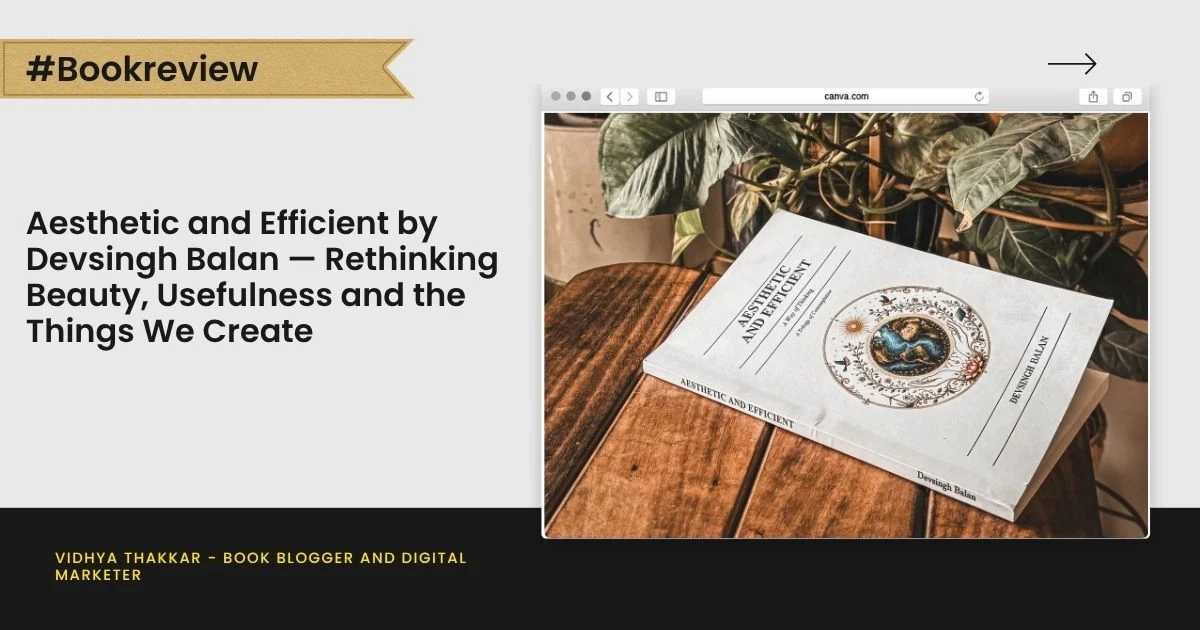
The cover itself is beautiful, and it fits the idea of the book quite well. Even before getting into the chapters, there is a sense of design and thoughtfulness in the way the book has been presented. One of the strongest ideas in the book is that nature is the teacher. It looks at how nature creates, adapts and functions without separating beauty from usefulness. The author brings in examples from nature, design, architecture and older ways of thinking to show how much can be learnt from what already exists around us.
The book also looks at ideas that existed long before technology became such a large part of everyday life. There is so much we have learnt to do with technology, but there are also things the old world understood simply by observing, making and living with nature. The book makes a strong case for paying attention to that knowledge instead of assuming that newer always means better.
The book has 40 chapters divided into seven movements, and the narrative moves through ideas rather than following one continuous story. Some chapters look at nature and design, some at old knowledge, some at waste and consumption, while others bring the discussion back to the way we make choices. This gives the book a conversational and exploratory tone. It does not feel like the author is trying to lecture the reader; instead, he introduces an idea, observation or question and gives it room to develop.
The writing is simple, accessible and easy to follow. The author uses examples, observations and questions rather than making the book feel overly technical, which keeps the larger ideas approachable. The shorter chapters also work well for this kind of book because they allow the reader to pause between ideas rather than simply moving towards the next chapter.
There are quite a few chapters that stand out.
“A Grammar and Not a Blueprint” was a favourite because of the distinction between having a fixed blueprint and understanding the grammar behind something. It looks at how understanding the thinking behind something can sometimes be more useful than simply following a set formula or answer.
“The Quiet Machines” turns its attention towards waste and the scale of what we throw away. It encourages the reader to think beyond simply putting something in the bin and consider everything that went into creating an object and what happens once we are finished with it.
“The Mountain That Comes with a Price Tag” looks at another familiar part of consumption: buying things because we like them, are excited about them or simply want them at that moment. The chapter raises questions about how easily enthusiasm can turn into accumulation and how much of what we own we actually use.
Another important thread running through the book is attention and noticing. Instead of immediately telling us what we should or should not do, the book encourages us to first pay attention to our own choices. Why are we buying something? Do we need it? Why are we keeping it? What happens when we no longer need it? What went into making it, and where does it eventually go?
The four questions make this approach more practical. Rather than leaving the discussion only at the level of philosophy or design, the book gives the reader a way to examine the things we make, buy and keep. They shift the focus from the object itself to its origin, purpose, use and what happens after its usefulness is over. This helps connect the larger ideas in the book with everyday decisions around consumption and creation.
And that is where the book becomes larger than a discussion about design. It brings together beauty, usefulness, nature, consumption, waste, old-world knowledge and the choices behind the objects and systems we create. The central argument is not simply about making things look better or work better, but about thinking more carefully about why and how we create, what we choose to bring into our lives, and what happens when we are finished with it.
At the same time, the book is not completely seamless. There are portions where it feels scattered, and some chapters take time to understand because the direction of the argument is not immediately clear. At times, similar ideas return in different forms, creating a sense of repetition and affecting the pace. But the slower pace also suits the nature of the book. It is not meant to be rushed through, and some of its strongest ideas work better when given a little time.
In all, Aesthetic and Efficient: A Way of Thinking is a thoughtful and engaging nonfiction read that brings together design, nature, sustainability, consumption and the way we make everyday choices. While some sections could have been tighter and clearer, the book has a strong central premise and enough depth to make the reader pause and reconsider familiar habits. It would be a good choice for readers interested in thoughtful nonfiction, design, sustainability, conscious consumption and books that encourage a closer look at how we create, use and discard the things around us.
Get your Book Reviewed by Vidhya Thakkar – Connect us Now
Frequently Asked Questions (FAQs)
1. What is Aesthetic and Efficient: A Way of Thinking about?
Aesthetic and Efficient explores the relationship between beauty and usefulness and how the way we create, buy, use, keep and discard things reflects the way we think and live. It also looks at nature, design, consumption, waste and older ways of understanding the world.
2. Is Aesthetic and Efficient an easy book to read?
The writing is simple, accessible and conversational, but the ideas require some attention. It is not a book to rush through, and some chapters need a little time to understand and reflect on.
3. How is the book structured?
The book has 40 chapters divided into seven movements, with each section exploring different ideas around nature, design, consumption, waste, efficiency and the choices we make.
4. What role does nature play in the book?
Nature is one of the central ideas of the book. The author looks at nature as a teacher and explores what natural systems can teach us about beauty, usefulness, efficiency and the way we create things.
5. Is Aesthetic and Efficient a practical book?
It is primarily a reflective nonfiction book, but the four questions in the book make its ideas easier to apply to everyday choices. They encourage readers to think more carefully about what they create, buy, use and keep.
Reader_viddh’s Take
If you enjoy thought-provoking nonfiction that connects design, sustainability, nature and conscious consumption with everyday life, Aesthetic and Efficient: A Way of Thinking is worth picking up. It is not a perfect read and does feel scattered in places, but it has enough interesting ideas and questions to make you pause and look at familiar choices a little differently.
Also Read:
Book Review: Journey to Infinity Within by DevSingh Balan | A Layered Spiritual Exploration