This post contains Amazon affiliate links. If you buy through one, I earn a small commission at no extra cost to you. It never changes what I write about a book.
Author: Dancing Snail
Publisher: Harpercollins India
Summary
This isn’t just a book you read, it’s a book you sit with. A quiet companion for the days when everything feels heavier than usual. It doesn’t demand productivity or positivity from you. It simply reminds you that slowing down is not weakness, and resting is not failure. Sometimes, healing begins the moment we allow ourselves to pause.If you are tired, overwhelmed, or simply in need of reassurance, this is a book you are going to love.
Review
“It’s better to focus on what we can do right now. This way we stop reality from getting us down and find something to read on.”
There is a particular kind of exhaustion that sleep does not fix. It is the exhaustion that comes from constantly proving that you are trying. From answering messages when you want silence. From showing up when your body is quietly asking you not to. From convincing yourself that if you just push a little more, you will finally feel enough.
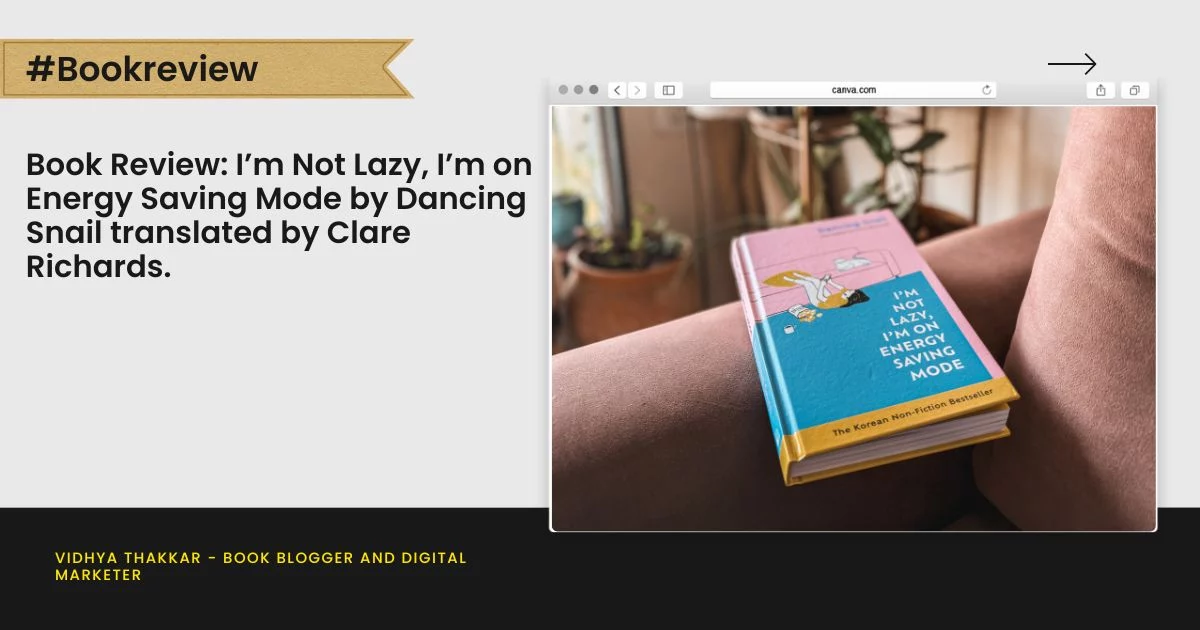
That was the space I was in when I picked up I’m Not Lazy, I’m on Energy Saving Mode by Dancing Snail, translated by Clare Richards. And I’m deeply grateful that I did. I did not pick it up because I was curious. I picked it up because I was tired and even more tired of feeling guilty for being tired. I remember reading it on a night when I couldn’t even open my laptop without feeling heavy, when rest felt undeserved. And this book quietly told me something I didn’t know I needed to hear: you are not lazy, you are on energy-saving mode.
Written by Dancing Snail and translated by Clare Richards, this Korean non-fiction book gently walks through emotional exhaustion, self-doubt, comparison, and the constant pressure to be “on.” Dancing Snail writes with an honesty that feels almost uncomfortable at times because it mirrors thoughts we rarely say aloud.
The book is divided into four parts, moving through emotional states like someone guiding you through rooms in your own house, the rooms you have avoided entering. In the first section, when the author talks about not knowing why we are the way we are, it feels deeply personal. How often do we judge ourselves for feeling “off”? For needing distance? For not having the energy to explain ourselves? It touches on the fear that we will only be loved once we are perfect, productive, or better than who we currently are.
One of the most striking parts for me was the conversation around boundaries. We are so afraid of saying no because we do not want to be seen as selfish. Yet, when others say no to us, they do it without apologizing for existing. That contrast is uncomfortable. It forces you to reflect on how much of your exhaustion comes from over-availability. It reassures us that it is okay to not understand ourselves all the time. It is okay to pause. To log out. To feel disconnected. The small “recharge your empty heart” notes throughout this section feel like gentle reminders to breathe. They read like permission slips for imperfection.
The second part, which became one of my favorites, speaks about the quiet exhaustion of adulting. This section feels less like advice and more like quiet companionship. It addresses something so simple yet so difficult – saying “no”. We often overextend ourselves because we are afraid of disappointing people. We stay available, we overdo things, we bend until we break. Yet when we ask for something, people say no without hesitation. That contrast makes us reflect on how much we give and how little we allow ourselves to receive. This section also touches on anxiety at night, overthinking, and the need to process multiple emotions at once. It is practical, relatable, and grounding. The reminders about spending money on things that genuinely make us happy also stood out. We often regret such choices later, but if something brings joy, why should we feel guilty about it?
The third part resonates deeply with anyone who feels socially drained. There are days when we do not want to step out, when being around people exhausts us, when even simple interactions feel heavy. The book discusses the paradox of overcoming depression, sleepless nights filled with imaginary worries, and the guilt of wanting to stay home. Reading this section feels like being understood without being judged.
The final part explores something we rarely admit, that sometimes we simply do not want to do certain things. We do not want to be positive. We do not want to stay busy just to cope. We are sick and tired, and pretending otherwise only makes it worse. It addresses toxic positivity, the pressure to always stay busy, and the exhaustion of pretending to be okay. It acknowledges the moments when we feel like giving up, when life feels overwhelming, and when we’re simply tired of everything.
The author acknowledges these feelings without trying to fix them instantly. She offers small shifts in perspective, small habits, and small steps that help us move through each day without overwhelming ourselves. This book also quietly challenges hustle culture. It questions the idea that being busy is the same as being valuable. It reminds you that resting is not a reward you earn after collapse. It is maintenance. It is care. It is necessary.
What stayed with me the most was a line:
“Nothing we choose will ever be the best choice. Why? Because ultimately, it is our decision how we respond to the outcome of the choices we make. Whatever choice we make, we have our reasons for doing so.”
Every choice we make is made for a reason. There is no guaranteed “best” path, only growth in how we handle where we land. There is no perfect path waiting somewhere, only choices, responses, and reflection. That shift in perspective changes everything.
The illustrations add warmth to the reading experience, minimal, soft, almost childlike creating a contrast to the heaviness of the themes. It feels like holding something fragile yet steady in your hands. From its illustrations to its writing style, this book feels like something you return to whenever you’re exhausted or emotionally drained. The language is minimal, almost conversational, yet layered with emotional depth. It does not rely on complex metaphors or dramatic storytelling, but instead uses short reflections, gentle observations, and intentional pauses that allow the reader to sit with each thought. There is a rhythm to the writing, soft, steady and unhurried, mirroring the very message it conveys. It is the kind of writing that seems simple at first glance, yet lingers long after you close the page.
It makes you realize how often we compare ourselves, how quickly we doubt ourselves when things do not go smoothly, and how little credit we give ourselves for even reaching this far. It gently reminds us to draw boundaries, to rest without questioning it, and to stop overburdening ourselves for the sake of others. The tone is light yet intense, gentle yet deeply insightful. It is comforting, honest, and profoundly relatable, a book that makes you feel seen.
The small “recharge your empty heart” notes scattered throughout feel like sticky notes left for your future self. They are simple, sometimes even obvious but when you are drained, simplicity is exactly what you need.
In the end, this isn’t just a book you read, it’s a book you sit with. A quiet companion for the days when everything feels heavier than usual. It doesn’t demand productivity or positivity from you. It simply reminds you that slowing down is not weakness, and resting is not failure. Sometimes, healing begins the moment we allow ourselves to pause.If you are tired, overwhelmed, or simply in need of reassurance, this is a book you are going to love.
Get your Book Reviewed by Vidhya Thakkar – Connect us Now