This post contains Amazon affiliate links. If you buy through one, I earn a small commission at no extra cost to you. It never changes what I write about a book.
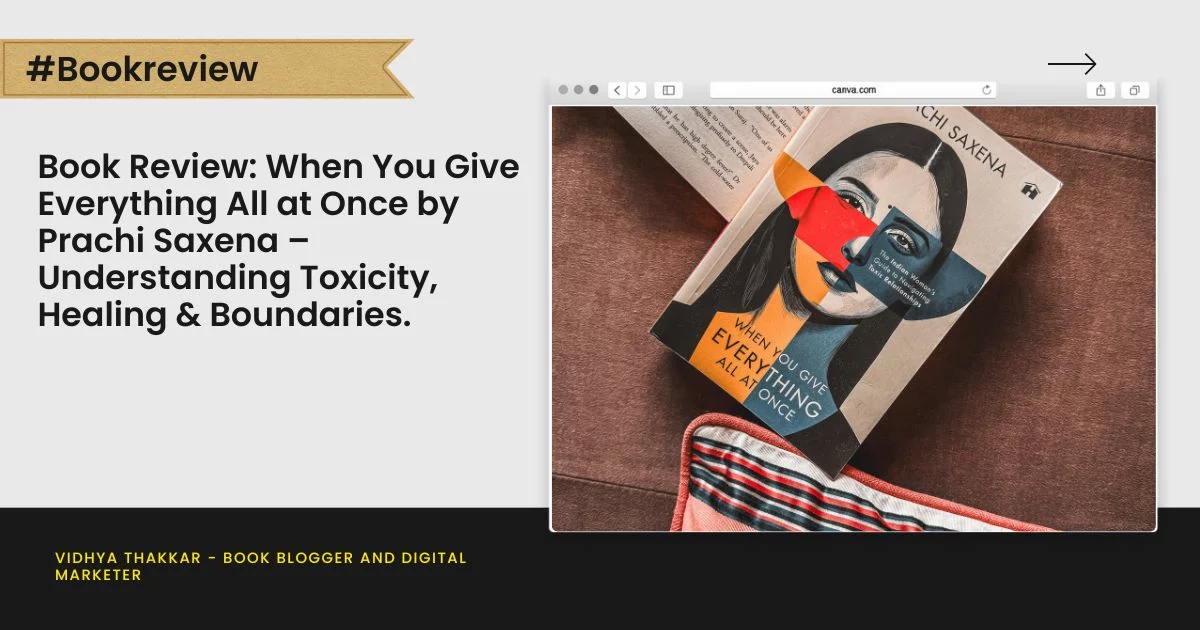
Author: Prachi Saxena
Publisher: HayHouse India
Summary
When You Give Everything All at Once is layered, honest, and deeply relatable. It’s a book that challenges you, comforts you, and makes you rethink the way you see yourself and your relationships. In all, it’s a masterpiece, one that will stay with you long after the last page.
Review
“Life as I knew it had to end, compelling me to rebuild a new one.”
Some books give us a reality check. They help us acknowledge the feelings we’ve been avoiding, and they bring clarity to thoughts we never put into words. For me, When You Give Everything All at Once by Prachi Saxena was that kind of book. It made me truly understand what toxicity looks like, the behaviours we often ignore, and what it takes to draw boundaries. It reminded me how everything changes when we finally speak up about what we really feel.
This book is more than powerful; it challenges the way we think. It makes us realise how often we ignore toxicity in the name of love and affection, and how, in the end, we are responsible for both our happiness and our sadness. Through her words, Prachi Saxena takes us into the world of toxic relationships, helping us recognise the wounds that block healthy love. She shares her own story, her struggles with love and self-worth, and the painful cycles of toxic relationships that kept pulling her towards self-sabotage. Blending her personal story with honesty and her insights as a trauma therapist, she takes us on a journey of growth and healing.
Divided into three parts, the book moves through stages. Recognising signs of toxicity, understanding the vulnerabilities that make us vulnerable to toxic cycles, and finding ways to heal by setting boundaries and choosing healthier patterns. What makes it stand out is how simple, clear, and relatable her explanations are. The way she explains toxicity feels simple and clear. She doesn’t complicate things but makes them relatable. From personal stories and client examples to questions and charts, every page feels like a gentle nudge to reflect on our own patterns. It’s written in a way that makes you pause, think, and understand. It feels less like a heavy textbook and more like an honest conversation that guides you forward.
What I really liked is how she makes us aware of our own vulnerabilities. Reading it felt like realising that we all carry some level of toxicity. The real question is: how much effort do we make to be less toxic and become more compassionate, more approachable versions of ourselves. With every situation she shares, she gives us a kind of roadmap, helping us identify patterns we’ve overlooked and showing us how to change them.
One of my favourite parts was the chapter on balancing feminine and masculine energy. We all have both within us, but we’re never really taught how to channel them right. The way she spoke about activating healthy feminine energy was beautiful and stayed with me. Another favourite was the part on boundaries.
“Boundaries are not walls; they are doors. The purpose of doors is not to ever let anybody enter our house; it is to keep ourselves protected and regulate who comes in and when.”
This line lingered long after I finished the book and shifted my perspective entirely. The idea that boundaries are not about shutting people out but about protecting ourselves and choosing who enters and when stayed with me.
The book also speaks about how prolonged distress affects not only our mental health but also our bodies, how trauma gets stored, and why regaining control of our lives is essential. It’s not just about identifying toxic patterns, but also about healing, setting boundaries, and finding peace. These reflections linger long after the last page. The way people react when we limit their access, the discomfort of drawing lines, and finally, the peace that follows. This isn’t a book you read fast. It’s one you sit with, slowly, letting each story sink in. Because the truth is, in one way or another, we’ve all been in those situations she writes about. Each chapter carries truths we have either lived through or ignored; each story feels uncannily familiar. It is layered, insightful, and deeply moving.
For me, When You Give Everything All at Once is layered, honest, and deeply relatable. It’s a book that challenges you, comforts you, and makes you rethink the way you see yourself and your relationships. In all, it’s a masterpiece, one that will stay with you long after the last page.
Get your Book Reviewed by Vidhya Thakkar – Connect us Now