This post contains Amazon affiliate links. If you buy through one, I earn a small commission at no extra cost to you. It never changes what I write about a book.
About The Author
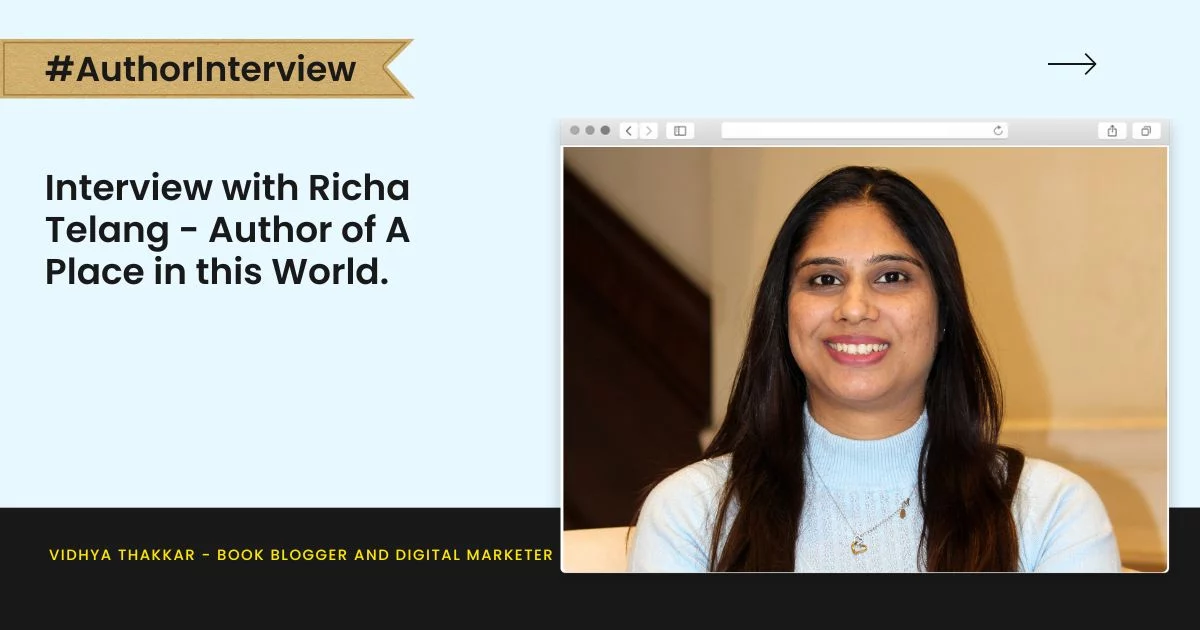
Richa Telang, a writer based in Gurugram, India, began her journey as an author after leaving behind a career in recruitment to pursue her true passion – storytelling. She made her literary debut in 2020 with the contemporary fiction novel A Bit of Both, which won praise from readers and is available on leading online platforms. Her second novel, A Place in This World, is an emotional narrative set during the COVID era and promises to be even more captivating than her first.
Known for her compelling plot-building skills and accessible writing style, Richa has a unique talent for keeping readers engrossed till the very last page. She initially shared her stories on her WordPress blog, Wordrazzi, where each piece ranged from 15,000 to 30,000 words, and her musings can also be found on platforms like Medium and Momspresso. Beyond writing, Richa finds joy in fitness, singing, and gardening, all while balancing her creative pursuits with her role as a homemaker and her life with her family, including her two children. Writing remains her happy place, as she continues to explore and expand her storytelling horizons.
Instagram: richa.telang
Email address: [email protected]
Get your copy here – https://amzn.to/421UmTQ
Also Read: Book Review: A Place in This World by Richa Telang – A Heartwarming Tale of Grief, Friendship & Healing
Interview
Q) What inspired you to write A Place in This World? Was there a specific moment or event that sparked the story?
The COVID-19 era was the catalyst for A Place in This World. It was a time when life came to a standstill, and nearly everyone experienced or witnessed a loss that felt deeply personal. The collective grief was overwhelming, but I also found myself drawn to the quiet resilience of the survivors. Those who had no choice but to carry on, to stay strong in the moment of sorrow. This story is my tribute to them. The moment that truly sparked the narrative came during the Delta wave, when news of deaths became a daily reality. One particular loss, which I’ve woven into a grieving scene in the book, became the emotional anchor for the entire story.
Q) Were Ira and Sahaj based on real experiences, or purely fictional creations?
Ira and Sahaj are purely fictional creations, but their story was born from a very real moment. During the Delta variant, one day, we heard about two families in the same residential society who lost loved ones to Covid, on the same day, almost at the same time. It was heartbreaking to imagine the grief they must have been experiencing, and even more emotional to think about how they might feel upon learning of each other’s loss. That moment stayed with me, and it sparked a need to explore the emotional aftermath of such shared tragedy, and that’s how the idea for the story began to take shape.
Q) How did the theme of grief and healing influence your writing? How do you balance the emotional depth of characters with keeping the story engaging?
As a writer, the theme of grief and healing has affected me a lot. I think I’ve never worked on something so emotionally demanding. That’s why I often say this book carries a piece of my heart. Writing scenes of deep sorrow and vulnerability wasn’t just challenging, but overwhelming as well. There were moments when the emotions I was trying to capture brought me to tears, because I wasn’t just imagining pain but I was reliving it through my characters.
Portraying grief with authenticity and empathy is never easy, not even for the experts, I’d say. I had to be extremely mindful of my words, ensuring they resonated with readers without ever feeling exploitative or insensitive. It was important to me that the emotional weight felt real, but also respectful. That’s why, to keep the story engaging, I introduced multiple characters, each facing their own personal battles. Their journeys added layers to the narrative and offered different perspectives on standing tall against difficulties. It’s through their interconnected struggles that the story finds its rhythm and emotional depth.
Q) Can you walk us through your writing process for this novel? How long did it take you to complete the book, from idea to final draft?
It took me almost two years to complete this novel. I began writing it in January 2022, and the final draft was ready by September 2023. The process was anything but linear – especially with multiple characters whose lives intertwine in complex ways. I couldn’t just open my laptop and start writing; I needed emotional space and clarity to dive into each character’s world. A lot of time went into shaping each character – deciding their traits, the depth of their arcs, and how their timelines would unfold chapter by chapter. After their Karjat trip, each character’s journey takes a turn – some face threats, others step into new roles, and some endure personal loss. Capturing these transitions in a way that felt natural and emotionally true required careful pacing and structure. To maintain the flow and keep the story engaging, I had to streamline my characters’ development into each chapter so that the reader could move seamlessly. It was a slow, deliberate process – but one that allowed the story to breathe and grow organically.
Q) Did you face any challenges while writing about sensitive topics like loss and grief?
Yes. A lot. Writing about grief was one of the most emotionally demanding parts of the process. It’s a delicate subject, and I was extremely conscious of not hurting the sentiments of readers who may have experienced similar pain. I endlessly revisited and edited those scenes, constantly questioning whether I had captured the emotions with enough authenticity and sensitivity. I wasn’t sure if what I had written was good enough, or even appropriate, until I shared the manuscript with the first person to read it – my best friend of two decades. When she genuinely appreciated the effort and the emotional honesty behind the story, only then I became sure that I needed to present it to the world.
Q) Were any supporting characters inspired by people you know?
Yes, Pia and Kairav were inspired by members of my own family. Pia’s warmth, her bubbly nature, and her quiet sense of responsibility are drawn from my cousin’s wife, but the challenges Pia faces in the story and how she responds to them are entirely fictional. Kairav, on the other hand, is a reflection of my nephew. He’s naughty, loud, curious – everything an eight-year-old should be!
Q) Which character was the most challenging or enjoyable to write, and why?
Soham, Pia, and the children were the most enjoyable to write. They brought lightness and warmth to the story, offering a much-needed balance to the emotional intensity surrounding characters like Ira, Sahaj, and Kritika. Their presence added moments of joy, humour, and tenderness that helped soften the weight of grief and introspection woven throughout the narrative. Ira, the protagonist, was by far the most complex to write. She’s confident and capable, yet deeply vulnerable in certain situations. She’s beautiful, but struggles with insecurity – especially when she fears Kritika might grow closer to Sahaj. Professionally, she knows her worth, but her financial constraints and personal responsibilities make her hesitant to take bold steps in her career. Capturing these contradictions – her strength and fragility, her ambition and hesitation – required a lot of emotional layering. And if readers pay close attention, they’ll notice a subtle yet powerful trait in Ira – whenever she’s in doubt or emotional turmoil, she retreats to the quiet sanctity of a washroom and finds reassurance by speaking to her reflection. It’s a deeply personal thing – one that reflects a kind of silent strength. This is something you’ll often find in people who don’t easily show vulnerability outwardly. They seek solitude not to escape, but to reconnect with themselves – to gain clarity, composure or courage before facing the world again.
Sahaj’s character was crafted to complement Ira’s journey. His role is a bit understated yet essential. Think of it like Irrfan’s character in Piku. While Deepika Padukone’s character drives the narrative, Irrfan’s presence brings grounding, emotional depth, and a quiet strength that elevates the entire story. He doesn’t overshadow the protagonist, but without him, the emotional arc would feel incomplete.
Similarly, in Tamasha, Ranbir Kapoor’s character is the focal point – his internal struggle, transformation, and emotional journey form the core of the film. But Tara, played by Deepika, is the catalyst. She sees the real him, challenges him, and ultimately helps him rediscover himself. Her presence is vital, even though the spotlight isn’t always on her. That’s the kind of importance Sahaj holds in this book. He’s not just a supporting character – he’s the emotional counterbalance to Ira. His quiet resilience and unwavering presence help shape her journey in ways that are both subtle and profound.
Q) Did you always know how the story would end, or did it evolve as you wrote?
Yes, I always knew! I always knew how I wanted the story to end. I’ve always been drawn to endings that leave space for the reader’s imagination. I love crafting conclusions that offer hope, but also allow readers to interpret what comes next based on their own emotional lens. That’s been a consistent theme across both of my books.
In A Bit of Both, it was actually my husband’s idea to leave the ending open rather than neatly tying it up with a happy resolution. With A Place in This World, I was certain from the beginning that I wanted the story to reflect the complexity of real life – where people may get what they want, but still have mountains left to climb. Because that’s what life is, isn’t it? You don’t reach one milestone and declare it’s over. There’s always more to learn, more to grow, more to feel.
I’ll again go back to my favourite movies as examples of this kind of storytelling – the film Piku – there’s no grand romantic gesture, no dramatic climax. Yet, by the end, you feel fulfilled. The characters who were meant to be together are together. They’ve grown, they’ve healed, and they’ve found a rhythm in their lives – but the story doesn’t force a “happily ever after.” It simply lets them be.
Similarly, in Tamasha, Ranbir’s character is the emotional core of the film, but Deepika Padukone’s character, Tara, is the catalyst. She doesn’t just support his journey – she transforms it. And yet, the film doesn’t end with a wedding or a proposal. It ends with completeness one finds within. With evolution. With a sense that life will continue to unfold in its own time.
That’s the kind of ending I love to write – where everything feels natural, unresolved in the best way, and still full of promise.
Q) Are there any unique rituals or habits you follow while writing?
There are no rituals as such, but I do have a few habits that help me stay focused. I usually write between 11 a.m. and 3 p.m. as it’s the window when my mind feels most alert and creative. Of course, if a compelling idea strikes at 1 a.m., I won’t hesitate to grab my laptop and start typing, or at least save a rough draft of it in my phone.
One quirky habit I’ve developed is tying my hair into a bun before I write. It helps me switch into “writing mode” and concentrate better. Interestingly, Ira – my protagonist in A Place in This World shares this trait. It’s a small detail, but one that connects me to her in a personal way.
Q) How important was it for you to depict family and friendship dynamics authentically?
Most important! I find it impossible to fake genuineness even in real life so I naturally carry that into my writing. I struggle to connect with books or shows that portray relationships in a way that feels forced or unrealistic. For me, authenticity in family and friendship dynamics isn’t just a preference – it’s a necessity. Therefore, the characters in my story are, in many ways, the kind of people I’d want to surround myself with. They’re sincere, emotionally grounded, and relatable. There’s no room for shrewdness, except for Loveleen, who has a brief presence in the narrative. Even she plays a subtle role in helping Ira, cloaked in the guise of a shrewd character. Her complexity adds texture without compromising the overall warmth and honesty of the relationships in the story.
Q) What has writing this book taught you personally?
This book has genuinely evolved me not only as a writer but as an author with a deeper understanding of my own creative capacity. Before A Place in This World, I wasn’t fully aware of what I was capable of. This book has tested me a lot and has taken a lot from me. And as a reader, I have three main takeaways from this book: First, clarity of thought is powerful – once you know what you want, things begin to align. Second, as RJ Manas tells Ira in the very first chapter, it’s okay to not be okay sometimes. Let yourself feel, and lean on the people who love you. And third, if you’re lucky enough to have friends like Sahaj and Kritika – hold them close, love them hard. They’re the kind of people who make life worth living.
Q) How do you cope with emotional fatigue after writing about grief or loss?
This is a tough question, but it is important to answer this as I feel it might help other writers to look after their own emotional well-being. Writing about grief and loss can be immensely draining. There have been scenes where the emotional weight was so intense, I found myself in tears. When you fully immerse yourself in a character’s experience, you’re not just imagining their pain – you’re feeling it, living it, and trying to translate it into words that resonate. There are some scenes that took me an entire week to write, simply because I needed time to process the emotions and make sure they felt real and honest. I had to sit with the grief or the profound emotion, let it settle, and only then could I write something that felt genuine. It’s a slow process, but one that’s deeply necessary.
Q) If you could give one piece of advice to aspiring authors, what would it be?
Just be real with your writing.
Art, no matter the form, only becomes beautiful when it’s created with honesty and heart. Don’t rush to fit in or chase trends. If you’re building something original, understand that it will take time to shape, to grow, and to find its place in the world. And fill yourself with patience. A lot of it. Brace yourself for the inevitable heartbreaks – from publishers, literary agents, readers, reviewers and who not!? But if your work is genuine, it will find the people it’s meant for. Stay true, stay steady, and keep writing.
Q) How do you decide which life experiences to weave into your stories?
Well, I don’t force life experiences into my writing; they usually find their way in naturally, as part of the creative flow. Sometimes I witness a moment or feel something deeply, and I make a mental note of it. But it doesn’t happen all the time. Only the experiences that truly resonate with me end up shaping my characters or scenes.
Q) Are there any upcoming projects or books you’re excited to share?
Well, I did start working on my third book, and my first draft is ready. But I’m holding off on sharing details for now. When the time feels right, I will reveal more.
Q) What message or feeling do you hope readers take away from this book?
I hope readers close this book feeling happy and deeply satisfied. At its heart, the story is about rediscovering light after profound loss. I want this book to offer them a quiet reassurance that life doesn’t end when someone close is gone. Instead, it can unfold in unexpected ways, presenting choices you never imagined, and revealing strengths you didn’t know you had. If this book leaves readers feeling more confident, hopeful, and rejuvenated, then I’ve done what I set out to do.
Get your Book Reviewed by Vidhya Thakkar – Connect us Now