
This post contains Amazon affiliate links. If you buy through one, I earn a small commission at no extra cost to you. It never changes what I write about a book.
About The Author
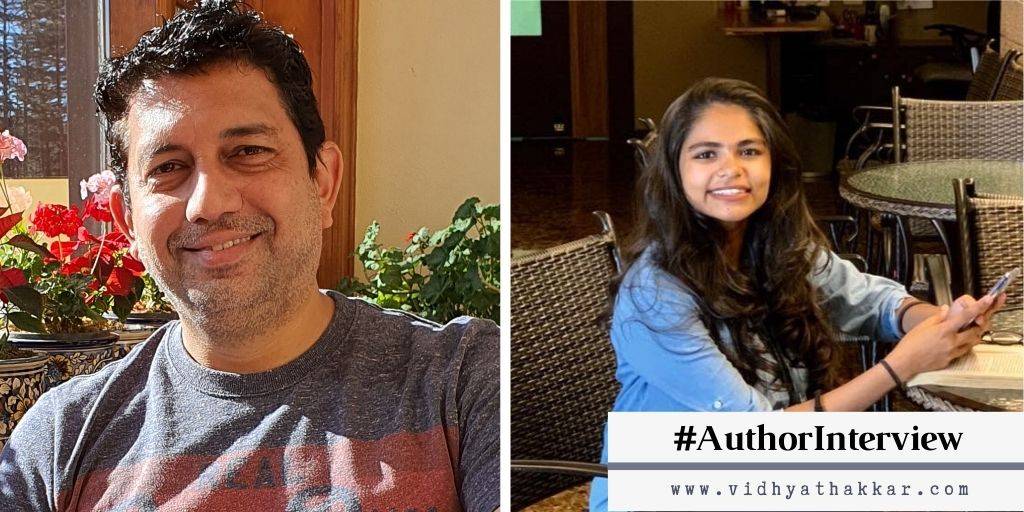
Sameer Sankhe is a leading voice in AI-driven transformation, having spearheaded digital revolutions at major Indian conglomerates and fast-scaling startups. As the serial tech entrepreneur, Chief Digital Officer at Genesys International Corporation, a cutting-edge mapping company—and previously consulting Fortune 100 firms globally—Sameer has witnessed the entire spectrum of success and failure in the digital era. He distils those experiences into actionable frameworks that any hungry business leader can deploy.
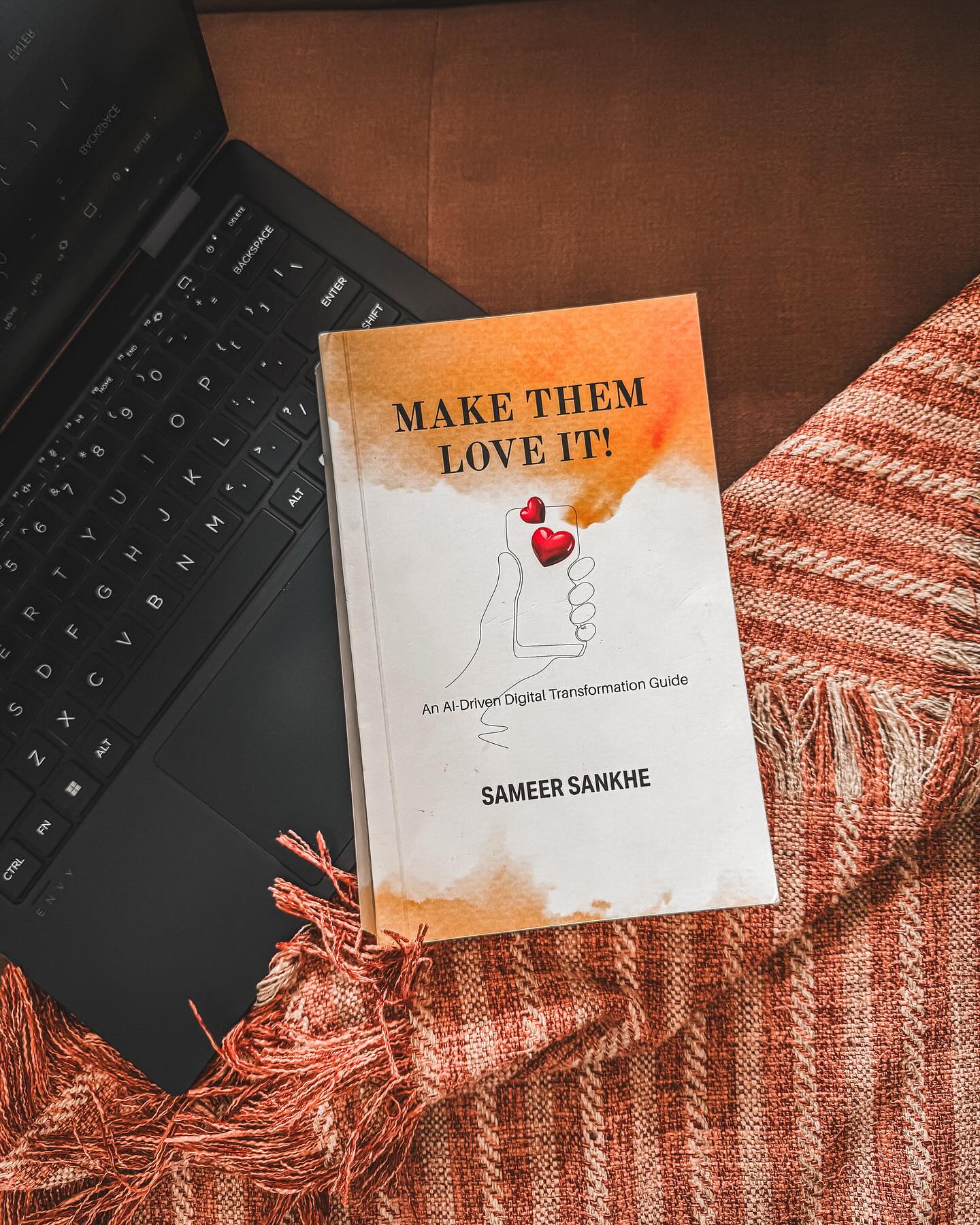
Get your copy here – https://amzn.to/4lTzeqM
Also Read: Book Review: Make Them Love It by Sameer Sankhe – a must-read on AI, innovation, and leadership.
Interview
Q) What made you take the leap from digital transformation leader to author? Was writing always on your mind, or did this book choose you? What inspired you to write Make Them Love It?
I spent 25 years digitising giants—then realised the real revolution begins on a blank page.
I never planned to be an author; I planned to keep building. But as I helped incumbents rewire themselves, I filled dozens of notepads with the same field-tested principles. A visiting CEO glanced at one of those dog-eared notebooks and said, “If you don’t bottle this, we’ll keep leaking value.” That was the nudge. Make Them Love It is the playbook I wished I’d had when I was first asked to “do digital”—a step-by-step guide to creating products and experiences so good your customers become your loudest marketers.
Q) The title is striking—“Make Them Love It.” Who is the “them” in this title, and what exactly should they fall in love with?
“Them” = your customers today and your customers tomorrow.
The title is a dare. Them are the end-users, partners, and even regulators whose enthusiasm can turn a roadmap into a movement. They must “love” not a slogan or an app but the complete digital business you create—its utility, its ethics, its ability to improve their lives. Affection is the ultimate moat; everything else can be copied.
Q) Your book shifts focus from automation to creating entirely new digital businesses. Why is this distinction important right now?
Saving cost is table stakes; inventing value is championship play.
Automation trims fat. Building net-new digital businesses—think ecosystems, data-as-a-service, platform plays—creates fresh revenue and fresh relevance. In an AI-accelerated market, the firms that win aren’t those who run leanest, but those who repeatedly design new value loops before rivals see them coming.
Q) You mention “legacy companies must disrupt themselves.” What’s the first step they should take to do that realistically?
If the mothership can’t turn, launch a speedboat.
Step #1 is to carve out a Day-Zero team: six to eight cross-functional rebels, funded like a VC-backed start-up, mandated to ship a minimum-lovable product within 120 days. Protect them from old KPIs; measure them on learning velocity and early user love.
Q) What are some of the most common myths or misconceptions leaders hold about digital transformation and AI?
Top five false beliefs that keep boards awake—and companies asleep.
1. “Digital = an app.” No—digital is a business model shift.
2. “AI replaces people.” The best AI augments people and raises the talent bar.
3. “Tech first, strategy later.” Technology magnifies either clarity or chaos.
4. “Culture will adapt automatically.” Culture is a backlog item with owners and dates.
5. “Big-bang transformation or nothing.” Momentum compounds; start micro, scale what works.
Q) What advice would you give to middle managers who want to drive change, but feel stuck in rigid structures?
Be the API between vision and reality.
Anchor one visible problem nobody owns, prototype a fix in weeks, and broadcast metrics in the language the C-suite speaks—growth, margin, NPS. Results buy you permission faster than slide decks ever will.
Q) Your journey includes roles in the Tata Group, Salesforce, and co-founding startups. What personal experiences shaped your understanding of transformation?
Tata taught me scale, Salesforce taught me cloud, start-ups taught me fearlessness.
Rolling out digital initiatives across 200,000 people showed me change management grit. At Salesforce, I learned how to win customers for a lifetime and how platforms turn upgrades into mere URLs. As a founder, I learned that cash flow clarity and customer obsession determine survival. These experiences inform every framework in the book.
Q) Who are some thinkers, books, or frameworks that have deeply influenced your own views on innovation and disruption?
Clayton Christensen lit the path; Rita McGrath gave me the map.
• Clayton Christensen’s dilemma theory
• Rita McGrath’s transient advantage
• Jeff Bezos’ “Day 1” mindset
• Wardley Mapping for situational awareness
• Nassim Taleb’s antifragility
Collectively, they remind us that opportunity lives where incumbents feel most comfortable.
Q) How long did it take from idea to finished book? What did your typical writing routine look like, especially while balancing other commitments?
I wrote before the world woke, so the world could wake up differently.
From first outline to final manuscript: three years. Routine: 5 AM to 7 AM drafting, evenings for editing, weekends for research sprints. And holidays for major marathon upgrades. I treated chapters like software sprints—demo-ready every two weeks, feedback loop built in.
Q) How did you decide on the tone of the book—balancing business strategy, tech, storytelling, and practical frameworks?
Story hooks the heart; authenticity and pragmatism guide the hands.
I fused entrepreneur-like ideation/passion, board-level strategy, executive-level execution, frontline anecdotes, and step-by-step canvases so a reader can be inspired on a flight and prototype on Monday. The tone had to be ambitious yet actionable—a mentor, not a lecturer.
Q) What was the hardest chapter or concept to write about—and why?
Boiling decades of messiness into two laws that fit on a coffee mug nearly broke me.
The toughest pages were Chapter 2, “Start with the Customer Experience and Work Backwards,” and Chapter 3, “Make Them Love It!” These chapters are where I convert a career’s worth of war stories into what I call “immutable laws of digital physics.”
• Why so hard? Because principles that claim universality must survive every counter-example. I stress-tested each sentence against a Tata Steel plant, a Salesforce platform play, and a two-person start-up in the same evening.
• My rule: If the idea didn’t help all three, it died.
• The result: A pair of chapters that act like a portable decision engine. Whether you’re a product manager, a CXO, or a solo creator, you can drop your problem into these frameworks and get a way forward—no buzzwords, just cause-and-effect.
Those 40-odd pages went through nine complete rewrites before they rang true, but now they’re the heart of the book—and the part readers dog-ear first.
Q) If you had to leave one idea from this book as your legacy to India Inc., what would it be?
Love is the answer. What’s the question?
Growth, margin, engagement, even ESG scores all trace back to a single root: Do customers love what you create? In early-stage start-ups, this truth is obvious—you live or die by user passion. Yet the larger the enterprise, the easier it is to drown that love in bureaucracy, compliance checklists, and quarterly rituals.
My legacy prescription is radical in its simplicity: institutionalise customer love.
1. Treat affection as a KPI. Track “Would you miss us if we vanished tomorrow?” with the same rigour you track EBITDA.
2. Reward love creators. Bonusing a factory supervisor whose tweak lifts NPS by 12 points signals louder than a town-hall sermon.
3. Design backwards from delight. Every new policy, product, or platform must earn the answer “Yes” to one gating question: Will this make them love it more? 4. Audit love leaks. Quarterly, map every touch-point where enthusiasm slips to indifference; patch ruthlessly.
When affection compounds, so do revenues, referrals, and resilience. Love is not fluffy—it’s the most under-priced asset on the balance sheet.
Build systems that protect, measure, and multiply it, and India Inc. can vault from a cost-arbitrage player to an emotion-powered global icon.
Q) What do you hope readers feel after finishing Make Them Love It, especially leaders and change-makers?
Close the book with restless optimism—and a roadmap to the next Zerodha.
I want readers to slam the covers shut and feel a compulsion to build—whether they sit in a 150-year-old conglomerate, a two-person garage, or a solo creator’s studio apartment.
1. See the Possible: If Zerodha can upend broking and Zepto can shrink delivery time to 10 minutes, what can you do with your data, talent, and grit?
2. Draft the Experiment: Before the adrenaline fades, sketch a 30-day pilot that tests one “immutable law of digital physics” from Chapters 2 & 3.
3. Measure Love, Not Vanity: Track customer delight the way public companies track EPS. Love converts to referrals, revenue, and resilience faster than any spreadsheet forecast.
4. Scale or Scrap Fast: If the pilot lights up users, double the fuel. If it fizzles— salvage the learning, pivot, and go again.
My dream outcome is an India crowded with intrapreneurs and founders who routinely spin billion-dollar value from first-principle love for the customer: the next wave of home-grown icons—born in legacy corridors, co-working hubs, and even living rooms. When the final page turns, may every reader feel a nagging impatience to answer a single question: “Why not us?”
Q) What advice would you give to other professionals who want to write their first book, especially in a niche like AI or transformation?
Write the memo you can’t find on Google.
Niche is fine; noise is everywhere. Gather battle scars, organise them into a toolkit, test it with real users, then write as if mentoring your younger self. Momentum beats muse— schedule protects progress.
Q) And finally, what’s next? More writing, speaking, mentoring… or another bold leap?
This book ships like software. I’ll release fresh, data-backed upgrades. Next, I might launch The Love-It Lab podcast, where real founders bring tough problems and we solve them live, turning each episode into a case study for the next edition. Maybe a 48-hour “builder’s sprints” inside both conglomerates and start-ups will prove the ideas on the ground.
Get your Book Reviewed by Vidhya Thakkar – Connect us Now