
This post contains Amazon affiliate links. If you buy through one, I earn a small commission at no extra cost to you. It never changes what I write about a book.
About The Author
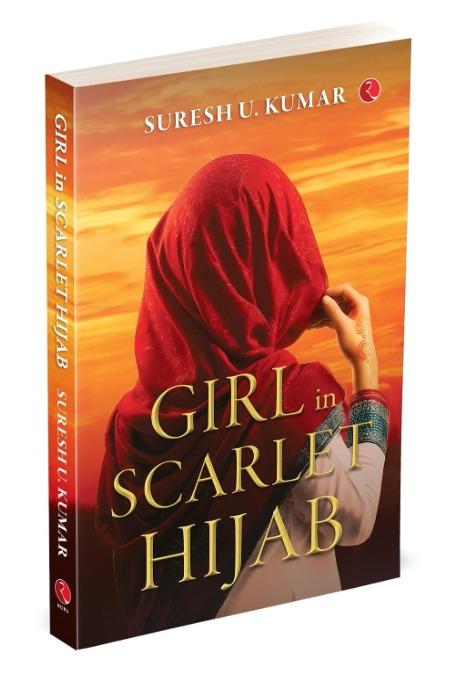
Dr Suresh U. Kumar is an Indian-American author of the highly acclaimed novel Girl in the Scarlet Hijab. He is a 5x Inc500-ranked serial entrepreneur, professor, start-up mentor, and non-profit leader with deep expertise in building resilient global startup ecosystems. Suresh is an avid writer and a winner of the 2022 National Novel Writing Month challenge (USA). He is currently the President of The Indus Entrepreneur-NJ (TiE-NJ) and is working on two books, which are expected to be published in 2024.
Get your copy here – https://amzn.to/452tTYp
Interview
Q) What inspired you to write Girl in Scarlet Hijab? Was there a particular moment or story that sparked the idea?
This is the question I have been asked most often. And there is an interesting story behind the story. On a hot summer day when I was in the eighth grade, I followed my older brother, Sashi Kumar, to serve as a volunteer at a public literary event in Kochi that featured the famous Malayalam writer, Sukumar Azhikode. After the event, my brother and I saw a young girl standing in line to meet the famous writer. She stood out because she was wearing a head covering of some sort, and for her youth, she must have been just a few years older than my brother. For reasons I cannot comprehend or explain, that fuzzy image — an ageing writer at the pinnacle of his fame and a young, unknown female fan hoping to have a word with him— stayed in my mind.
Over the years, I have imagined multiple storylines around these two characters. How did he develop the ability to speak and write with such eloquence? Could he have been a freedom fighter? Maybe a future chief minister of Kerala? Was she just a reader or a die-hard fan? Was she somehow related to him? Maybe a secret admirer? Decades passed with my questions unresolved. I secretly tucked away these little nuggets of creative thoughts in my mind, and whenever time permitted, I revived them and nurtured the storyline. This image of a famous author and a fan is the seed from which my novel, Girl with Scarlet Hijab, emerged. The author and the girl in the hijab are among the important characters. I hope you get a chance to read the book and let me know what you think.
Q) The protagonist remains unnamed and mysterious for much of the book. What was the intention behind that narrative choice?
My story has multiple protagonists. The Girl in the Scarlet Hijab is one of them. To reflect the time of the story, which is the 1980s, Kochi, Kerala, I make the choice not to make her a superwoman, but a nervous teenage student who is first introduced as an outsider in the college. She is caught up with the events around her and slowly takes an increasingly involved role that brings her to the forefront of the students’ movement. She becomes a student leader and then, towards the end, a revolutionary. So it is a gradual evolution of a revolutionary due to the circumstances.
Q) How did you research the political and historical context of Kerala in that era? Were there any challenges in blending fiction with fact?
Though this plot is fictional, I have strived to remain true to the major real-world events of that time. Key historical events woven into my story include Mahatma Gandhi’s visit to Vaikom, Kerala, in 1925, Jayaprakash Narayan’s escape from Hazaribagh Jail in 1942, the establishment of the Azad Dasta, the mutiny of the Royal India Navy in 1946 and the fall of the Nayanar government in 1981. Some incidents and dialogues I imagined for this story are inspired by quotes from books, movies and plays I encountered growing up. Fans of the Kerala People’s Arts Club (KPAC) will recognize the incident where Baby asks her son Shibu to hand her the flag to challenge the police, as being inspired by the popular 1950s’ Malayalam drama Ningalenne Communistakki (‘You Made Me a Communist’), which I first watched as a young boy growing up in Cochin in the 1970s. The scene where Shibu taunts the police officer with the line ‘Want this flag? Come get it’ was inspired by Steven Pressfield’s spectacular reimagination of the battle of Thermopylae (Gates of Fire, 1998). These, mixed with personal reflections, brought my characters to life and, in turn, resurrected my spirits and recharged my creative zeal.
For information on historical events, politics, culture and freedom fighters of India, I relied on various sources ranging from the treasure trove of Amar Chitra Katha’s comic collections to online news articles, Government of India websites and Wikipedia reports. Additionally, I referenced works of esteemed Indian historians such as Dr Bimal Prasad and Sujata Prasad, Professor A. Sreedhara Menon, Mr Sukumar Azhikode and Professor K.N. Panikkar, who have diligently chronicled the activities of leaders and events that have shaped modern India.
Q) How did you go about shaping the youth leaders and their individual ideologies? Were any characters inspired by real people?
It was not hard as I was deeply involved with student politics in Kerala in the 1980s’. Also, the characters were inspired by real people I know, including my own brothers (Shibu and Sashi) and my parents (Commander Velayudhan and Baby)
Q) There’s a strong undertone of gender, faith, and power in the protagonist’s journey. What message did you hope readers would take away from her arc?
The protagonist arc is a reflection of the struggles that many Indian women I know have gone through in their lives. I just raised the bar higher by making Ruksanar a young Muslim girl who moves from the Gulf to Kerala and has to find her way in a male-dominated society. Then I add the politics, crime and romance into the mix. So her journey is a tough one, which is what makes the story interesting. However, I must add that in Kerala in the 1980s, women had equal status as men, and it was common to see girls wear a Hijab in school and colleges. At another level, for me, this novel is a labour of love—love for the land of my birth, India, her brave sons and daughters, and the incredible diversity that makes her the nation she is today. I hope to have captured but a tiny fraction of that uniqueness.
Q) How do you view the role of student protests then and now? Do you see parallels between the 1980s setting and the world today?
In the 1970s and 80’s, India went through a social and political transformation due to the National Emergency. This was also reflected in the student movements. I am not sure if students today are prepared to make similar sacrifices, but I remain hopeful.
Q) How long did it take you to write the book, from the first draft to publication? Did you face any writer’s block during the process? If so, how did you overcome it?
It was in the summer of 2022 that I embarked on the exciting journey of putting pencil to paper (yes, I hand-wrote the first and second drafts). It took me over two and a half years of writing, revising, editing, embellishing and rewriting to get this story where it is today. What started as a hobby soon became an obsession. I wrote late into the night after my family went to bed. Into the wee hours of the morning, my thoughts would often drift to the conversations I had with my father long back—his experience as a young sailor hired to support the war efforts of the British Indian Navy, working on the deck of the ships docked at Bombay Harbour and dreaming of serving a free nation. These stories, along with the countless conversations with my grandfather, mother and brothers about politics, freedom fighters and heroism, became central to my novel.
Q) The title itself is striking—why “Scarlet” and why a “Hijab”? What layers of meaning did you want the reader to explore with it?
I wanted to push the boundaries of who we accept as friends or insiders- that is why I made the decision to have a girl with a hijab, and the colour scarlet gives it added resonance and deeper meaning. As I have explained in the author’s note, the seed of this idea for the hijab was planted on a hot summer day when I was in the eighth grade. I followed my older brother, Sashi Kumar, to a literary event in Kochi, featuring the renowned Malayalam writer Sukumar Azhikode. After the event, we noticed a young girl standing in line to meet the writer. Her head covering and focused demeanour left a lasting impression on me. For reasons I cannot comprehend or explain, that fuzzy image—an ageing writer at the pinnacle of his fame and a young female fan hoping to have a word with him—persisted in my mind. Over the years, I imagined countless stories around these two characters.
Q) The mystery surrounding the protagonist adds suspense and symbolism. Was she always written this way in the first draft?
No, her role was a limited one when I started the book; Karnan was the main protagonist. However, as I wrote her role grew and evolved organically until she became the most important character.
Q) What kind of impact do you hope this book has, especially on young readers or students?
My goal with this book is to bring to light the unknown heroes of India’s freedom struggle and tell their stories in a way that compels readers, especially the younger ones, to ask: Did such events really happen? Did people like these walk this earth? I hope some readers will dig deeper and realise, as I did, that history is often as much about what is unsaid as what is recorded—and sometimes, facts can be stranger than fiction.
Q) If your book were to be adapted into a film or series, who would you love to see play the Girl in Scarlet Hijab?
This is a very interesting question. When I was writing this story, I pictured several women actresses playing the lead role. Among them are Malayalam actress Parvathy, Hindi actress Yami Gautam. I must add that, as this is a sweeping saga, I would love to have someone like Mani Ratnam direct it. But there are so many talented directors in India who can make my story come alive on the screen.
Q) What books or authors have influenced you the most as a writer? And are there any books you return to again and again as a reader?
Throughout the writing process, I sought inspiration from authors whose work I admire, including President Barack Obama, Senator John McCain, Alex Haley, Delia Owens, Amish Tripathi, Arundhati Roy, M.T. Vasudevan Nair, K.R. Meera, Thakazhi S. Pillai, Dr Shashi Tharoor, Dr Abraham Verghese, Jhumpa Lahiri, Chitra Banerjee Divakaruni, Khaled Hosseini to mane a few. While they are in a league of their own, I carry a quiet hope that their writing magic may somehow rub off on me.
Q) What are you working on next? Can readers expect a sequel or something entirely new?
I have multiple book projects planned- both fiction and non-fiction, including a prequel to this book about the Mutiny of the Royal Indian Navy of 1946
Q) What advice would you give to someone wanting to write political fiction or debut their first novel later in life?
Take your time. Writing fiction is like fine wine- it gets better with age & time. Use feedback and reflection to enhance your story. So do not rush it. The world can wait.
Q) Tell us about the choice of the setting of the story- Kerala and the city of Kochi- that you have described in rich detail.
The physical setting of my story—the South Indian State of Kerala—has been popularised by well-known English writers such as Shashi Tharoor, Dr Abraham Verghese, and, of course, Arundhati Roy. My story is not just set in Kerala; it is dedicated to the beautiful city of Kochi, a place so unique and charming that ancient mariners referred to her as the ‘Queen of the Arabian Sea’.
How am I connected to the city, and how did it impact my story? I was born in Kochi—then called Cochin—and went to school and college there. I worked there until I was 28, when I came to New York on a job transfer. Kochi is one of my favourite places on earth for multiple reasons: her natural beauty with backwaters, tall coconut palms, the cultural richness and the diversity of her people — to name a few. Growing up in a middle-class Hindu family with limited means, I got to walk all over the city, so I know the city like the back of my hand. Even after migrating to the US, the city and the people of Kochi have drawn me back almost every year. For all the reasons listed above, I absolutely loved creating this story against the backdrop of Kochi.
Q) Lastly, what does the scarlet hijab mean to you today, beyond the pages of your novel?
If your question is about the book (and not the Hijab), it is very special for me. As I explain in the author’s note, this novel will forever remain close to my heart—not only because it is my first book but also because it explores the qualities of the human heart that I most admire: courage, love and sacrifice. Written during a time when I faced the first major health crisis of my life, which coincidentally was related to my heart, this book became an extremely personal journey. The experience of unearthing my past to write this story helped me rediscover myself, realign my priorities and reconnect with my roots.
Another reason this book is so special is that many of the characters are inspired by people dear to me. They include my parents, Baby and Velayudhan; my grandparents, Kalyani and Kandappi; my brothers, Sashi and Shibu; my sister, Shashikala; my uncle, Sivadas; and my aunts, Joy, Chandrika and Geetha. Had they been confronted by the fictional events I have imagined for this story, I have no doubt that their actions would have been along the lines I have depicted. I also loved setting this story against the backdrop of one of my favourite places on earth—the city of Kochi (formerly Cochin), Kerala, India—a place so unique that ancient mariners referred to it as the ‘Queen of the Arabian Sea’.
Get your Book Reviewed by Vidhya Thakkar – Connect us Now