
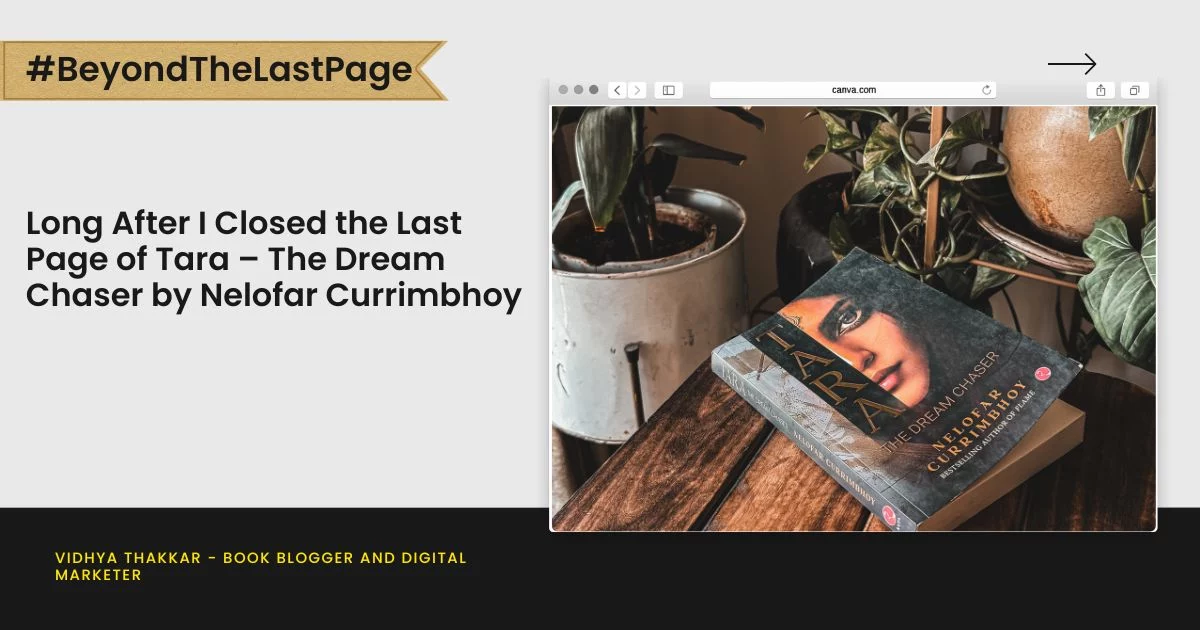
“Sometimes, walking back is the toughest part of life — but tonight, she had to.”
Long after I closed the last page of Tara – The Dream Chaser, I kept thinking about Tara. Not because she is a princess or because her story is filled with drama and unexpected turns, but because she feels like every person who has ever stood at the crossroads of duty and desire, fear and freedom.
At its heart, this is a story about leaving behind what no longer serves us and finding the courage to create a life of our own. At first glance, Tara has everything one could dream of — royalty, privilege, and a life many would envy. Yet, beneath the grandeur of Jaivangarh lies loneliness, emotional neglect, and a life shaped by decisions made for her. She grows up in a world where appearances matter more than feelings and expectations weigh more than dreams. Her escape to Mumbai is not simply an act of rebellion; it is an act of survival. Tara’s journey from the palaces of Jaivangarh to the chaos and comfort of Mumbai is not merely a change of place; it is a journey towards herself.
Even when she leaves Jaivangarh behind, Tara never truly leaves her people behind. Beneath all the glamour, romance, and reinvention lies a woman who carries a deep sense of responsibility. Some of her most difficult choices come from wanting to protect, give back, and become worthy of the place she once fled. That conflict between personal freedom and responsibility makes her journey even more compelling. Nelofar’s writing has a certain warmth and ease to it. She balances drama with introspection, grandeur with intimacy, and allows emotions to unfold naturally. The narrative feels cinematic in its settings yet deeply personal in its quieter moments, making it easy to become emotionally invested in Tara’s world and the people who inhabit it.
What stayed with me was the idea of a gilded prison and the way Nelofar Currimbhoy balances grandeur with intimacy. How beautifully Nelofar Currimbhoy captures this transformation — Tara’s journey from a woman trapped in a gilded cage to someone determined to create a world of her own. Her choices are messy, painful, and uncertain, but they are also brave. She doesn’t emerge as a fearless heroine overnight. She stumbles, questions herself, makes difficult choices, and learns that freedom often comes with its own price. Tara is surrounded by privilege and grandeur, yet she is starved of tenderness, understanding, and the freedom to make her own choices. Her escape to Mumbai feels less like rebellion and more like an act of self-preservation. Sometimes, walking away is not about giving up on a place; it’s about refusing to give up on yourself. The story carries the weight of secrets, politics, and betrayal, yet it never loses sight of its emotional core.
And then there is Kabir. In a story filled with power, politics, and emotional upheaval, he feels like a quiet pause. As a photographer, he sees people for who they are, and perhaps that is why he becomes so important to Tara. He sees beyond the armour she has carefully built around herself. Their relationship is not just romantic; it is healing. Their conversations, silences, and quiet acts of understanding reminded me that sometimes love arrives not to rescue us, but to help us recognise ourselves again.
Vivan Mehta, on the other hand, brings an entirely different energy to the narrative. He represents glamour, temptation, and possibility. His presence complicates Tara’s journey because he forces her to confront questions about desire, identity, and what she truly wants from life. Together, Kabir and Vivan become more than love interests; they become mirrors reflecting different versions of the life Tara could choose.
Even the supporting characters linger in memory. Tara’s mother and the royal family are not merely people in her life; they represent the expectations, tradition, control, burdens, obligations, and emotional complexities that come with lineage and legacy. They become reminders of how love can sometimes be replaced by expectations and how difficult it is to walk away from a world that has defined you for so long. I also found myself thinking about Divya. Amidst all the grandeur, romance, and reinvention, her friendship with Tara feels like a breath of fresh air. She reminds us that while love may help us rediscover ourselves, friendship often gives us the courage to keep going. There is something deeply comforting about her presence – the kind that makes you realise how profoundly our lives are shaped by the people who stand beside us when everything else feels uncertain. Through Divya, the novel gently suggests that sometimes friendships become the family we choose for ourselves.
What moved me most was that, despite everything, Tara never stops being the Princess of Jaivangarh. She redefines what being a princess means — not privilege or power, but responsibility, resilience, and the courage to stand up for both herself and her people. What I loved most about the novel was its emotional layering. It moves effortlessly between Jaivangarh and Mumbai, between the weight of the past and the possibilities of the present. It is cinematic in its setting and intimate in its emotions. Beneath the drama, the politics, and the romance lies a quieter story — one about reclaiming agency, finding your voice, and choosing yourself despite everything that tells you not to.
Through Tara and Kabir’s heartfelt conversations, moments of vulnerability, and quiet acts of love, the book reminds us that healing often begins when someone sees us as we are and still chooses to stay. The alternating timelines, the vivid contrast between royalty and reality, and the emotionally layered characters make the narrative immersive and cinematic. Yet, beyond all its drama, this book asks a simple question: What does it take to choose yourself?
Perhaps that is why Tara’s story stayed with me. Long after the plot points fade and the dramatic moments settle, what remains is a feeling — the memory of a woman choosing herself despite fear, the comfort of finding people who truly see her, and the hope that it is never too late to begin again. In many ways, Tara’s journey stops being just her story and quietly becomes ours too. It reminded me that chasing dreams isn’t always about ambition or success. Sometimes, it is about rebuilding, reclaiming your voice, and creating a world where your heart finally feels at home. Sometimes, it is about having the courage to choose yourself while still honouring where you came from and the person you hope to become.
And even now, I find myself returning to one line from the book:
“You won’t find a new world; you have to create one.”