
This post contains Amazon affiliate links. If you buy through one, I earn a small commission at no extra cost to you. It never changes what I write about a book.
Authors: K.C. Tata
Summary
If you love Dan Brown–style thrillers, ancient mysteries, or tantric thrillers, this one’s a must-read. It’s thought-provoking, cinematic, and deeply engaging. A Day of Brahma is not just a book; it’s an experience that makes you question the very fabric of time, belief, and existence.
Review
“Now… a thousand Yuga cycles make a Kalpa — a single day of Brahma. At the end of every Kalpa, dissolution occurs in the form of Pralaya. That’s the law.”
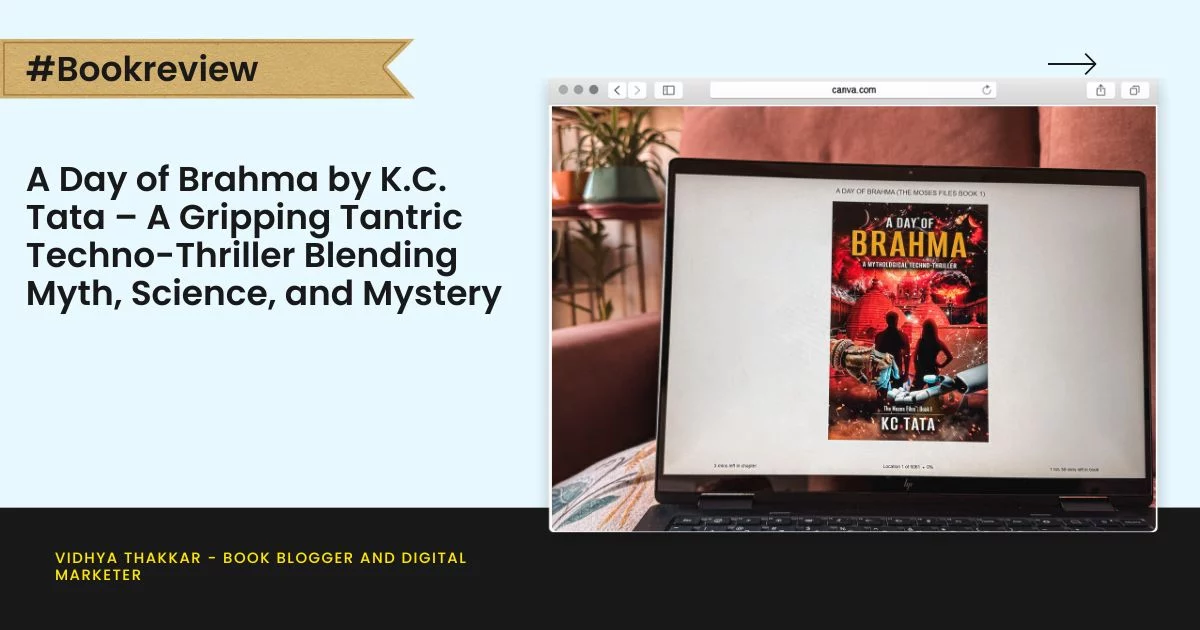
What if ancient scriptures weren’t just mythology but coded truths about our present and future? That’s the thought that A Day of Brahma by K.C. Tata leaves you with. It’s been a long time since I read a tantric techno-thriller that kept me glued from the very first page. This book is an adrenaline rush—an immersive, cinematic experience that blends mythology, science, and spirituality with pulse-pounding suspense.
The story follows Moses Raju, an investigator known for his sharp intellect and unconventional approach, and Nitya Iyer, a journalist whose curiosity draws her into a web of secrets. The two are called to India when the nation goes on high alert after a series of mysterious events and deaths. Unexplained natural phenomena, coded ancient symbols, and hidden temples become part of a puzzle that points toward something catastrophic—a force that could bring about Pralaya, the dissolution of the world. With time running out, Moses must decode the clues before the final destruction begins. But every answer opens another door, leading to deeper mysteries involving secret organisations, political conspiracies, ancient rituals, and scientific experiments that blur the line between divinity and destruction.
K.C. Tata weaves a multi-layered narrative that feels both ancient and modern. He reimagines mythology through the lens of quantum science, spirituality, and power politics. The story travels through India, Nepal, Tibet, and Myanmar, taking readers into sacred sites, research labs, monasteries, and secret chambers that hide world-altering truths. The writing style is crisp yet descriptive; you can almost feel the energy of every place Moses and Nitya visit. The narrative moves swiftly across multiple locations and perspectives, yet it all connects seamlessly. The book is fast-paced, cinematic, and deeply thought-provoking. What I liked most was the investigation Moses carries out and the way he connects every clue. Each revelation adds a new layer of thrill and mystery. The way he pieces together every fragment—trusting his instincts while balancing logic and faith is truly exciting to read. Every discovery feels earned, keeping the tension high and the story’s momentum alive right till the end.
Moses stands out as a protagonist who’s not only intelligent but spiritually aware. His calm, composed demeanor amidst chaos makes him both relatable and inspiring. Nitya, on the other hand, is the bridge between the ordinary and the extraordinary, curious, grounded, and emotionally strong. Their chemistry is subtle yet beautiful, blooming amidst the tension. Other characters, too, from government officials to monks to mysterious scientists, play vital roles in building tension and adding philosophical depth.
At its heart, A Day of Brahma isn’t just about saving the world; it’s about understanding the cycle of creation and dissolution, and recognising that we cannot bend or force the laws of nature. It reminds us that the victory of truth over evil is inevitable, that the bad must be destroyed or delayed for the greater good, for balance to be restored. It touches upon themes like the power of faith and knowledge, the price of ambition and loyalty, the intersection of technology and ancient wisdom, and the eternal question — are we creators or destroyers? Why do we constantly seek control, trying to prove ourselves as the higher power, when in truth, we exist in service of something greater?
The politics and the power struggles in the book are something you can truly feel. The budding tensions between people, the hidden motives, and the way power is used or misused create ripples that affect the world and its people. While some destroy in the name of control, others rise to save what’s left. This contrast between destruction and preservation makes the story even more gripping and realistic, reminding us how easily balance can shift when power comes into play. What I loved most was how the author made complex concepts from Hindu cosmology—like Tantric Hinduism, Kundalini Yoga to attain Siddhis, the Kapalikas and their ways, and much more—feel relevant in today’s context. It’s rare to see mythology and science blend so naturally. The way Moses explains each concept is commendable and leaves you wanting to learn more. Each twist kept me guessing, and the final act delivered a spectacular climax that tied the spiritual and scientific threads beautifully. It’s a fast-paced, layered, and visionary story that challenges you to think, question, and believe.
The climax is powerful and satisfying, as all the pieces of the puzzle finally come together with precision and purpose. I already cannot wait for Part Two of the book—as the ending hints that there’s much more to come, leaving me curious and eager to see what happens next.
If you love Dan Brown–style thrillers, ancient mysteries, or tantric thrillers, this one’s a must-read. It’s thought-provoking, cinematic, and deeply engaging. A Day of Brahma is not just a book; it’s an experience that makes you question the very fabric of time, belief, and existence.
Get your Book Reviewed by Vidhya Thakkar – Connect us Now