This post contains Amazon affiliate links. If you buy through one, I earn a small commission at no extra cost to you. It never changes what I write about a book.
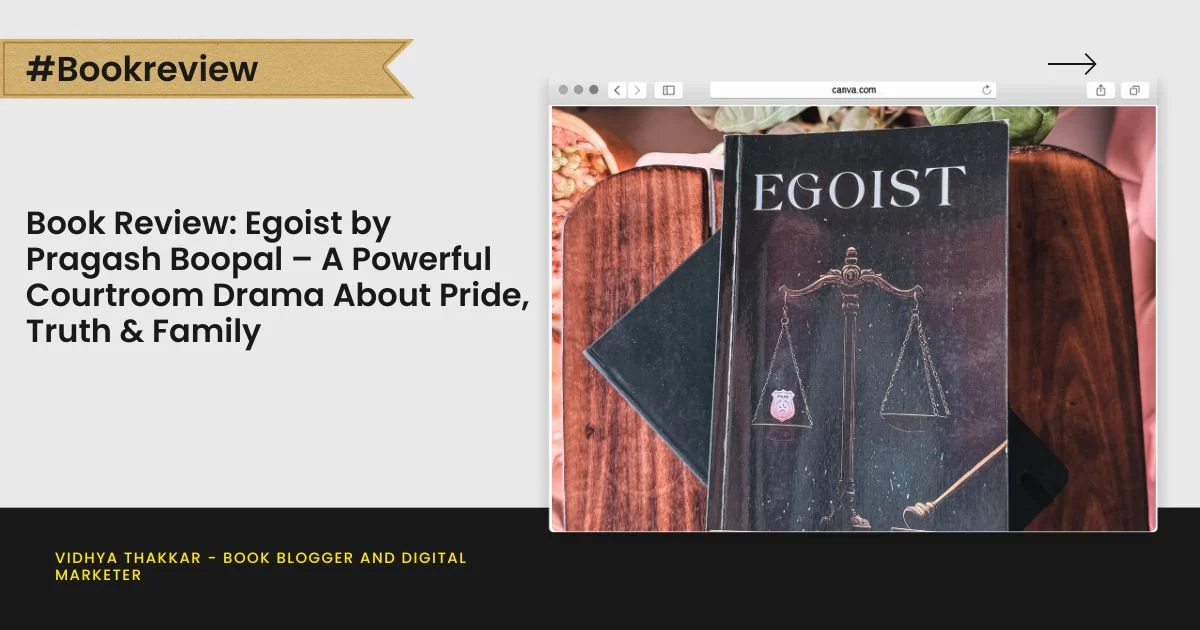
Author: Pragash Boopal
Publisher: BlueroseOne Stories
Summary
Egoist is a compelling blend of courtroom drama, family conflict, emotional growth, and moral introspection that successfully balances legal intrigue with emotional depth. With its strong character arcs, engaging legal battles, emotional family moments, and thought-provoking themes, it offers much more than a simple story of rivalry.
Review
“You are your enemy.”
There is something undeniably fascinating about courtroom dramas – the arguments, the evidence, the pursuit of justice, and the constant battle between truth and perception. I have always enjoyed stories that revolve around legal battles and investigations, where every argument matters and every decision carries consequences, creating a tension that keeps readers questioning every move. As someone who enjoys stories set in courtrooms, Egoist by Pragash Boopal arrived at the perfect time, and it turned out to be an engaging read that not only delivers compelling courtroom drama but also explores the emotional cost of pride and ambition.
At its core, Egoist is the story of two determined and highly accomplished men—Kalyan, a well-known advocate, and Rudran, a newly appointed Assistant Police Commissioner. A seemingly small incident sparks a conflict between them, setting the stage for an intense rivalry that gradually escalates into a full-fledged battle of egos. What begins as a professional disagreement soon transforms into a deeply personal war, placing them on opposite sides of the courtroom and forcing them to question their own beliefs, priorities, and sense of justice.
The title Egoist perfectly encapsulates the novel’s central conflict. While the courtroom battles drive the narrative forward, the real struggle lies within Kalyan and Rudran themselves. Their greatest opponent is neither the law nor each other, but the pride that clouds their judgment and distances them from the people who matter most. This internal conflict ultimately becomes the novel’s most compelling battle.
As the story unfolds, readers are taken through a series of courtroom confrontations, legal cases, and personal struggles that shape the course of their lives. While Kalyan and Rudran throw themselves into their professional duties with unwavering dedication, their obsession with winning gradually begins to affect everything around them. Their personal lives start to crumble, and in their relentless pursuit of victory, they lose sight of what truly matters—their families, relationships, and emotional well-being. In this clash of pride and ambition, the greatest casualties are not merely the men themselves but also the people they love and, at times, even the truth they claim to defend.
One of the things I appreciated about the novel is how Pragash Boopal takes time to establish both protagonists and their worlds. The book begins at a relatively slow pace, but those early chapters help us understand Kalyan and Rudran as individuals—their personalities, values, professional approaches, and family dynamics. As the story progresses, the narrative becomes increasingly engaging, drawing readers deeper into the conflict and its consequences.
The writing style is crisp, descriptive, and easy to follow. One of the book’s strengths lies in its detailed portrayal of the legal and law-enforcement worlds. Through Kalyan and Rudran, the author takes readers into the lives of both a police officer and an advocate, highlighting the immense responsibilities and pressures that come with their professions. The authenticity with which these professions are portrayed adds credibility to the narrative while also shedding light on the challenges of balancing duty with personal commitments.
The courtroom scenes are undoubtedly among the strongest aspects of the novel. The legal battles, arguments, and ethical dilemmas surrounding justice, truth, power, and professional integrity add depth to the narrative and keep the story moving forward. The novel offers an interesting look at how far people can go when they become consumed by the need to prove themselves right. As the rivalry intensifies, readers are left questioning where justice ends and ego begins.
In doing so, Pragash Boopal transforms a legal conflict into a broader reflection on human nature, ambition, and accountability. What makes the conflict particularly compelling is that the novel constantly blurs the line between seeking justice and seeking victory. As readers, we are left wondering whether the pursuit of truth still remains the ultimate goal when personal pride enters the equation.
However, while the legal details contribute authenticity to the narrative, there are moments when excessive case-related information slows the pace, particularly when readers are eager to see how the central conflict unfolds. A tighter narrative in certain sections would have strengthened the momentum. That said, the slower portions are rewarded by a satisfying payoff as the story gradually pieces together its larger emotional and thematic puzzle.
What truly elevates Egoist is its character development. Both Kalyan and Rudran are portrayed with remarkable depth, allowing readers to understand not only their strengths but also their flaws and vulnerabilities. As their lives spiral under the weight of their own decisions, it becomes difficult not to sympathize with either of them. Among all the characters, Parvathy and Lakshmi stood out the most for me. They are strong, resilient women who refuse to remain silent spectators in the lives of the men around them. Rather than simply accepting the consequences of Kalyan’s and Rudran’s actions, they challenge them, question them, and ultimately play a crucial role in helping them recognize their mistakes. They are not merely supporting characters; they become the emotional anchors of the narrative.
One of the most touching aspects of the book was Lakshmi’s relationship with her children. I particularly loved how she helped them understand the importance and value of a homemaker. Through her character, Pragash Boopal beautifully highlights the countless sacrifices, responsibilities, and emotional labour that often go unnoticed within a family. More importantly, these moments serve as a powerful reminder that the work done within a home deserves the same respect and recognition as any profession outside it. Those scenes felt genuine, heartfelt, and emotionally impactful, making them some of the most memorable moments in the novel. They add warmth and emotional resonance to a story otherwise driven by legal conflicts and professional rivalries.
Beyond the courtroom drama, Egoist is also a story about family, relationships, and self-discovery. The novel explores the loneliness that can accompany responsibility and ambition, especially when work begins to overshadow personal life and loved ones. It reminds us that success achieved at the cost of meaningful relationships is often an incomplete victory. A house becomes a home because of the people who fill it with love, warmth, understanding, and support.
The story also beautifully portrays various family relationships—from the bond between parents and children to the dynamics between husbands and wives. Through moments of conflict, misunderstanding, and reconciliation, the novel emphasizes that lasting change begins when we choose to transform ourselves rather than trying to change the people around us.
What makes the emotional arc particularly effective is that it emerges naturally from the character’s choices. The consequences they face never feel forced; rather, they become a reflection of the decisions they make throughout the story, making their eventual realizations feel earned and believable. What I also appreciated was that despite standing against each other, both Kalyan and Rudran possess their own sense of ethics and justice. Rather than presenting a clear hero and villain, the novel allows readers to understand the motivations, flaws, and convictions of both men. This moral complexity makes the conflict feel nuanced, realistic, and far more engaging.
The climax is particularly satisfying. The final chapters bring together the various threads of the story and reveal how all the pieces fit into place. Watching the characters confront the consequences of their choices and grow from them provides an emotionally rewarding conclusion.
In all, Egoist is a compelling blend of courtroom drama, family conflict, emotional growth, and moral introspection that successfully balances legal intrigue with emotional depth. With its strong character arcs, engaging legal battles, emotional family moments, and thought-provoking themes, it offers much more than a simple story of rivalry.
More than a courtroom drama, it is a story about the consequences of allowing ambition to overshadow relationships and the courage required to acknowledge one’s mistakes. At its heart, Egoist is a study of how unchecked pride can quietly erode relationships, distort priorities, and make even successful individuals lose sight of what truly matters. It is a reminder that unchecked pride can become one’s greatest enemy and that true victory often lies not in defeating others but in overcoming oneself. Sometimes the toughest battle is not against an opponent standing across the courtroom, but against the ego within ourselves.
For readers who enjoy courtroom dramas layered with emotional depth, family dynamics, and thoughtful reflections on pride, accountability, and personal growth, Egoist offers an engaging and meaningful reading experience.
Get your Book Reviewed by Vidhya Thakkar – Connect us Now