This post contains Amazon affiliate links. If you buy through one, I earn a small commission at no extra cost to you. It never changes what I write about a book.
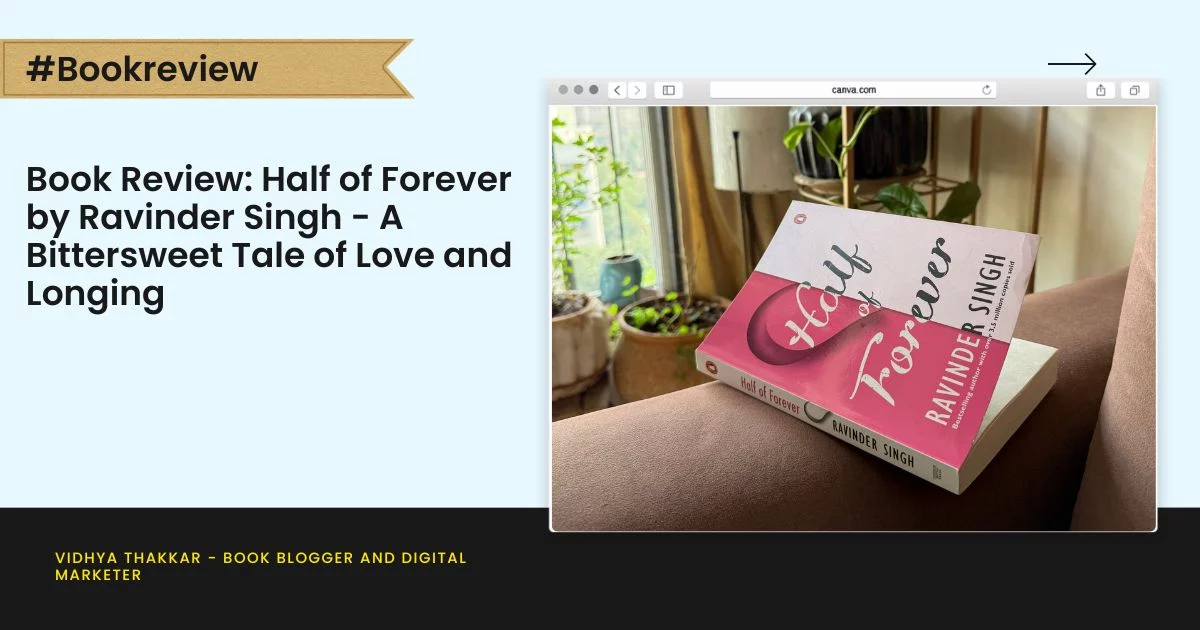
Author: Ravinder Singh
Publisher: Penguin India
Summary
Half of Forever by Ravinder Singh is a light yet emotionally engaging read. It captures the joy of liking someone, the nervous excitement of first conversations, the ache of unspoken feelings, and the bittersweet truth that sometimes love exists beautifully, even if only halfway.
Review
“In that moment of staggering joy, you are left in awe, uncertain of what comes next, but deeply aware that you have just crossed into a new chapter.”
There are books that sits beside you like nostalgia, taking you down memory lane and reminding you of old-school love, where handwritten notes mattered, where a simple glance could make your entire day, and where telling your friends you liked someone felt like revealing the biggest secret of your life. This Valentine’s Day, I finished reading this beautiful story, and it felt like revisiting that innocent, fragile phase of first love. For me, Ravinder Singh has always been special. I began my reading journey with his earlier books, and his writing has consistently felt simple, heartfelt, and deeply emotional. Half of Forever is the third part of his Love Trilogy, following I Too Had a Love Story and Can Love Happen Twice?, and it carries forward the same vulnerability that made his earlier works memorable.
Also Read: Book Review: The Babel Murders by Abhishek Roy – A Thriller About Language, Ideology, and Power
The plot unfolds gently, almost like a memory resurfacing after years. The story revolves around Ravin, who falls for Heer the very first time he sees her. There’s curiosity that refuses to rest- the curiosity to know her name, the impatience to find out everything about her. He doesn’t miss a single opportunity to see her, speak to her, or simply be around her. The story moves through stolen conversations, growing fondness, and that beautiful nervous excitement that comes with liking someone for the first time.
But while Ravin is certain about his feelings, Heer is fighting her own battles. If she confesses, what will truly change? Is there ev en a future waiting for them? He loves her. She loves him. Yet they cannot be together. Why? Because sometimes love is not just about two people. It carries the weight of families, expectations, and society. That silent tension- loving deeply yet not being free to choose each other becomes the emotional backbone of the story. It is this conflict between desire and duty that gives the narrative its quiet ache.
The narrative flows beautifully, filled with drama, chaotic emotions, realizations, and tiny moments that feel deeply personal, much like Ravinder Singh’s signature style. The emotions unfold naturally and honestly. Themes of longing, love, friendship, and societal pressure run consistently through the story. It shows how love can make us forget everything else, bring back childish excitement, and make our hearts race faster than our thoughts can process. It also reminds us that sometimes love is not defeated by lack of feeling, but by circumstances. And that realization lingers long after the last page.
While their conversations feel mature and meaningful, it is the lightness of their budding friendship that makes the relationship special. We see strangers becoming friends and slowly falling in love, reminding us of the famous dialogue from Kuch Kuch Hota Hai, “Pyaar dosti hai.” There is a subtle Bollywood charm in the way their bond grows, filled with warmth, hesitation, and unspoken understanding. The playful banter among friends, their contrasting opinions, and their quiet understanding of one another are beautifully captured, adding warmth and authenticity to the story.
The events unfold steadily, allowing us to witness not just what happens, but how it feels when it happens. The pacing is balanced, light in the beginning and gradually layered with emotional intensity. What makes the story relatable is how easily you see yourself in Ravin and Heer. In their hesitations, their conversations, and their decisions. How sometimes love strengthens us and sometimes it quietly tears us apart. The tone of the novel remains soft and reflective, even when it touches upon conflict. Even at its most dramatic, the story never loses its emotional sincerity.
The characters feel relatable and well-developed. Ravin is vulnerable, emotional, and hopeful, someone whose world slowly begins to revolve around Heer. Heer, on the other hand, is loving and full of dreams, yet burdened with responsibilities and internal conflicts. While Ravin’s love for her grows every day, it is their friendship that becomes her safe space. But the lingering question remains how long can love survive if it is forced to stay only half-lived?
One character I truly loved was Prakhar. We all need that one wise friend, the one who pulls us back when we are about to crash into a stone we can clearly see but choose to ignore. The one who warns us, stands by us, and stays when we fall. That is what Prakhar is to Ravin.
“We need wise friends in our lives to remind us of what we already know but have temporarily forgotten. Because when hearts race, minds freeze.”
The story begins softly, builds gradually, and then the climax surprises you. Just when you think you know where it is heading, the narrative shifts, bringing in unexpected drama and emotional intensity. The final stretch feels cinematic, filled with longing, separation, and realizations that linger even after the last page is turned.
In the end, Half of Forever by Ravinder Singh is a light yet emotionally engaging read. It captures the joy of liking someone, the nervous excitement of first conversations, the ache of unspoken feelings, and the bittersweet truth that sometimes love exists beautifully, even if only halfway.
It reminds us that “forever” is not always measured in time, sometimes, even half of it is enough to change us completely.
Get your Book Reviewed by Vidhya Thakkar – Connect us Now