This post contains Amazon affiliate links. If you buy through one, I earn a small commission at no extra cost to you. It never changes what I write about a book.
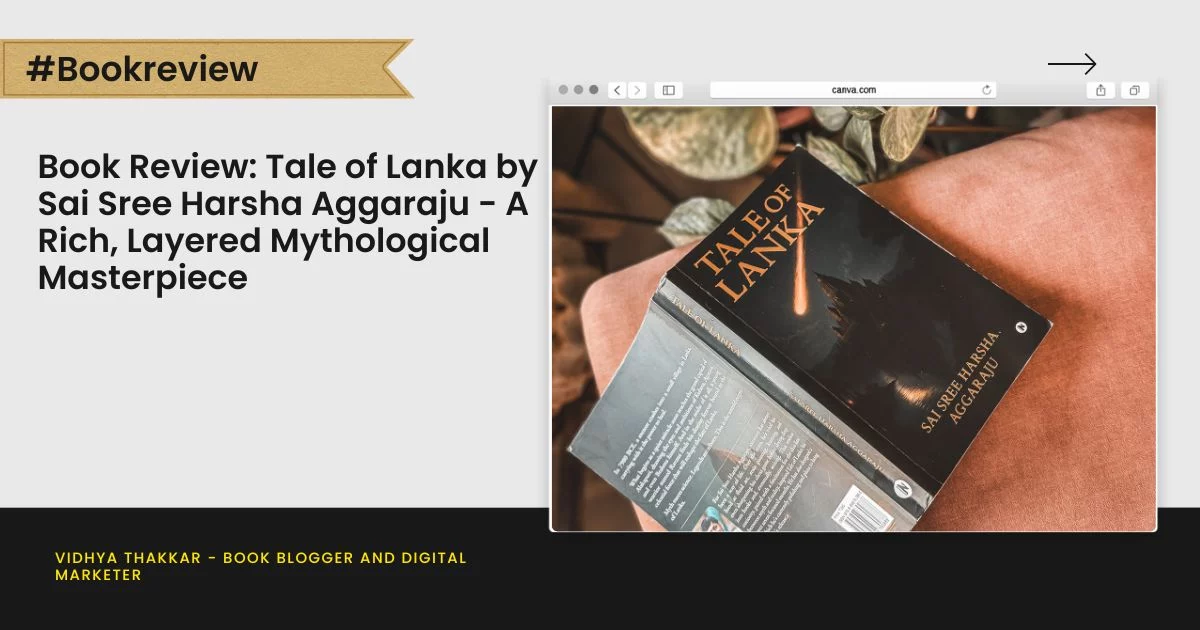
Author: Sai Sree Harsha Aggaraju
Publisher: Notion Press
Summary
This is a tale you absolutely must read. The celestial force at the heart of the story was set to reshape Lanka’s destiny. Tale of Lanka is a brilliantly imagined, deeply emotional mythological fiction that stands out for its layered storytelling. With its exquisite blend of science, mythology, politics, and human emotions, it becomes a thought-provoking masterpiece filled with curiosity, mystery, and depth.
Review
“Let your loyalty not be swayed by old prejudices, but by the will of the throne and the well-being of our people.” For now, Lanka stood upon a knife’s edge- its balance fragile, its future uncertain and in the silence that followed, doubt still lingered.
With this powerful line, Tale of Lanka opens its gates into a world standing on the edge of destiny, fragile, uncertain, and filled with questions that echo through time. We often associate Lanka with Ravana, but Sai Sree Harsha Aggaraju rewinds history to show us a lesser-known truth: before it was Ravana’s Lanka, it was Kubera’s Lanka. Kubera nurtured the kingdom, and Ravana, the disciple of Brahma, was once its prince, still learning the ways of the world.
The story takes us back to 7980 BCE, when a meteor crashes into a small village in Lanka. This celestial stone carries miraculous healing properties. Though Lanka is wealthy, it lacks medical knowledge, making the meteor’s arrival nothing short of divine intervention. The news reaches King Kubera in Alkapuri, accompanied by Agastya, a fellow disciple of Brahma. Curious, brilliant, and determined to understand this celestial stone, Agastya’s arrival marks the moment when myth meets science, and the research that follows sets the foundation for an extraordinary tale.
Also Read: Book Review: Too Good To Be True by Prajakta Kohli – A Sweet, Refreshing Romance.
The themes are rich and layered: research, love, brotherhood, relationships, responsibility, science, and mythology. While the villagers respect the meteor as a gift of God and ask the king not conduct research, Agastya is driven by pure curiosity, his need to understand the meteor’s life, its healing powers, and the strange, almost mystical experiences surrounding it. Those scenes remind us that some things in this universe are truly beyond human perception.When Agastya decides to research the celestial stone, realizes he cannot do it alone and asks Kubera to call Brahma, because only Kubera can. This moment opens a rare window into Brahma’s kingdom, its aura, its structure, and the family dynamics that silently influence both Ravana and Kubera. This layer adds cosmic richness to the narrative and deepens our understanding of their lineage.
What I enjoyed the most about Tale of Lanka is how the author doesn’t just retell a familiar story, he rebuilds the world around it with refreshing layers, perspectives, and emotional depth. This is not just Ravana’s tale; it is a tapestry of destinies, relationships, and choices that shape Lanka itself. The plot is truly exciting, unfolding with such sharp curiosity that it constantly leaves the reader asking questions. We see King Kubera as a ruler deeply loved by his people, and right from the beginning, the events raise questions about the kingdom, the king, and the changing tides within Lanka. Sai Sree reveals every layer with a crisp, descriptive narrative and immersive writing style. Tale of Lanka is a masterpiece filled with mysteries, emotions, and revelations.
What stands out beautifully is how love often takes second place because, in Lanka, duty always comes first. While Agastya and Brahma conduct their experiments on the meteor, Kubera battles his own emotional dilemmas in the kingdom. When Ravana returns, he is confronted with past mistakes, the love he still holds for his brother, and the memories of the time they once shared. Sai Sree balances these contrasting perspectives, kingdom and village, science and myth, past and present so well that readers feel connected to both worlds.
What I loved most is how the author brings out Kubera’s personality. We rarely see him in such depth in mythological fiction. We’ve always known him as the God of Wealth, but here we see the king, the leader, the elder brother, rooted in purpose. He comes across as balanced, wise, and wholeheartedly devoted to the welfare of his people. The way he presents Ravana as the Prince of Lanka showcases his strategic mind and emotional intelligence. The way he wins over his people, fulfills his duties, maintains harmony, and upholds the integrity of the kingdom makes him one of the most standout characters in the book. This portrayal gives Kubera a presence we rarely see in mainstream mythological retellings.
Meanwhile, Ravana returns home after years away. His reunion with Kubera, filled with warmth, regret, and unresolved tension, brings an emotional layer to the story. Ravana wishes to join the research, but Kubera urges him to first shoulder the responsibilities of the kingdom. Yet destiny has other plans: when Brahma himself summons Ravana to the meteor site, everything begins to shift. From here onward, the story becomes even richer. As experiments unfold at the meteor site, political shifts, emotional tensions, and power dynamics reshape both the village and the kingdom. Sai Sree masterfully balances these dual narratives, offering equal weight to each perspective.
As the narrative grows deeper, political shifts, emotional tensions, and power dynamics continue to reshape both the village and the kingdom. Sai Sree crafts these scenes with precision, giving equal weight to the grand decisions of kings and the intimate fears of ordinary villagers. The book beautifully intertwines themes of research, relationships, loyalty, curiosity, mythology, science, and human nature. While villagers fear losing the meteor, Agastya remains determined to uncover its healing properties and the truths that lie beyond human perception. Sai Sree’s writing is crisp, descriptive, and immersive. The tone stays serious yet thrilling. Lighter moments, especially the interactions between Agastya and Brahma, bring balance while making the science behind their experiments genuinely fascinating.
What makes Tale of Lanka truly immersive is the writing, especially the conversations. The dialogues between brothers, master and disciple, commanders, ministers, and friends paint a vivid picture of how a kingdom truly functions. Through these interactions, the author portrays the intricate machinery of a kingdom, its rules, its vulnerabilities, and its unspoken truths. The internal functioning of the kingdom is portrayed so realistically that it feels grounded and authentic.
Ravana’s character arc is one of the strongest elements. We always see him as the fierce ruler of Lanka or as the one who abducted Sita, but here, we see an entirely different Ravana. A disciplined learner, a seeker of truth, a mind hungry to understand the meteor’s mysteries. Shaped by rejection, loneliness, and a painful past, glimpses of his childhood, isolation, and the hatred he endured reveal the formation of the Ravana he eventually became. These layers add immense depth to his character.
The climax is gripping and unforgettable, especially Ravana’s conversation with a mysterious shadow. It adds emotional weight, a touch of darkness, and a hint of the future to come. It is one of the most powerful scenes in the book and leaves you eager for the next part. This is a tale you absolutely must read. The celestial force at the heart of the story was set to reshape Lanka’s destiny. Tale of Lanka is a brilliantly imagined, deeply emotional mythological fiction that stands out for its layered storytelling. With its exquisite blend of science, mythology, politics, and human emotions, it becomes a thought-provoking masterpiece filled with curiosity, mystery, and depth.
A must-read for anyone who loves epics that explore not just legends but the hearts of the people who shaped them.
Get your Book Reviewed by Vidhya Thakkar – Connect us Now