This post contains Amazon affiliate links. If you buy through one, I earn a small commission at no extra cost to you. It never changes what I write about a book.
About The Author
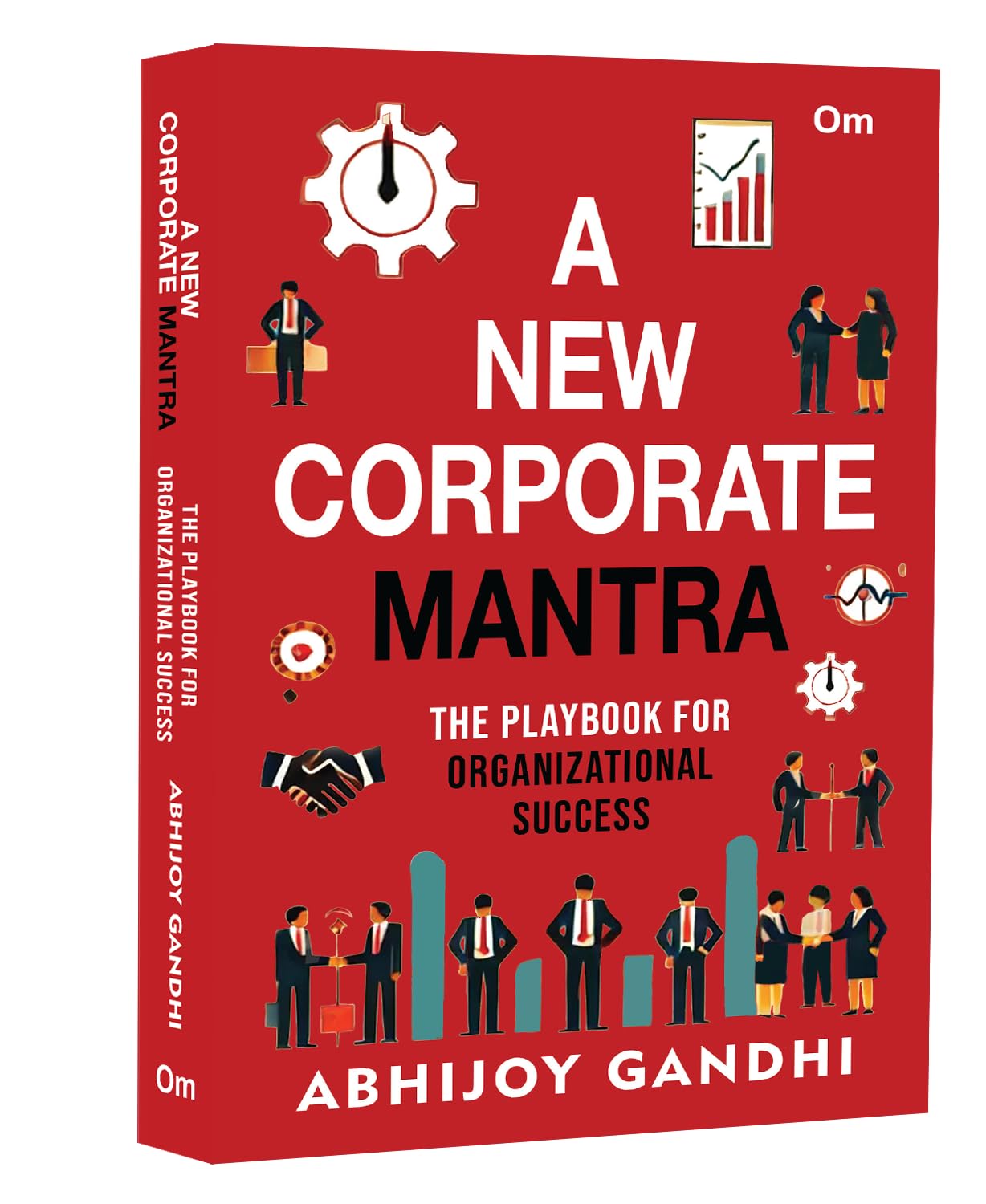
ABHIJOY ‘AJ’ GANDHI is a wellness-obsessed operator, strategist and investor with a passion for driving innovation and growth at the nexus of technology and business services, through leveraging expertise in mergers and acquisitions, business development, and technology.
AJ is CEO of Glue Inc, a Greylock Partners-funded, Seattle-based start-up on the journey to building the largest AI-wellness platform on Earth. AJ’s Ultimate Goal is to create a universal gateway to wellness at work.
AJ started out as a McKinsey strategy consultant and held finance and investment CXO leadership roles at Lehman Brothers, Wells Fargo, and SunTrust Banks. He earned an MBA in Finance from the Wharton School, University of Pennsylvania, where he was a Joseph Wharton Scholar. Known digitally as AJTRON, AJ is a recognized thought leader in corporate wellness and health tech AI.
Get your copy here – https://amzn.to/4qFSh9D
Also Read: Book Review: A New Corporate Mantra by Abhijoy Gandhi for Millennials & Gen Z Professionals
Interview
Q) What inspired you to write A New Corporate? Was there a personal moment or
observation that made you realize the modern workplace needed this kind of guide?
Absolutely. It goes back to the time when I was managing the strategy group for what was then the largest bank in the world. Our leadership observed that young professionals were very different from previous generations of corporate workers. They decided to place all the young trainees recruited from colleges into my strategy group for three months. That was when I was first exposed to Gen Z, and I quickly realized they approached work very differently. One of the reasons for this three-month acculturation period was that earlier batches had been struggling.
It became clear to me that they had a very different worldview. These were young professionals with enormous potential, yet they were underperforming, not because they lacked talent, but because they struggled to interpret and navigate the realities of corporate America at the time. No one had decoded for them the emotional, political, and psychological architecture of the corporate world. That was precisely why they were brought into my group.
That experience planted the seeds for this book. They were eager to succeed and relied heavily on their technical skills, but what they lacked was the right mental operating model—something the acculturation process was designed to provide.
Q) In your journey across corporate spaces, what’s the most surprising lesson about
people and leadership you discovered?
This is a very straightforward observation on my part: throughout the school system, the focus is almost entirely on hard skills—on competence, as it is often called. But that is rarely the main driver of success. Across different facets of life, we see that the person with the highest IQ or the most prestigious education is seldom the leader. That’s because corporations are run by humans, not by technical skills.
And humans are driven by emotion, security, ego, and everything else that comes with being human. To me, the most surprising insight is that the loudest person rarely holds the real power. It is the person who understands people, who grasps the underlying dynamics, and who can orchestrate strong outcomes for organizations and teams who ultimately wields influence.
That is the individual who can read a room, decode personalities, and interpret unspoken signals faster than most. That, essentially, is the key takeaway—and what I seek to reinforce throughout the book.
Q) You talk about balancing ambition with wellness. For young professionals starting out, how do you suggest they stay motivated without burning out?
I believe this is one of the defining challenges of our time. Young people today are deeply ambitious, and every generation seeks to differentiate itself in some way. What remains constant, however, is the underlying energy architecture—the secret fuel, the rocket fuel behind sustained success.
People often frame this in terms of time management or skills development, and those factors certainly matter. But especially for Gen Z, my key advice is to pace ambition so that it becomes sustainable rather than sacrificial. When I was growing up, how much sleep I sacrificed and how much personal time I gave up for work were seen as major differentiators.
That era has changed. Gen Z neither needs to adhere to that model nor, frankly, has the inclination to. They have grown up in a world of abundance and choice. The focus now should be on distinguishing between costly time and costless time. For example, if they have five or six unstructured hours on a Saturday, that could be invested in self-development or meaningful contributions to work.
At the same time, if it is six in the evening and they are with their partner, they should be able to check out fully, spend quality time, and perhaps plug back in later if needed. This is a rhythm they naturally gravitate toward, and leaders and organizations must learn to support it. Burnout is no longer a badge of honor.
As I emphasize in the book, burnout is simply a tax on future potential. Sustainability and wellness are now foundational elements of a long and successful career.
Q) The book emphasizes navigating corporate politics authentically. Can you share a story from your career that shaped this perspective?
Yes. Actually, there are 50 anecdotes, a lot of what I emphasize is authenticity, documentation, thoughtfulness, being able to read underlying drivers, being able to understand and steer motivation, all while being authentic. At no point are we promoting politics for the sake of politics, but we are also saying very categorically that politics and political savvy is an integral part of human development, and they need to very quickly come to that realization themselves.
So good work needs air cover, good work needs allies, and good work needs strategic positioning. And in some circles that is called political, but for Gen Zs, especially as they enter a very complex and changing ecosystem, they need to be very conscious of that. So authenticity is what allows them to work with the politics without losing themselves, without losing their inherent belief in who they are. And that is part of what I emphasize in terms of how to navigate the landscape while keeping true to themselves.
Q) In today’s ever-evolving workplaces, what do you see as the biggest mistake professionals make early in their careers?
Many young professionals assume that skills and effort alone drive success, and that the workplace is purely meritocratic, much like grading in a university course or a calculus exam. I wish it were that simple.
It isn’t.
One of the biggest lessons is challenging the belief that everyone shares the same intentions, that effort is always visible, that managers automatically notice good work, and that feedback will naturally be positive if one simply checks the boxes. Unfortunately, in corporate America, and in most structured corporate environments, nothing simply happens.
One must advocate, align, signal, and strategize. Otherwise, it is very easy to fall through the cracks. This is something Gen Z will need to understand quickly. Many of them are the product of helicopter parenting, having been shielded in various ways from the harsher realities of professional life. The workplace, however, operates on a different set of rules—rules that must be consciously learned and navigated.
Q) You write about aligning personal purpose with organizational goals. How can someone figure out what “purposeful work” really means for them?
At a fundamental psychological and philosophical level, purpose is not something that is found; it is constructed, through reflection, self-analysis, and the elimination of what does not resonate with the self.
For each individual, that construction will naturally lead to a different answer. The key questions young professionals should ask themselves are simple yet profound: What energizes me? What problems do I feel personally responsible, driven, attracted, or compelled to solve? And what strengths do I possess that create disproportionate value or advantage?
Once these questions are thoughtfully answered, it becomes much easier to define one’s purpose, whether within an organisational framework, a team, or a specific project. And once that clarity is achieved, most people tend to perform exceptionally well.
Q) Leadership is a recurring theme in your book. From your experience, what differentiates a good leader from a great one in today’s corporate environment?
The answer to this question has evolved over the years, and my response is very specific to the world Gen Z is now entering.
When it comes to Gen Z, good leaders manage tasks, but great leaders manage energy, clarity, and emotion. We often see that leaders who are able to meet Gen Z at their level, speak their language, and accept their worldview tend to be highly successful. In contrast, those who attempt to replicate the environment in which they themselves began their careers are often less effective. This is why there is so much discussion about Gen Z being entitled, lazy, or lacking resilience.
Much of that perception stems from evaluating them against standards that are no longer relevant.
Today’s workplace requires leaders who can stabilise uncertainty, create psychological safety, crucially, protect bandwidth, inspire disciplined execution, and amplify the intelligence of Gen Z. Their intelligence may not always present itself in overt ways, as it did with Gen Xers or early millennials. It is often more subtle, but it must be recognised and amplified.
The traditional command-and-control model, where the boss directs and the subordinate complies, simply does not work for Gen Z. We are now in the era of empathetic intelligence. Unlocking that intelligence requires a partnership between employer and employee.
Q) If a reader could implement just one key principle from your book this month, what would it be?
Today, five years from now, and at any point in one’s career, the answer remains the same: learn to read the room beyond the obvious. It is the foundational corporate skill that compounds everything else.
The book is entirely focused on understanding the different personalities within a work environment, who drains energy, who amplifies it, who sabotages, what their motivations might be, who distracts despite being pleasant and engaging, and who truly elevates performance.
Once young professionals learn to navigate the workplace through this lens, they tend to feel more energized and experience greater job satisfaction. More often than not, they also progress faster than peers who have not invested in understanding this landscape.
Q)The book features insights from over 50 leaders. Was there a particular story or lesson that stayed with you personally while writing it?
I’m reminded of a CEO who once told me, “Your career is shaped less by your decisions and more by who you allow into your psychological space.” That stayed with me. It stayed with me for a long time.
In many ways, the essence of the book is about bringing that insight to life through multiple characters. My favorite section of the book, and I’ve mentioned this in many media interviews, is the final part on the “clock burners,” the senior professionals in the swan song of their careers.
I share a couple of anecdotes there, one about a German titan and another about a wealth management banker. Both were well past their prime. Technology had reshaped their industries, and they were struggling, even though they had once been extraordinarily successful during their heyday.
I was in my early to mid-20s at the time, and I learned a great deal from them. I did not judge them by the standards of the rapidly changing world around us. Instead, I tried to understand their leadership experiences during their peak years. I still feel very warmly toward them. I often encourage young professionals to seek out those who are on their way out of an organization and ask about their experiences when they were at their prime.
Technology will continue to evolve, but human insight and wisdom tend to endure. That kind of wisdom cannot be taught; it must be experienced through authentic, mutually rewarding relationships. Success, therefore, is not just about doing the right things. It is also about learning to glean what the ecosystem around you has to offer.
Q) The corporate world is changing fast. How do you envision workplaces evolving in the next 5–10 years, and what skills or mindsets will be essential?
These are themes I work very closely with, especially given my experience in the startup environment. First, AI will absorb low-cognition work. There is a promise that menial tasks, grunt work, and anything that can be systematized or solved through algorithms will become the domain of AI, freeing humans to focus on creative and strategic work.
Second, wellness, whether in India, the US, Europe, or elsewhere—will shift from being a perk offered by some organizations to a core part of organisational infrastructure. Companies will realize that burnout is not just a human resources issue but a P&L issue, and wellness will be baked directly into the operating model.
Third, hybrid and multi-generational teams will demand new communication fluency. Navigating a mix of in-person conversations, Zoom calls, and phone discussions will become a critical skill. The most valuable employees will be those who can engage seamlessly across different mediums, an emerging competitive advantage.
Ultimately, the future belongs to professionals who can think clearly, regulate their energy (something I emphasise repeatedly), and collaborate effectively across complexity, all while being attuned to the subtle dynamics that truly make teams and organisations thrive.
Q) Finally, what’s one piece of advice you would give to someone who feels lost or stuck in their corporate journey right now?
For starters, I would tell young professionals: you are not the problem. The system is increasingly complex and confusing. All the negative publicity about Gen Z can be misleading, and it’s important to shield them from that, they are not the problem. They are simply stepping into an environment shaped by privilege, technology, and geopolitics, which has become highly complex. Most of us can navigate it because we have 15, 20, or 30 years of experience to contextualise it. They are just walking in.
The second piece of advice is: shrink the problem. I urge young professionals to stop thinking in terms of the next promotion, the next decade, or where they want to be in 30 years. Instead, think in terms of 30- and 90-day plans or project-based goals. Focus on what you can do to be distinctive in the next three months within this role or project. Stack those short-term wins over time, and before long, you’ll achieve significant success. Thinking in smaller, achievable time blocks is crucial.
Third, I encourage them to ask: what is the smallest action I can take this week to create momentum, clarity, or energy? I often call this the “Monday morning test”. Reflect over the weekend: based on what happened last week, what would I do differently to create impact on Monday morning? Starting each week with this focused perspective can be transformative.
The corporate world rewards motion, not perfection or erudition. Small wins shift identity, and identity shifts drive breakthroughs. Learning to operate in that swim lane is essential for every young professional.
This is the spirit of a new corporate mantra, painting 50 different scenarios through different characters to show that impact is possible no matter the challenge. In conclusion, clarity, confidence, and a clear way forward, even when one feels young, inexperienced, or ill-equipped, are at the heart of this almanac, this book, this best friend, embodying a new corporate mantra.
Get your Book Reviewed by Vidhya Thakkar – Connect us Now