This post contains Amazon affiliate links. If you buy through one, I earn a small commission at no extra cost to you. It never changes what I write about a book.
About The Author
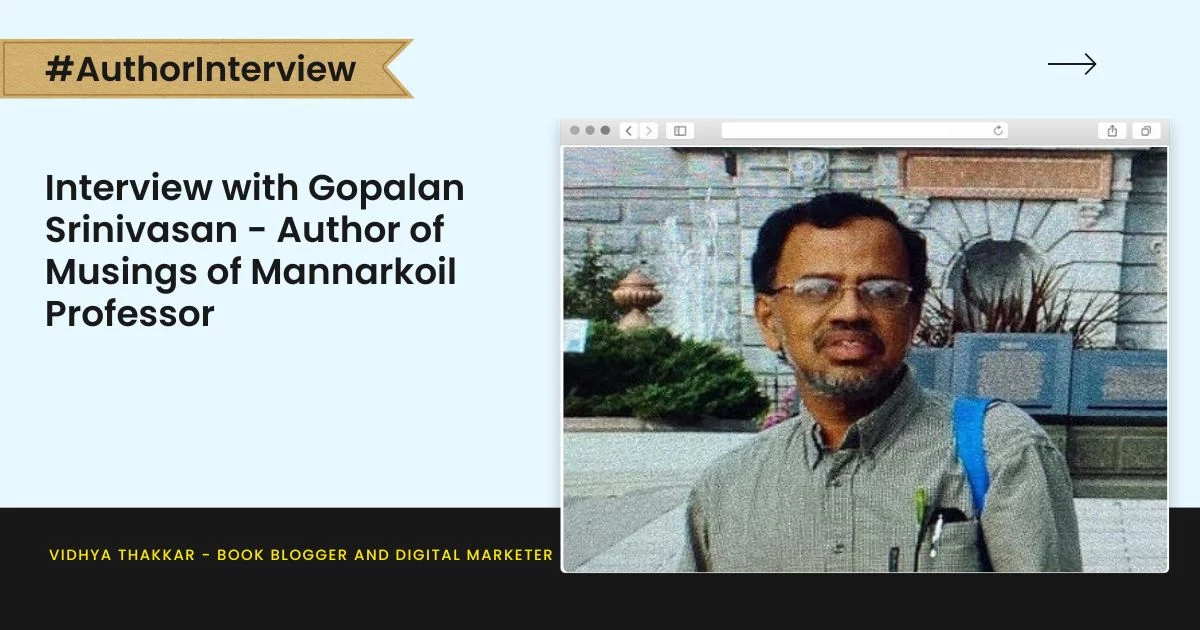
I was born in Mannarkoil village in Tirunelveli district of Tamil Nadu, India. After completing my early education at St. Xavier’s High School and College in Tirunelveli, I worked with the Union Bank of India for a few years. Resigning from the bank, I joined the doctoral programme at the Indian Institute of Management Ahmedabad (IIMA). I worked at IIMA for a few years before moving to Canada. In Canada, I joined the University of New Brunswick (UNB)Fredericton Business Faculty, where I served for over three decades as a Professor of Finance. Currently, I am leading a retired life in Mississauga, Ontario, with my wife and life partner, Kalyani.
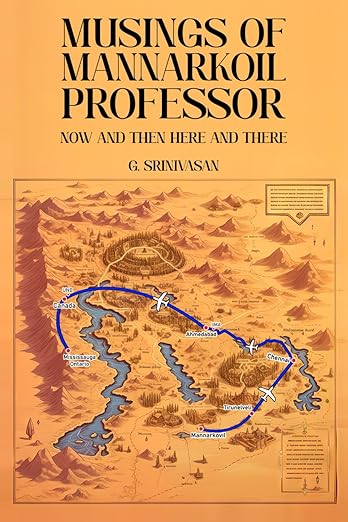
Recently, Literary Titan has chosen me as an award-winning author for my book Musings of Mannarkoil Professor
Get your copy here – https://amzn.to/4oDHlso
Interview
Q) Your book beautifully captures the essence of a bygone era. What inspired you to pen down these memories now? Was there a particular moment or memory that nudged you to start writing Musings of Mannarkoil Professor?
I have been circulating individual episodes among family members and close friends. They appreciated the narrative style and encouraged me to bring it to a larger audience. It was my Professor Dr. Shreekant Sambarani, who planted the idea of making the collections into a book.
Q) Many of your anecdotes carry both humour and heart. How did you strike that balance between lighthearted storytelling and deeper reflection?
Humour runs in our family. All my brothers are humorous in the sense that even snide remarks are delivered with a humorous phrase and a smiling face. I was also influenced by R.K. Narayan’s writing and R.K. Laxman’s cartoons.
Q) The chapter about receiving your first pen from your father is deeply emotional. What did that pen symbolise for you then — and what does it mean to you now, looking back?
My father had a beautiful pen with his name inscribed. I admired the way he used to hold the pen and write with his index finger up and trembling. More than the first pen, the one I got from him happened to be the last pen that I was to get from him made it very emotional.
Q) In the book, you’ve written about your journey from a small village in Tamil Nadu to life abroad in Canada. How did that transition shape your sense of identity and belonging?
I was never ashamed of my identity, and I never considered ignorance as a sin, so long as one is willing to learn. That made the transition less painful.
Q) The tone of your stories feels authentic and unhurried — almost like listening to someone narrate memories over tea. Was this storytelling style intentional, or did it evolve naturally from your lived experiences?
I do not know how much of it is natural and how much evolved out of necessity. When one struggles to find a precise word, one manages by describing, and that is endearing. I remember when I did not know the Hindi word for a young plan,t पौधा, I told my gardener पेड़ ka pachcha and he laughed and laughed. That was a validation for my humorous narration.
Q) Among all the anecdotes you shared, which one was the hardest to write — either emotionally or because of how vivid it still feels?
I would say the episode on Sir, Are you illiterate? It was one of the tough ones to pen. I would not say it was hard in terms of writing, but the regret I carried haunts me even today. When the old lady gave a blow to my ego with a simple question, rather than taking it in its stride and trying to help her by co-opting others nearby, I ran away ashamed. It was almost like running away from the scene of the accident rather than trying to help the victim. The episode was filled with deep reflection than humour.
Q) The relationship you describe with your family, especially your siblings and daughter, is filled with warmth. How did your family respond when they read these reflections?
We re-lived. My brothers, especially my immediate brother Rengan, supplemented with more details in our exchanges that enriched the write-ups. My wife and daughter, apart from being sharp critics, learned a lot about my childhood days, and that has become part of our conversations.
Q) You often highlight small, everyday details — like your fascination with pencils or simple village rituals — that make the book so relatable. What do you think these ‘small moments’ teach us about life and happiness?
Small moments give us real, rich and long-lasting pleasant memories. Reading the pencil episode in a blog, one of my classmates who holds a very senior position in the World Bank sent a picture of Nataraj Pencil that she had got at a conference and had kept intact out of sheer nostalgia. The pencil is asking us to be bold. That is the attitude I carry in narrating my genuine feelings, even if it may appear insignificant in the larger scheme of things.
Q) If you could go back and relive one day from your Mannarkoil days, which day would it be and why?
It is hard to pick, but if I have to, I would like to be the little kid who enjoyed shooting rockets with immature coconuts, kurumbai in Tamil. The sheer fun without knowing the science behind it and the impish pleasure when it rattles the passerby are priceless.
Q) You write about different phases of life — student days, early career, family life. Which phase do you think shaped you the most as a person?
Every experience adds to the personality, and in a sense, I am still evolving. But I would say my childhood days growing up in a joint family and four years of dormitory life in D-16 of IIMA have had a significant influence in shaping me as a person.
Q) Many readers have said your stories feel like conversations. How do you feel knowing that readers connect to your words in such a personal way?
I am elated, not because they connect to me in a personal way, but because they are relating to their own memories and enjoying.
Q) The book moves between India and Canada — two very different worlds. How did you ensure the emotional thread remained seamless across geographies?
I did not labour to make it that way. It is the nature of the topics, such as haircuts, going back to school or learning to ride a bicycle are common across geographies.
Q) What was your writing process like? Did you revisit old letters, journals, or simply rely on memory to bring these stories to life?
It was entirely from my memory, authenticated by family members, colleagues and friends.
Q) If you could give one piece of advice to young readers or writers who wish to document their own stories, what would it be?
To readers: learn to laugh. not at, but with others and learn to laugh at yourself.To writers:. Be true to yourself. No one’s experience is insignificant
Q) Do you think nostalgia writing has a role in today’s fast-paced world, where everything is digital and fleeting?
I think nostalgia writing will always have a role. What may be changing is the time frame at which things move from nostalgia, to ancient, to arcane. Writing about a QWERT keyboard in a BlackBerry phone may be nostalgic now, and moving to ancient soon.
Q) Finally, what message or feeling would you like readers to carry with them after finishing Musings of Mannarkoil Professor?
My message is the following. If reading the book worked as a catalyst for you to reflect on your own joyful memories, I am thrilled. Cherish and share those memories.
Get your Book Reviewed by Vidhya Thakkar – Connect us Now