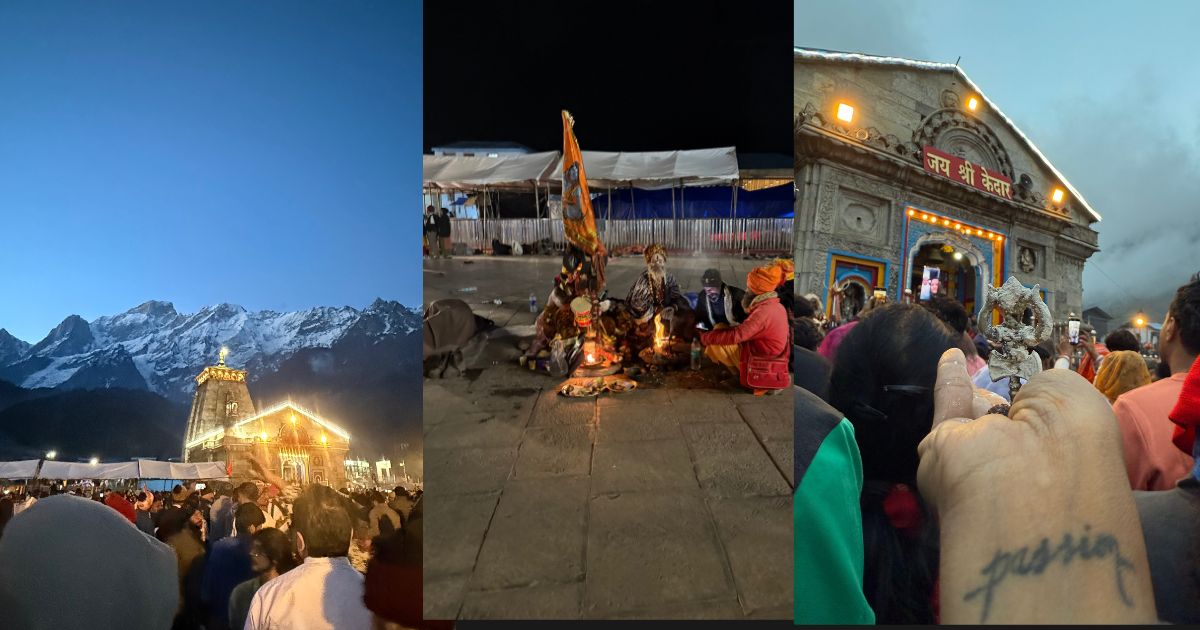

Day Three of our Char Dham Yatra — Vardaan Dham, the land of divine blessings. As we began our journey to Baba Kedar, little did we know that this wasn’t just another destination. This was an inner calling. A soul’s yearning answered. I had no idea that what awaited me was not just a temple or a darshan, but a meeting with the divine. A calling that whispered through the wind, through each breath we took, as the mountains welcomed us with open arms.
From the very beginning, things unfolded so effortlessly. Things fell into place as if the universe conspired for us to be there — a direct landing at Kedarnath, a rare blessing — and the weather was just perfect. No mist, no snowstorm. Just a clear sky and a calm heart. It felt like Mahadev himself had set everything in motion. You don’t just reach Kedarnath; you are called. And when you’re called, no force can stop you. It means Baba wants to see you. It felt like Baba himself was waiting.
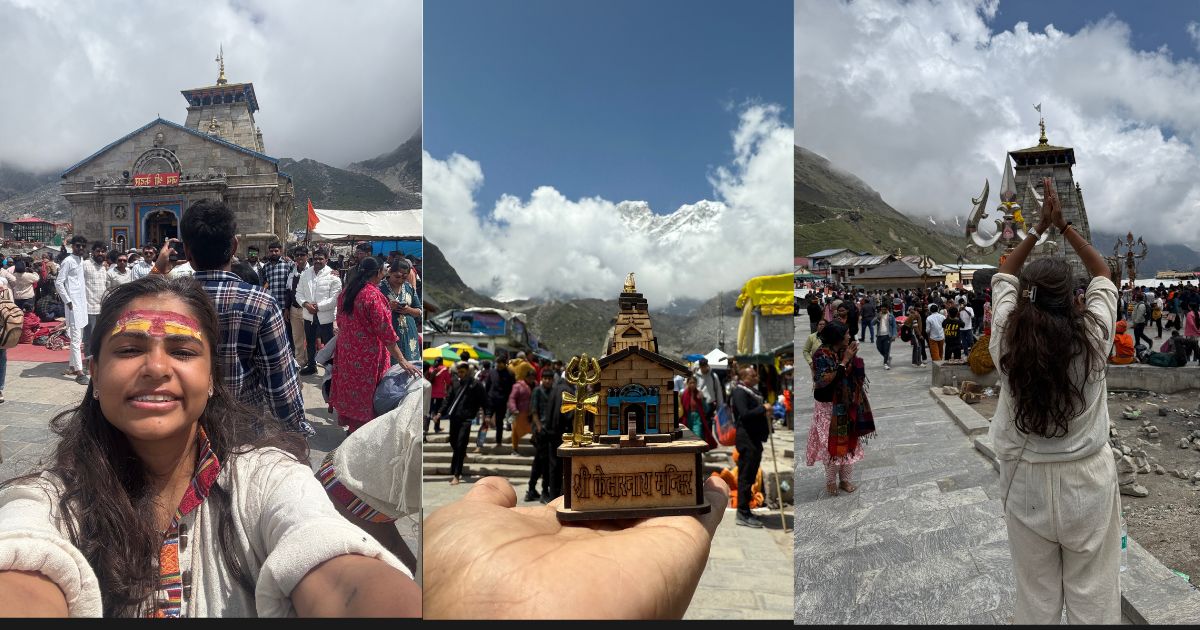
As we walked through the valley, the air changed. The chants of Har Har Mahadev weren’t just around us — they were within us. The wind carried devotion, and there was a deep stillness between all the sounds — everything whispered Mahadev. And then, there it was — the Kedarnath temple, standing tall, fierce, and gentle all at once. A witness to centuries. A home to seekers.
Built by the Pandavas, restored by Adi Shankaracharya, and protected by Mahadev himself, it stood as a symbol of resilience. Of timeless faith. Kedarnath is one of the twelve Jyotirlingas, the holiest shrines of Lord Shiva. According to the Mahabharata, the Pandavas sought Shiva to absolve themselves of sins after the Kurukshetra war. Shiva, avoiding them, took the form of a bull and disappeared into the ground. It is said that the hump remained at Kedarnath, while the other parts of the body emerged at other locations — together forming the Panch Kedar.
The current stone structure, rebuilt by Adi Shankaracharya in the 8th century, has weathered centuries of snow, storms, and silence. Even the devastating 2013 floods could not harm the inner sanctum. Even the floods of 2013 bowed to its presence, as the Bhim Shila behind it held its ground and protected what was meant to remain. To stand before that temple is to stand before time itself. A living, breathing proof of faith that neither fire nor flood could erase.
They say Kedarnath is Vardaan Dham — the Dham of blessings. Because here, Shiva gives. Not just material wishes, but what your soul truly seeks. For some, it’s peace. For others, it’s a strength. For me, it was remembrance. To be here is to receive — in silence, in surrender, in ways you won’t even understand until later. His boons don’t always come as miracles; sometimes they come as clarity. As inner anchoring. And in every step, I felt like I was being given something, even without asking.
They say, “You can find Shiva in many forms — in a still river, in a mountain peak, in silence, in surrender.” I found him here — in the faces of the pilgrims, in the smile of the sadhus, and in the silence that moved my soul.
The energy around the temple was magnetic. Despite the crowd, nothing felt rushed. It was as if time paused. We stood in line for barely an hour, and before I knew it, I was in front of Mahadev. And when you stand in front of him, there’s no fear, no noise, just stillness. And what a moment that was. In front of Mahadev, I didn’t pray for anything. I simply stood still. In awe. In surrender. I had reached home.
Later, I sat with some sadhus, drawn by their energy. They carried the weight of wisdom in their silence. I shared pieces of my journey, and one of them looked at me with knowing eyes and said:
“Baba ne bulaya hai. Toh kuch bhi chinta ki baat nahi. Jo hoga, accha hi hoga. Sirf use bhoolna mat.”
“He has called you. So don’t worry about anything. Whatever happens now will be for the best. Just don’t forget him.”
And I nodded, unable to say anything, but feeling those words settle deep within. Those words didn’t just comfort me. They anchored me.
From there, we walked to the Kaal Bhairav temple, where protectors of the Dham watch silently. On the way, we met a group of friends—strangers yet familiar souls-all of us connected by this shared journey. They spoke of the hardships they faced coming up, but also of the grace that guided them through. And isn’t that what faith is? Knowing the path may be tough, but you’re never alone. Coming back, I asked a Sadu for Tilak. He then dipped his thumb in sandalwood paste and gently applied chandan on my forehead. The touch was cool, calming — as if it was peace itself pressing gently onto my skin. Then he took a pinch of kumkum and with slow reverence, marked a tilak on my forehead. That moment wasn’t just a blessing. It was a reminder. Like he was marking me, reminding me who I am.
Later, we walked behind the temple and bowed down to the Bhim Shila — the silent guardian who saved the shrine when the floods came. I touched its surface gently, in deep gratitude. There’s a silence it holds. A kind of devotion that doesn’t need words. I then gathered seven small stones and placed them behind the temple, making a little home — my offering. My prayer in the form of a quiet ritual. I had no instructions, no logic, just an instinct to do it. And in that small act, I felt seen. I felt held.
And then came the most magical part — the evening aarti. The bells, the chants, the fire, the smoke — it was a moment where the divine felt close enough to touch. I had tears in my eyes. Something deep inside me softened, released. It was during that aarti that I found Mahadev, not just in the temple, but inside me. That moment felt infinite. They say “Look for Mahadev in the mountains. He speaks to you there.” And he did.
People around were on video calls, sharing their darshan with families back home. There were tears, chants, folded hands, people crying after darshan and so many stories being lived in real time. Everything felt alive and divinely orchestrated. The mountain was speaking. To each of us. In our own way.
As the aarti ended and I sat down in silence, a baba walked up to me quietly, like he’d been sent. He looked at me for a moment that felt longer than it was. His eyes saw something in me, I think. Without saying much, he held out a trishul and gently placed it in my hand.
“For Shiva’s daughter,” he said softly. I looked at him, held it, unsure what to say, my eyes moist.
He added, “Be still. Be unapologetic. Be you, just like your father, Mahadev.”
Be wild in your stillness. Be soft in your strength. He danced through destruction and created life from ash. He never needed validation to exist. So don’t shrink. Don’t doubt your fire. Walk with your truth — even if it shakes the ground beneath you.
That trishul wasn’t just a symbol. It felt like a part of my being. A thread connecting me back to the source. To strength. To surrender. To the truth. I held the trishul close. I didn’t need anything more. That one moment was a blessing I didn’t even know I was waiting for.
We did abhishek that night, offering Shiva water and flowers with devotion. And as the day came to a close, we realised how lucky we were to spend the night in Baba’s palace, under the stars, surrounded by his presence. Resting in the arms of the Himalayas. Next morning, before leaving, I turned around one last time. Took a deep breath. Folded my hands. Whispered a goodbye:
“Thank you, Baba. For calling me. For seeing me. For reminding me.”
Because this wasn’t just a visit. This was a meeting of souls. A remembering. A blessing that will walk with me for life. One last glance — eyes full, soul fuller — and I began the descent. I wasn’t leaving anything behind. I was carrying everything with me. And somewhere, I know… I’ll be called again.